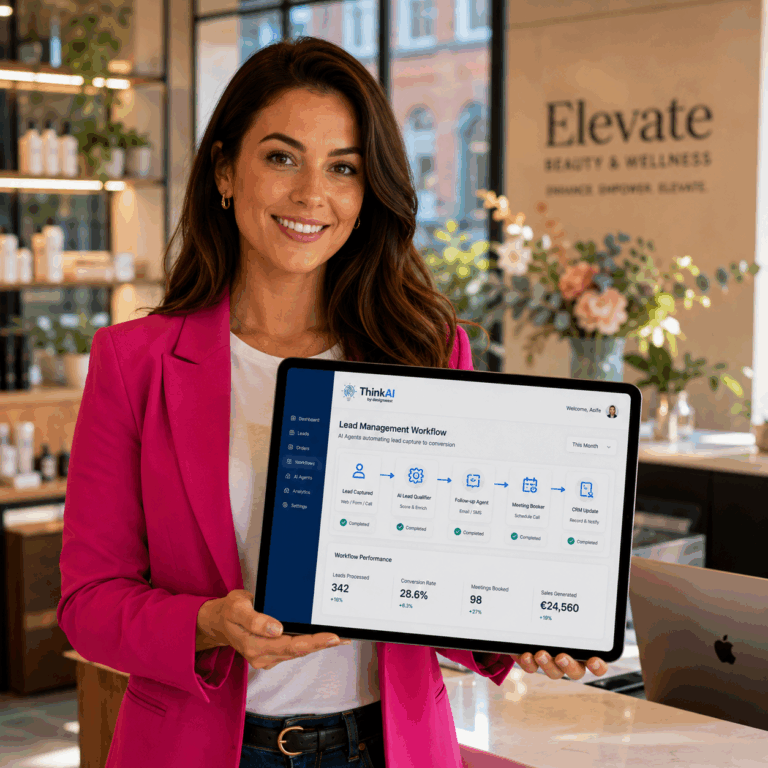


AI agents for business automation are intelligent software systems that can perceive information, make decisions, and carry out multi-step tasks autonomously, without requiring a human to guide each step. Unlike basic automation tools that follow fixed rules, AI agents can handle ambiguity, adapt to changing inputs, and connect across multiple business systems. For Irish SMEs, they represent a practical route to eliminating manual bottlenecks in sales, operations, finance, and customer service.
AI agents for business automation are reshaping how Irish businesses operate, and the pace of change in 2026 means that understanding them is no longer optional. Irish SMEs are dealing with the same pressures that have always held back growth: too much time spent on repetitive tasks, too many disconnected tools, and not enough hours in the day to focus on work that actually moves the business forward.
According to a March 2026 OpenAI survey of 200 Irish SME leaders, 89% are already using AI tools at work. However, only 29% have moved to AI agents, the advanced tools capable of acting autonomously rather than simply responding to prompts. That gap between basic AI use and true AI business automation represents the most significant opportunity available to Irish businesses right now.
This blog explains what AI agents are, how they differ from simpler automation tools, the real-world results Irish businesses are seeing, and the steps to get started with custom AI agents in your own operations. ThinkAI works with businesses across Mayo and Ireland to build and deploy these systems.
What Are AI Agents for Business Automation?
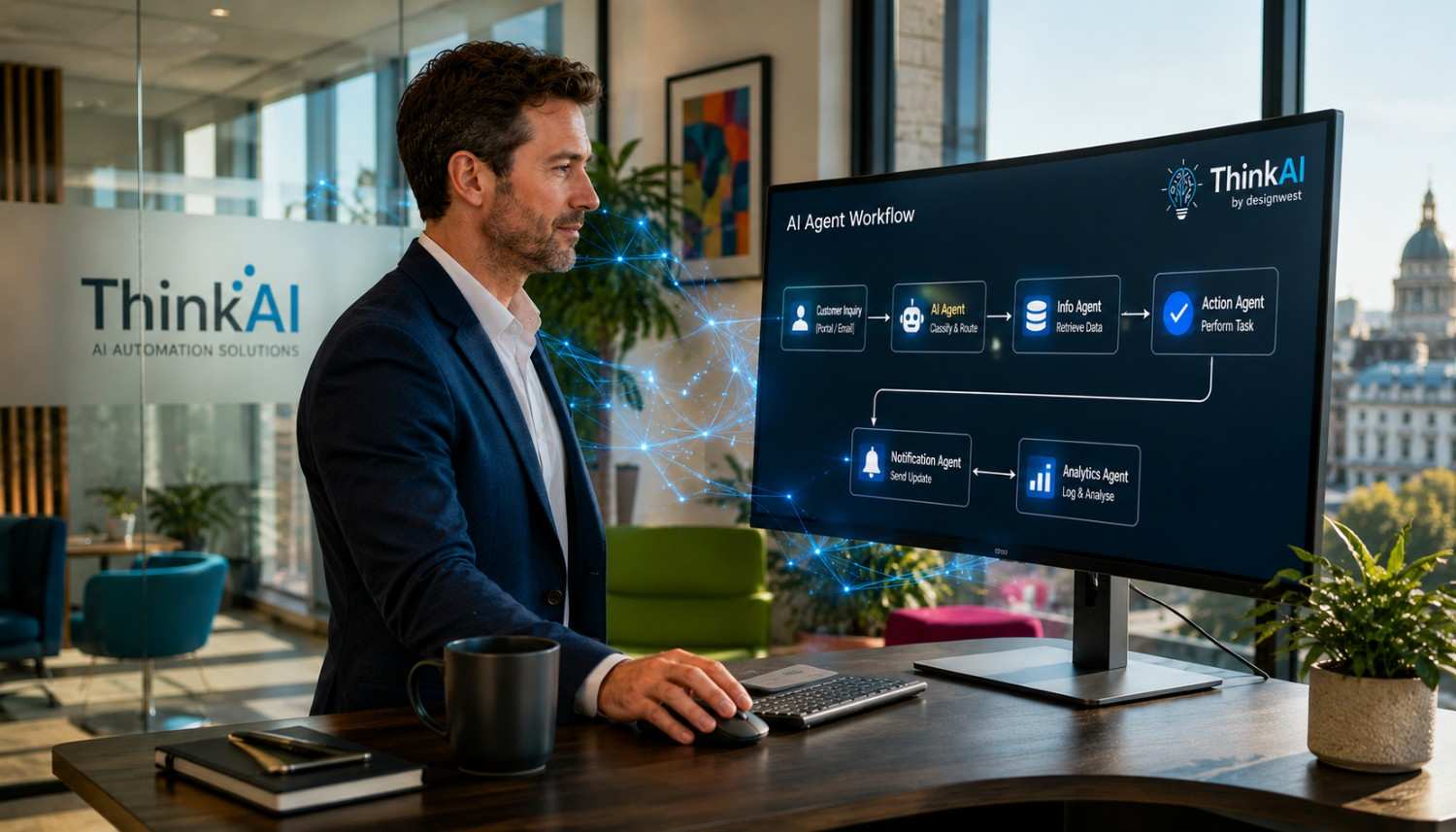
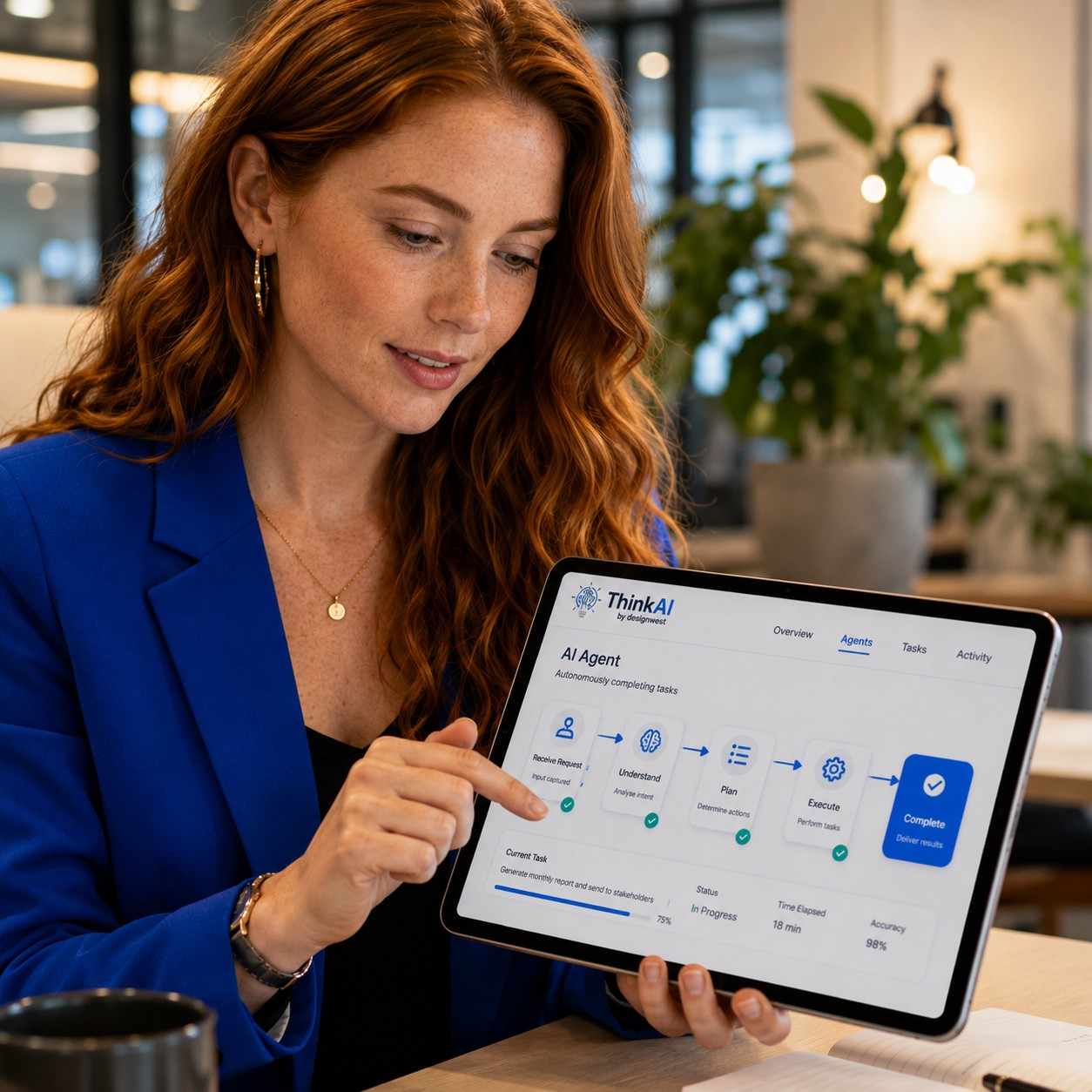
AI agents for business automation are software systems that can interpret a goal, break it down into steps, use tools and data to complete those steps, and adapt when something unexpected happens. Unlike a basic chatbot that answers a single question, or a rule-based automation that fires the same action every time, an AI agent reasons through the task and makes decisions along the way.
The practical difference matters enormously for Irish SMEs. Traditional automation breaks when variables change: a form field moves, a supplier changes their email format, a customer asks something unexpected. AI agents handle that ambiguity. They can read an unstructured email, decide it is a sales enquiry, enrich the contact details, update the CRM, and send a personalised response, all without a human involved at any stage.
By 2026, Gartner projects that 40% of enterprise applications will include built-in task-specific AI agents, up from under 5% in 2025. For Irish businesses, this signals that agent-based automation is rapidly becoming a standard feature of the tools they already use, including HubSpot, Xero, Shopify, and Microsoft 365. As adoption grows, many organisations are also working with an AI agent developer to create customised automation workflows tailored to their specific operational needs.
How AI Agents Perform AI Task Automation
AI task automation through agents works via a perceive-plan-act loop. The agent reads incoming information, such as an email, a form submission, or a data update, then decides what action to take, then executes that action across one or more connected tools.
In daily business operations, this looks like:
- Emails: An agent reads incoming messages, identifies the intent, routes urgent ones to the right person, and drafts replies for standard queries.
- Scheduling: An agent checks calendar availability, sends booking invites, and follows up with reminders without any manual coordination.
- Data handling: An agent extracts information from documents or forms, validates it, and writes it directly to the correct field in your CRM or accounts system.
- Workflow triggers: When a customer places an order, an agent can simultaneously update stock records, trigger a shipping notification, and log the transaction, all in one chain of actions.
How AI Business Automation Is Changing Irish SMEs
AI business automation is closing a gap that has held Irish SMEs back for years. The ability to handle more volume without proportionally increasing headcount is one of the most commercially significant shifts a business can make, and AI agents are making it possible for companies of any size.
Research from McKinsey shows that AI-powered automation can boost relationship manager productivity by 3 to 15% and reduce cost to serve by 20 to 40%. For Irish SMEs where every margin matters, those numbers translate directly into competitive advantage. A small firm deploying agents in its sales and customer service functions can respond faster, make fewer errors, and handle more customers than a competitor still relying entirely on manual processes.
The shift is visible in the data. Four in ten Irish SME AI users are now automating tasks through AI tools, according to the OpenAI 2026 survey. Among those that have moved beyond basic use to connected workflow agents, the productivity gains are measurably larger. Irish firms that have deployed agents in customer service report 40 to 60% reductions in support costs, with ROI achieved within two to four months.
Decision-making speed is another area where AI agents are making a clear difference. Rather than waiting for a weekly report or a manual data pull, business owners can access live operational data processed and summarised by an agent in real time. For Irish SMEs in fast-moving sectors such as retail, hospitality, and professional services, this makes a material difference to how quickly the right decisions get made.
Real Use Cases of Business Automation AI Agents in Ireland
Business automation AI agents are already delivering measurable results across multiple sectors in Ireland. The following three examples illustrate the kinds of outcomes achievable with a focused deployment.
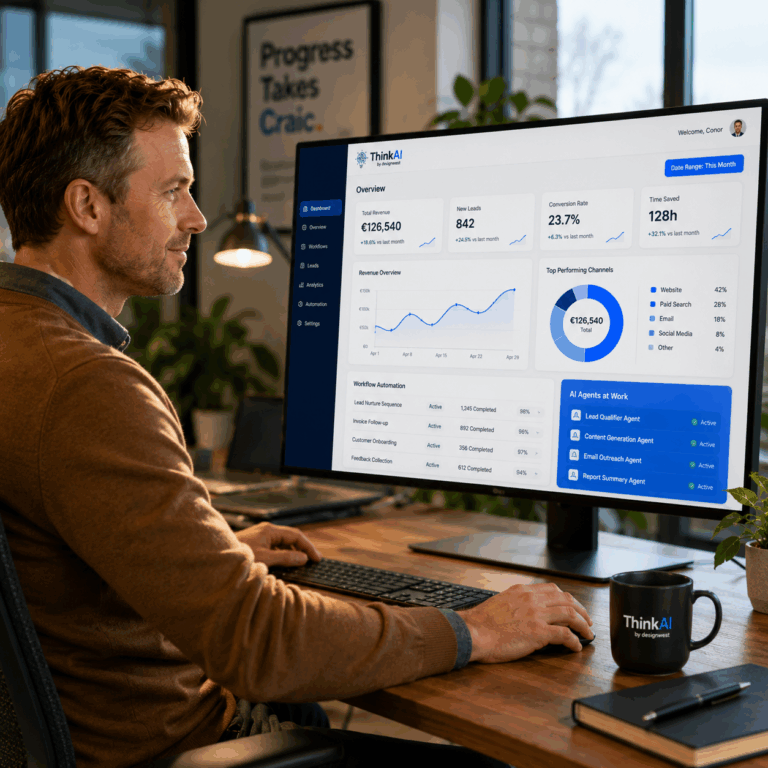
A Galway-based clothing retailer deployed an AI agent that monitors inventory levels in real time, automatically triggers reorder notifications when stock falls below set thresholds, and handles standard customer enquiries including order status, returns, and product availability around the clock. Staff previously spending several hours per week on these tasks were redirected to higher-value work. The business reduced manual social media and admin time by 80% and saw a 12% increase in revenue during promotional weekends as the agent identified and acted on demand signals faster than any manual process could.
A Dublin professional services firm managing over 100 inbound leads per week deployed an AI agent to qualify prospects, book discovery calls, and send personalised follow-up sequences. The agent assessed each lead against the firm’s ideal client profile, enriched contact data, and sent meeting invites to qualified prospects within minutes of their first contact. Lead response times dropped from several hours to under two minutes, and conversion from initial enquiry to booked consultation increased by 22%. The equivalent of 15 hours of senior staff time per week was recovered.
A Mayo-based distributor used an AI agent to process 500 supplier invoices per month. The agent read invoice PDFs, matched each one to the corresponding purchase order in Xero, flagged any discrepancies to the finance team, and filed the completed records automatically. Processing time per invoice fell from six minutes to 30 seconds. The manual error rate dropped to under 1%, eliminating the VAT reclaim losses and supplier payment delays that had previously resulted from manual input mistakes.
Steps to Implement Custom AI Agents in Your Business
Implementing custom AI agents does not require a technical team or a large budget. The following five steps provide a clear and practical path for any Irish SME.
Start by listing the processes in your business that follow a predictable pattern and consume the most staff hours. Common starting points include lead qualification, invoice processing, customer query handling, appointment scheduling, and weekly reporting.
For most Irish SMEs, no-code platforms like n8n, Zapier, or HubSpot AI provide the fastest route to a live agent. These platforms connect directly to tools you already use and require no specialist coding skills. For more complex requirements, frameworks like CrewAI and LangGraph allow custom agents to be built with specific business logic built in.
Off-the-shelf agents work well for standard use cases. Custom AI agents are the better choice when you have proprietary processes, unique data, or compliance requirements that generic tools cannot accommodate. Enterprise Ireland Innovation Vouchers of up to €5,000 are available to fund feasibility work at this stage.
Connect the agent to your CRM, accounts software, calendar, and communication tools using APIs or middleware platforms. The goal is to make the agent a working part of your existing stack, not a separate system that staff have to manage independently.
Track time saved, error rates, and response times over a 6 to 10 week pilot period. Assign one person to review agent logs weekly during this phase. Once results are proven, expand to the next process. Skillnet Ireland training programmes can help existing staff develop the confidence to manage and adapt these systems as they scale.
Key Benefits of AI Agents for Business Automation
The commercial case for AI agents is now backed by strong evidence from Irish and international research. The primary benefits for Irish SMEs are:
- Time savings. Administrative automation delivers 15 to 25 hours saved per employee per week. Sales agents return 10 to 12 hours per week to each sales team member by eliminating manual prospecting, follow-up, and CRM updates.
- Cost reduction. Businesses using AI agents for customer service report 40 to 60% lower support costs. Operational sales costs reduce by 40 to 60% through automation of routine qualification and follow-up tasks.
- Improved accuracy. Unlike manual processes, agents do not make transcription errors or miss follow-ups. Invoice error rates in Irish deployments have fallen from 10% to under 1% following agent-based automation.
- Scalability. AI agents handle increased volume without increased headcount. A business that deploys agents in its sales function can engage significantly more prospects simultaneously than a human team alone could manage.
- Faster, better-informed decisions. Agents process and surface operational data in real time, allowing business owners to act on current information rather than waiting for manually compiled reports.
Why ThinkAI Is Mayo's Trusted AI Partner
ThinkAI is a Mayo-based AI consultancy that designs and builds AI automation solutions specifically for Irish SMEs. From initial strategy through to full deployment, ThinkAI creates custom AI agents and connected workflows tailored to how your business actually works, not how a generic platform assumes it does.
With expertise across the Irish market and a hands-on understanding of the compliance requirements introduced by GDPR and the EU AI Act, ThinkAI builds systems that are both commercially effective and fully governable. Whether you need your first automated workflow or a multi-agent system connecting your entire business stack, ThinkAI provides the local knowledge and technical capability to deliver it.
Contact ThinkAI to request a consultation and find out how AI agents can start saving your business time from day one.
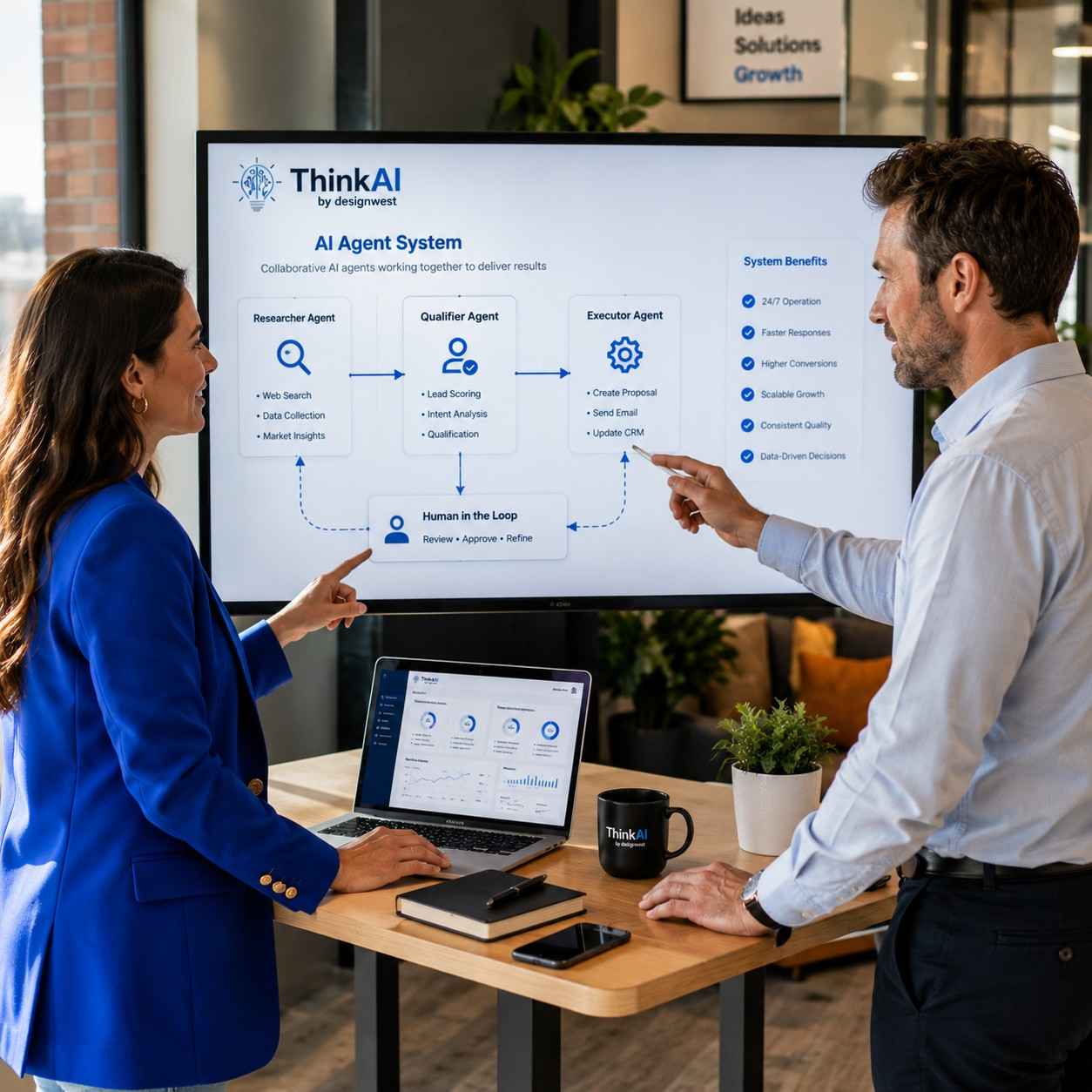
AI agents for business automation are no longer a future prospect for Irish businesses. They are available, affordable, and already delivering measurable results across retail, professional services, and operations throughout Ireland. The businesses deploying them now are building an efficiency and responsiveness advantage that compounds over time. ThinkAI is here to help Irish SMEs move from curiosity to production, with practical solutions built around your specific needs. The time to start is now.
Key Takeaways
- AI agents for business automation go beyond basic tools by reasoning through tasks, adapting to changing inputs, and operating across multiple connected systems without human involvement at each step.
- 89% of Irish SME leaders are using AI tools, but only 29% have moved to agents. That gap is where the most significant productivity opportunity currently sits.
- Real Irish deployments in retail, professional services, and distribution are delivering results including 22% higher lead conversion, 80% reduction in admin time, and invoice processing times cut from six minutes to 30 seconds.
- Custom AI agents built on platforms like n8n, CrewAI, and HubSpot connect directly to existing business tools without requiring a technical team or a large upfront investment.
- Enterprise Ireland Innovation Vouchers and Skillnet training programmes are available to help Irish SMEs fund and resource their first AI agent deployment.
Frequently Asked Questions
An AI agent for business automation is software that can interpret a goal, plan the steps required to complete it, use connected tools and data, and execute the full task without requiring a human to guide each action. Unlike a basic chatbot or rule-based workflow, an AI agent handles ambiguity and adapts when circumstances change, making it suitable for real-world business processes that rarely follow a perfectly predictable pattern.
Standard automation tools follow fixed rules: if X happens, do Y. They break when inputs change or something unexpected occurs. AI agents reason through tasks using a language model, which means they can handle unstructured inputs like emails or documents, make contextual decisions, and complete multi-step workflows that no rule-based system could manage reliably.
AI agents deliver the strongest results on tasks that are repetitive, data-driven, and involve multiple steps or tools. The most common starting points for Irish SMEs are lead qualification and follow-up, invoice processing, customer query handling, appointment scheduling, weekly report generation, and stock management. These tasks are high-volume, well-defined, and directly measurable.
Entry-level tools with basic agent capabilities start from €20 to €100 per month. A custom pilot project designed and implemented by a specialist typically costs between €5,000 and €10,000. Full production systems range from €25,000 to €50,000. Enterprise Ireland Innovation Vouchers of up to €5,000 can fund feasibility work, significantly reducing the initial outlay.
A basic agent using a no-code platform like n8n or HubSpot can be live within one to two weeks. A fully custom multi-agent system typically takes four to eight weeks from initial scoping to deployment. Allow six to ten weeks of monitoring before scaling to additional processes.
No. Most AI agent platforms available in 2026 are designed for non-technical users. No-code tools like n8n and Zapier use visual builders where you connect apps and configure triggers without writing code. For more complex deployments, working with a specialist like ThinkAI removes the need for in-house technical expertise entirely.
Custom AI agents are agents built specifically around your business logic, data, and workflow requirements rather than configured from a generic template. You need a custom agent when your process is unique to your industry or business, when you have proprietary data that gives you a competitive advantage, or when compliance requirements mean a standard tool cannot be used without modification.
AI agents connect to existing tools including Xero, HubSpot, Shopify, Gmail, Microsoft 365, Stripe, and hundreds of other platforms via APIs and middleware tools like n8n or Zapier. This means you do not need to replace your current software stack. The agent sits on top of what you already have and automates the connections between tools that your team currently makes manually.
Yes, when implemented correctly. Irish businesses must ensure their AI agents process personal data in line with GDPR, which includes conducting a Data Protection Impact Assessment where required, using GDPR-compliant infrastructure, and keeping data within EU borders where possible. Self-hosted platforms like n8n provide strong data sovereignty options for businesses with strict compliance requirements.
Results vary by use case, but published benchmarks show customer service automation delivering 40 to 60% cost reductions with ROI achieved in two to four months. AI sales agents report 317% annual ROI with a payback period of around five months. Administrative automation saves 15 to 25 hours per employee per week. Irish deployments in distribution have reduced invoice processing time by over 90%.
No. AI agents are designed to handle repetitive, rule-based, or data-heavy tasks so that existing staff can focus on work that requires judgement, creativity, and human relationships. The OpenAI 2026 Irish SME survey found that business owners are reinvesting time saved from AI primarily into improving products and services, planning, and managing their teams, not reducing headcount.
AI task automation refers to the process by which an AI agent completes a defined business task from start to finish without human input at each step. The agent perceives incoming data, decides on the appropriate action, executes that action using connected tools, and confirms completion. This cycle can happen in seconds across thousands of tasks simultaneously, something no manual process can match.
For most Irish SMEs, n8n and HubSpot AI offer the fastest and most accessible starting points. CrewAI is ideal for deploying role-based teams of agents for sales or marketing use cases. LangGraph is the preferred choice for complex, high-stakes workflows in legal or financial services where auditability is critical. ThinkAI can advise on the right framework for your specific situation.
AI customer service agents handle standard enquiries including order status, product questions, booking requests, and complaints around the clock, without any human involvement for routine cases. Modern agents resolve between 70 and 85% of inbound queries automatically, reducing response times from hours to seconds and cutting customer service operating costs by 40 to 60%. They escalate anything complex or sensitive to a human team member.
The primary risks are poor data quality, which causes agents to underperform or make errors; over-automation in high-stakes areas like legal or financial decisions without appropriate human oversight; and vendor lock-in if you build entirely within a single proprietary platform. These risks are manageable with proper scoping, a phased deployment approach, and human approval gates on decisions that carry significant consequences.
AI agents process and surface operational data in real time rather than requiring a staff member to compile a report manually. A business owner with agents monitoring sales, stock, and customer activity can access a live operational summary in seconds. This shifts decision-making from reactive, based on last week’s data, to proactive, based on what is happening right now.
Yes. The most commonly used business platforms in Ireland, including HubSpot, Salesforce, Xero, Sage, and Stripe, have well-documented APIs that AI agents can connect to directly. Once connected, agents can read data, update records, trigger actions, and generate summaries across all these platforms as part of a single automated workflow.
Enterprise Ireland Innovation Vouchers provide up to €5,000 for AI feasibility studies. Local Enterprise Offices offer digitalisation grants and subsidised advisory support. Skillnet Ireland funds sector-specific training programmes that cover AI tool adoption for non-technical staff. The government’s Digital Ireland strategy provides a broader framework of supports for businesses investing in automation.
Design agents to handle routine and transactional interactions while routing anything requiring empathy, complexity, or personal judgement to a human team member. Build clear escalation triggers into every customer-facing agent. In Ireland’s relationship-driven business environment, agents should free your team for the conversations that matter, not replace them. Review agent outputs regularly to ensure tone and accuracy stay consistent with your brand.
Start by identifying the single most time-consuming, repetitive process in your business and building one agent workflow around it. Set a clear measurement baseline before you start, track results over six weeks, and scale once the ROI is proven. If you are unsure where to begin, contact ThinkAI for a consultation. ThinkAI will map your current processes and identify the highest-impact automation opportunity for your specific business.
Want to see how AI agents could automate repetitive tasks in your business? Talk to ThinkAI about building a tailored AI automation system for your Irish company.
About the Author:
Declan Foley is the founder of ThinkAI.ie and Creative Director at Designwest. He helps Irish businesses unlock growth through AI-powered strategy and digital innovation. Explore how ThinkAI can support your business at ThinkAI.ie.