

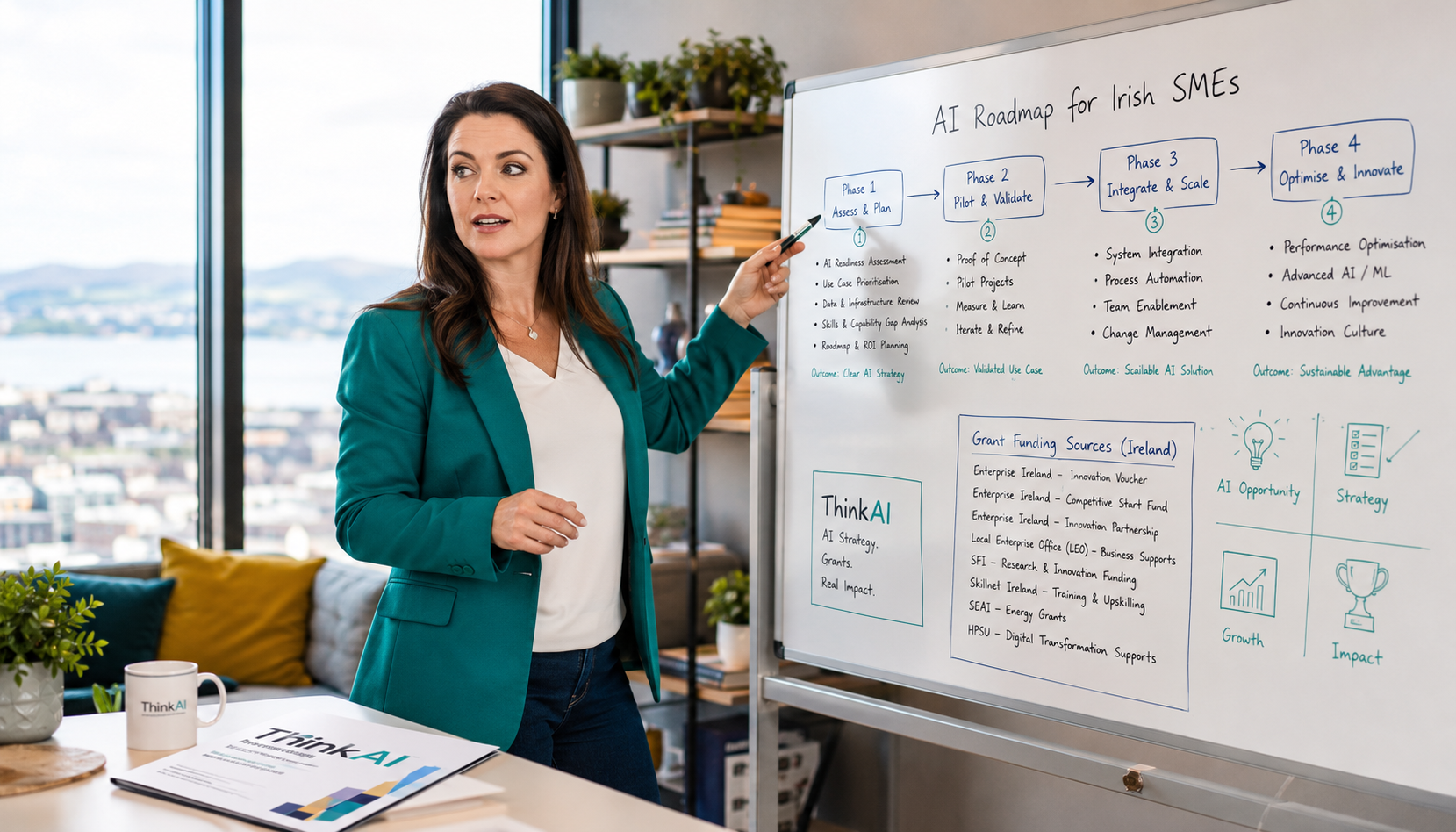
An AI roadmap is a structured, phased plan that defines which business processes an Irish SME will automate or enhance with AI, which tools it will use, how it will measure success, and how it will fund each stage of implementation. In 2026, having a documented AI roadmap is not just good practice for Irish businesses; it is the prerequisite for accessing most of the Irish government grants available to fund AI adoption. Without one, fewer than 15% of eligible Irish SMEs have successfully accessed any form of digital grant. With one, a business can fund 70 to 80% of a significant AI transformation through public money.
Irish businesses have access to more AI funding right now than at any point in history, so why are fewer than 15% of eligible SMEs actually claiming it?
An AI roadmap is the single most important document an Irish SME can produce before investing in AI in 2026, and I say that not as a theoretical point but as a practical one. Without a structured plan, AI adoption in Ireland typically means scattered tool purchases, misaligned expectations, and missed funding opportunities that could have covered the majority of the cost. With one, it means a clear starting point, a fundable case for grants, and a business that knows exactly what it is trying to achieve and how it will measure whether it got there.
The scale of the funding opportunity for Irish businesses that come prepared is significant. Between Enterprise Ireland Innovation Vouchers, LEO Grow Digital grants, Skillnet training subsidies, R&D Tax Credits, and the Western Development Commission for businesses in the west and northwest, a well-prepared Irish SME can realistically fund 70 to 80% of a meaningful AI transformation through public money. Most do not, because only 35% of Irish SMEs currently have a formal digitalisation strategy, and fewer than 15% have applied for any form of digital grant.
This guide walks through exactly what an AI roadmap involves for an Irish SME, the steps to build one, how to align it with available funding, and where ThinkAI helps Irish businesses in Mayo, Dublin, and across Ireland get it right from the start.
Why Every Irish SME Needs an AI Roadmap in 2026
The Irish government has made AI adoption a national economic priority. Enterprise Ireland is developing a sector-specific AI Adoption Roadmap for its client companies. A new Observatory for Business AI Readiness (OBAIR) will track adoption metrics across the Irish economy in real time. An AI Innovation Hub has been established as a National First Stop, providing expertise and guidance to Irish enterprises on their AI adoption journey. The infrastructure for funded, supported AI adoption has never been more developed.
At the same time, the competitive pressure on Irish SMEs is intensifying. Eight in ten Irish firms plan to increase their technology budgets in 2026, and the gap between businesses with structured AI strategies and those without is widening visibly. Research shows that only 35% of Irish SMEs currently have a formal digitalisation strategy, yet 90% are operating without any formal AI strategy at all. That is not a technology problem; it is a planning problem.
For Irish businesses in sectors from professional services and retail to manufacturing and hospitality, an AI roadmap provides the strategic direction that prevents wasted investment, satisfies grant application requirements, manages GDPR and EU AI Act compliance obligations, and gives staff and stakeholders a clear, credible picture of where the business is going and why.
Without a roadmap, AI adoption tends to happen in disconnected pockets, individual staff members using consumer AI tools that create security gaps and GDPR exposure, a phenomenon Irish tech consultancies are now calling shadow AI. A formal AI roadmap replaces that fragmentation with a governed, strategic programme that is both commercially effective and compliant.
AI Roadmap: Understanding the Foundation for Success
An AI roadmap is a documented, phased plan that maps the journey from an Irish SME’s current operations to its intended AI-enabled future state. It defines which processes will be automated and in what order, which AI tools and platforms will be used, what success looks like at each stage, who owns each part of the programme, how much each phase will cost, and how funding will be sourced.
The foundation of any effective AI roadmap for an Irish SME is alignment with business objectives rather than technology for its own sake. A legal firm in Dublin that wants to reduce time spent on client intake should not start with AI-generated marketing content. A distributor in Mayo that is losing hours every month to manual invoice processing should not start with a customer-facing chatbot. The roadmap starts with the business problem, not the technology solution.
A well-constructed AI roadmap also manages risk and expectation. Irish businesses that approach AI without a structured plan are significantly more likely to invest in tools that do not integrate with their existing systems, underestimate the data preparation required, or fail to secure staff buy-in because change management was an afterthought. The roadmap addresses all of these before any money is spent.
For Irish businesses seeking grant funding, a formal AI roadmap is frequently the central document required in an application. Enterprise Ireland, LEO, and Skillnet all expect to see evidence of strategic planning, defined objectives, and measurable outcomes before approving funding. A roadmap that is built grant-ready from the start accelerates that process considerably.
Creating an AI Adoption Roadmap That Aligns with Business Goals
An AI adoption roadmap that genuinely reflects a business’s goals rather than a consultant’s preferences starts with the business owner and their team, not with a list of available tools. The process for Irish SMEs follows a clear sequence.
- Identify the business challenges you want to solve. Be specific. Not ‘improve efficiency’ but ‘reduce time spent processing invoices from six minutes to under one minute’ or ‘respond to every inbound lead within five minutes, including evenings and weekends’. The more specific the problem definition, the more targeted and fundable the AI solution becomes.
- Set measurable objectives for each challenge. Every goal in the roadmap needs a baseline measurement and a target. How long does the process take now? How many errors occur? How many hours per week does it consume? These numbers become the ROI evidence that satisfies both internal stakeholders and grant application requirements.
- Prioritise automation opportunities by commercial impact. Not every process that could be automated should be automated first. Prioritise the ones where time saving or error reduction has the most direct commercial impact. For most Irish SMEs, invoice processing, lead qualification, and customer query handling are consistently the highest-impact starting points.
- Plan resources and responsibilities. Define who in your Irish business will own the AI programme, who will be involved in testing and rollout, and what external support is required. For Irish SMEs without in-house technical expertise, identifying the right implementation partner at this stage, rather than after the grant is approved, prevents costly delays.
- Involve stakeholders from the start. Irish businesses where staff are involved in the roadmap development process achieve significantly better adoption outcomes than those where automation is introduced as a top-down mandate. The team members who will use the automated systems every day have the most accurate view of where the current process breaks down.
Key Steps for Effective Business AI Implementation
Effective business AI implementation for an Irish SME follows a disciplined sequence that prevents the most common and costly mistakes. The following steps apply whether you are implementing a single automated workflow or a multi-system AI programme.
- Assess your current systems and data. Understand what software your business currently uses, how data flows between those systems, and where the gaps and inconsistencies are. For Irish businesses using a combination of Xero, HubSpot, Shopify, and Gmail, the priority is confirming that these tools support the integrations required. Data that is fragmented, inconsistently formatted, or held in spreadsheets will undermine any AI implementation regardless of how well the technology is configured.
- Evaluate data readiness. AI tools perform only as well as the data they work with. Before implementing any automated workflow, Irish SMEs should audit the quality and consistency of the data in their core systems. This is particularly important for Irish businesses in sectors like legal, financial services, and healthcare where data held on clients is sensitive and GDPR obligations are significant.
- Select AI technologies that fit your existing stack. Avoid tools that require replacing your current software. The most effective AI implementations for Irish SMEs in 2026 connect an AI layer to the tools already in use, including Xero, HubSpot, Shopify, and Microsoft 365, using integration platforms like n8n or Zapier. n8n is particularly popular among Irish businesses because its self-hosting capability addresses GDPR data sovereignty requirements.
- Start with a pilot project on one process. Choose one workflow, implement the automation, and measure results over four to six weeks before scaling. A Mayo-based distributor that started with invoice processing automation reduced per-invoice time from six minutes to 30 seconds and cut error rates to under 1% within the first month of deployment.
- Measure outcomes and build the ROI case. Track time saved, error rate reduction, cost per transaction, and customer response times before and after implementation. These measurements are what enable Irish businesses to make confident internal decisions about scaling, and what grant bodies require when evaluating the impact of funded projects.
Developing an AI Implementation Plan for Sustainable Growth
An AI implementation plan translates the strategic direction of the roadmap into a deliverable programme with timelines, budgets, responsibilities, and governance. For Irish SMEs, the plan typically covers three to twelve months depending on the scope of automation being pursued.

- Project timelines: Break the implementation into phases. Phase one typically covers one pilot workflow, taking four to eight weeks from scoping to live deployment. Phase two scales to two or three additional workflows over the following two to three months. Phase three extends automation to additional departments or functions based on the evidence generated in earlier phases.
- Budget considerations: Entry-level automation tools for Irish SMEs cost €20 to €100 per month. A structured pilot implementation with external support typically costs €5,000 to €10,000. A full multi-department automation programme runs from €25,000 to €50,000. Grant funding, where accessed, can cover 50 to 80% of these costs depending on the combination of schemes applied for.
- Team responsibilities: Every AI implementation plan for an Irish SME should name an internal AI champion who owns the programme, a data lead who is responsible for data quality and GDPR compliance, and a change management lead who ensures staff adoption. These do not need to be three different people in a small business.
- Compliance and governance: Irish businesses must build GDPR obligations and EU AI Act requirements into the implementation plan from the outset, not as an afterthought. The Data Protection Commission is actively monitoring compliance, and the EU AI Act reaches full enforcement on August 2, 2026. A plan that addresses these requirements from the start is also stronger as a grant application.
- Continuous optimisation: An AI implementation plan is not a one-time delivery. Schedule quarterly reviews of each automated workflow to assess performance against the original targets, update processes as business requirements change, and identify the next automation opportunity based on the evidence generated to date.
Funding and Grant Opportunities Supporting AI Projects in Ireland

Ireland has one of the most comprehensive public funding ecosystems for SME digital transformation in Europe. For Irish businesses with a well-prepared AI roadmap, the following grant and funding options are the most relevant in 2026.
- LEO Digital for Business: A free structured digital assessment and tailored roadmap service available to businesses with up to 50 employees through your local Local Enterprise Office. This is often the best first step for Irish SMEs that want an independent view of their digital readiness and a structured starting point for grant applications.
- LEO Grow Digital Voucher: Up to €5,000 for implementing digital tools recommended through the Digital for Business assessment. Eligibility requires under 50 employees, under €2 million turnover, and at least six months of trading. Available through your county LEO. Grant budgets run out annually, so Q1 applications have the best success rate.
- Enterprise Ireland Innovation Vouchers: €5,000 to €10,000 for working with a registered knowledge provider, such as a university, research institute, or approved consultant, to validate AI feasibility for your Irish business. Ideal for businesses that want an evidence-based starting point before committing to full implementation.
- Enterprise Ireland Digitalisation Vouchers: Up to €9,000 for digital transformation consultancy. Covers the cost of external expertise to design and implement digital and AI solutions for Irish SMEs.
- R&D Tax Credit: 35% tax credit rate from 2026, with a first-year refund threshold of €87,500. Many Irish businesses underestimate how much of their AI development activity qualifies as R&D under Revenue’s definition. A tax advisor familiar with Irish technology R&D can identify qualifying expenditure that offsets a significant portion of implementation costs.
- Skillnet Ireland: Covers 50% of training costs for Irish SME staff through over 70 sector-specific Skillnet networks. Particularly relevant for upskilling existing Irish staff to manage and optimise AI systems rather than hiring new technical expertise.
- Western Development Commission: Grants and loans for businesses in Connacht, Donegal, Clare, and Roscommon. Particularly relevant for Irish SMEs in Mayo, Galway, and the northwest seeking to fund AI and digital transformation projects.
- InterTradeIreland: Up to €130,000 combined in innovation funding for SMEs operating across the island of Ireland.
When preparing a grant application, the most common mistake made by Irish businesses is submitting without a robust business plan, clear market analysis, and realistic financial projections. A well-prepared AI roadmap addresses all of these requirements and significantly strengthens any application.
Common Mistakes Irish SMEs Make When Planning AI Adoption
The businesses that struggle most with AI adoption in Ireland tend to make the same preventable planning mistakes. Recognising them in advance makes the difference between a funded, effective programme and an expensive lesson.
- No strategic direction: Buying AI tools without a roadmap means solving the wrong problems or solving the right problems in the wrong order. 90% of Irish SMEs operate without a formal AI strategy, which is why so many AI investments underperform.
- Unrealistic expectations: AI does not fix broken processes. If the current workflow is poorly designed, automation makes it faster and more consistently wrong. Define clear, achievable targets rather than expecting a single AI tool to transform the business overnight.
- Ignoring change management: In Irish businesses where team culture is central to how work gets done, introducing automation without involving staff early creates resistance that derails even well-designed systems. The team that will use the automated workflow every day should be part of designing it.
- Poor data preparation: Fragmented, inconsistent, or incomplete data is the single most common technical cause of AI underperformance in Irish businesses. Audit and clean your core data before any automation goes live, not after.
- Failing to define success metrics: Without a clear baseline and measurable targets, it is impossible to know whether the AI programme is working, make the case internally for further investment, or satisfy the reporting requirements of Irish grant bodies.
How ThinkAI Helps Irish SMEs Build Grant-Ready AI Strategies
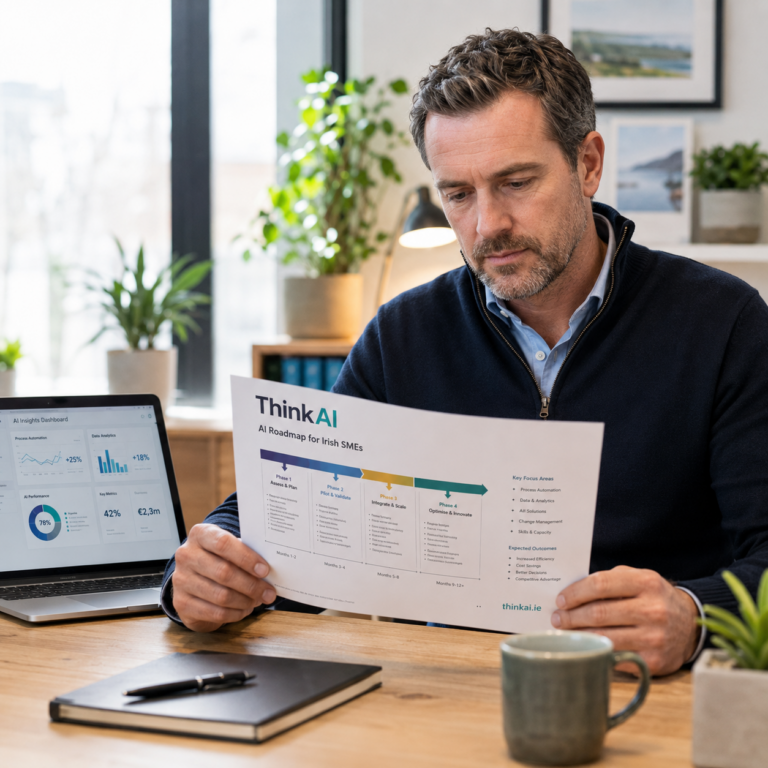
ThinkAI is a Mayo-based AI consultancy that specialises in helping Irish SMEs across Mayo, Dublin, Galway, and beyond build structured, grant-ready AI roadmaps and implement them effectively. Every engagement starts with an AI readiness assessment that maps your current operations, identifies your highest-value automation opportunities, and produces a documented roadmap that meets the requirements of Irish grant applications.
Services cover strategic roadmap development, grant preparation support, process mapping, AI implementation guidance, system integrations across tools including Xero, HubSpot, Shopify, and Microsoft 365, and ongoing optimisation as your programme scales. ThinkAI has direct experience working with Enterprise Ireland, LEO, and Skillnet funding frameworks and can guide Irish businesses through the application process as part of every project.
Contact ThinkAI to request a consultation and start building your grant-ready AI roadmap today.
I’ll be straight, the Irish businesses that will look back on 2026 as the year they pulled ahead are the ones that started with a plan rather than a purchase. The funding is there. The tools are accessible. The government support infrastructure is in place. What most Irish SMEs need now is a clear roadmap, a properly prepared grant application, and a local partner who knows both. ThinkAI is here to provide all three.
Key Takeaways
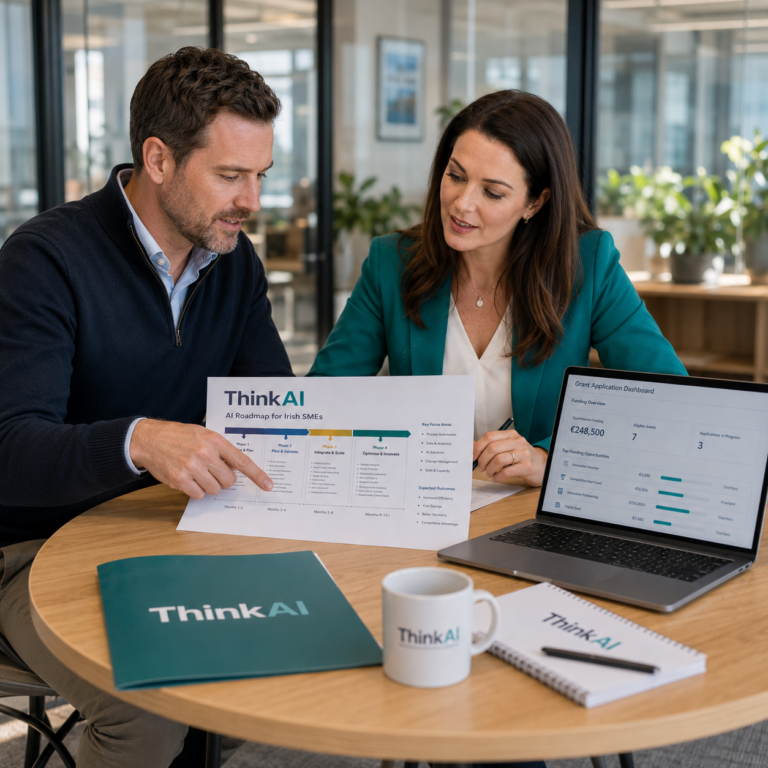
- An AI roadmap is the prerequisite for accessing most Irish AI grants; businesses that come with a structured plan can fund 70 to 80% of a significant AI transformation through public money.
- Only 35% of Irish SMEs have a formal digitalisation strategy, and fewer than 15% of eligible businesses have applied for any digital grant, creating a significant competitive advantage for those that do.
- Ireland’s grant ecosystem for AI adoption includes LEO Grow Digital Vouchers, Enterprise Ireland Innovation and Digitalisation Vouchers, Skillnet subsidies, R&D Tax Credits, and Western Development Commission funding.
- The most common planning mistakes among Irish SMEs are buying tools without a strategy, skipping data preparation, and failing to define measurable success metrics before implementation begins.
- ThinkAI helps Irish businesses build grant-ready AI roadmaps and guides them through the full funding application and implementation process from a base in Mayo.
Frequently Asked Questions
An AI roadmap is a structured, phased plan that defines which business processes an Irish SME will automate or enhance with AI, which tools it will use, how it will measure success, and how it will fund each stage. Irish SMEs need one because most Irish grants for AI adoption require evidence of strategic planning, and businesses that approach AI without a plan are significantly more likely to invest in the wrong tools, underestimate data preparation requirements, and fail to achieve measurable results.
Start with a business problem audit, not a technology list. Identify the three or four processes in your Irish business that consume the most staff time or generate the most errors. Set a measurable target for each one. Then assess what data and systems you currently have, what integrations are needed, and what budget and timeline are realistic. A LEO Digital for Business assessment provides a free structured starting point and can inform your first grant application.
The main options for Irish SMEs in 2026 are: LEO Grow Digital Voucher (up to €5,000), Enterprise Ireland Innovation Vouchers (€5,000 to €10,000), Enterprise Ireland Digitalisation Vouchers (up to €9,000), Skillnet Ireland training subsidies (50% of training costs), R&D Tax Credit (35% rate), and Western Development Commission funding for businesses in the western region. When stacked, these can cover 70 to 80% of a full AI implementation.
The LEO Digital for Business programme provides a free structured digital assessment and a tailored roadmap for Irish businesses with up to 50 employees. It identifies your current digital maturity, maps specific opportunities for improvement including AI tools, and produces a documented plan that can be used directly to support a Grow Digital Voucher application. It is run through your local county LEO and is one of the best free starting points for any Irish SME considering AI adoption.
Entry-level implementation using no-code automation tools costs €20 to €100 per month in ongoing tool costs, with a pilot project implementation typically costing €5,000 to €10,000 for design and setup. A full multi-department AI programme runs from €25,000 to €50,000. With available Irish grants, a business can reduce its net outlay to 20 to 30% of these figures, provided the grant application is well-prepared and the roadmap is documented to the required standard.
A grant-ready AI roadmap for an Irish SME includes a clear description of the business problem being solved, measurable objectives and success metrics, a phased implementation plan with defined timelines, a technology selection rationale explaining why the chosen tools are appropriate, a budget breakdown with cost per phase, a data readiness assessment, a GDPR and EU AI Act compliance plan, and team responsibilities for implementation. Most Irish grant applications require all of these elements in some form.
A structured AI roadmap for a typical Irish SME can be developed in one to three weeks with the right external support, covering the business process audit, opportunity prioritisation, tool selection, phased implementation plan, and grant application alignment. A LEO Digital for Business assessment typically takes one to two weeks to complete. Once the roadmap is in place, the first pilot implementation can be live within four to eight weeks.
The key readiness indicators are: your core data is held in digital systems rather than paper or disconnected spreadsheets; you can clearly describe one or two processes that are repetitive, time-consuming, and rule-based; at least one senior team member is committed to owning the programme; and you have a basic understanding of your GDPR obligations regarding any data the AI system will process. If some of these are not yet in place, the LEO Digital for Business assessment will identify the specific gaps and recommend how to address them.
The R&D Tax Credit allows Irish businesses to claim a 35% tax credit on qualifying research and development expenditure as of 2026, with a first-year refund threshold of €87,500. Many AI implementation activities qualify under Revenue’s definition of R&D, including developing custom AI workflows, training models on proprietary business data, and building integrations between systems. Irish businesses frequently underestimate how much of their AI investment qualifies, so a tax advisor with experience in technology R&D is recommended.
Shadow AI refers to the use of unapproved, consumer-grade AI tools by Irish employees without the knowledge or oversight of the business. It is increasingly common and creates three specific risks: security vulnerabilities from tools that process sensitive business or client data on external servers; GDPR exposure from processing personal data through tools that are not GDPR-compliant; and fragmented, inconsistent outputs that undermine data quality across the business. A formal AI roadmap replaces shadow AI with a governed, compliant programme.
Start with the process you are trying to automate, then identify tools that integrate with the software your Irish business already uses. For most Irish SMEs, the priority integrations are with Xero, HubSpot, Shopify, Gmail, or Microsoft 365. Avoid tools that require replacing your existing stack. For businesses with GDPR data sovereignty concerns, n8n’s self-hosting option is particularly relevant. ThinkAI can advise on tool selection as part of the roadmap development process.
The EU AI Act reaches full enforcement on August 2, 2026. Most common SME AI uses, including automation tools, chatbots, scheduling systems, and admin workflows, fall under the limited or minimal risk categories and require basic transparency measures. Higher-risk uses in areas like HR screening, credit scoring, or biometric identification require pre-market conformity assessments, audit logs, and human oversight. A well-prepared AI roadmap addresses the EU AI Act classification of each planned AI application from the outset.
Data preparation is frequently the most underestimated element of any AI implementation for Irish SMEs, and poor data quality is the single most common technical cause of AI underperformance. Before automating any workflow, Irish businesses should audit the data held in their core systems for consistency, completeness, and accuracy. This is particularly important for businesses in legal, financial, and healthcare sectors where data on clients is sensitive and GDPR obligations are most significant.
Yes. Building the strategic roadmap does not require technical expertise; it requires a clear understanding of your business processes and goals. The LEO Digital for Business programme provides a free facilitated roadmap process for businesses with up to 50 employees. For the implementation stage, working with a specialist like ThinkAI means you do not need in-house technical expertise. Most of the no-code tools used for Irish SME automation are also designed for non-technical users.
Set a clear baseline before implementation begins. Track time spent per process before and after automation, error rates, cost per transaction, and customer response times. Review these at four weeks, eight weeks, and six months post-deployment. For Irish grant-funded programmes, you will also need to report on the impact of the investment to the funding body. A well-designed AI roadmap builds these measurement requirements in from the start rather than trying to reconstruct them after the fact.
The Western Development Commission (WDC) provides grants and loans specifically for businesses in Connacht, Donegal, Clare, and Roscommon, covering counties including Mayo, Galway, Sligo, Leitrim, and Roscommon. For Irish SMEs in these regions pursuing AI and digital transformation, the WDC provides an additional funding source that complements Enterprise Ireland and LEO grants. ThinkAI, based in Mayo, works directly with WDC-eligible businesses as part of AI roadmap and implementation projects.
The most effective approach for Irish SMEs is to use grants for different phases or elements of the same project. A typical combination might be: LEO Digital for Business assessment (free) to produce the roadmap, LEO Grow Digital Voucher (up to €5,000) to fund initial tool implementation, Enterprise Ireland Innovation Voucher (up to €10,000) to fund technical feasibility with a knowledge provider, Skillnet training subsidy (50% of costs) to upskill existing staff, and R&D Tax Credit to recoup a further 35% of qualifying development expenditure. When correctly stacked, this combination can cover 70 to 80% of total project costs.
Your AI roadmap should include a named Data Protection Lead responsible for GDPR compliance across all AI implementations, a data inventory identifying what personal data each AI system will process, a Data Protection Impact Assessment (DPIA) for any high-risk processing activities, confirmation that all AI vendors are GDPR-compliant and store data within EU borders, and a process for responding to data subject access requests across automated systems. The Data Protection Commission is actively monitoring compliance, and Irish businesses that address these requirements proactively are significantly better positioned than those who leave it to implementation.
The AI Innovation Hub has been established by the Irish government as a National First Stop for AI, providing expertise, guidance, and access to testbed facilities for enterprises on their AI adoption journey. It forms part of Ireland’s European Digital Innovation Hub network. Irish SMEs can access the hub for independent advice on AI strategy, technology selection, and compliance as part of their roadmap development. Contact Enterprise Ireland or your local LEO for current access details and any associated funding available through the hub.
ThinkAI provides an end-to-end service for Irish SMEs that covers AI readiness assessment, strategic roadmap development, grant application preparation, tool selection and implementation, system integrations, and ongoing optimisation. Every ThinkAI roadmap is built to the documentation standard required by Enterprise Ireland, LEO, and Skillnet grant applications, and ThinkAI supports clients through the grant application process as part of every engagement. Contact ThinkAI to request a consultation and find out how your Irish business can fund and build a structured AI roadmap in 2026.
About the Author:
Declan Foley is the founder of ThinkAI.ie and Creative Director at Designwest. He helps Irish businesses unlock growth through AI-powered strategy and digital innovation. Explore how ThinkAI can support your business at ThinkAI.ie.
