


Direct Answer Summary
Agentic AI refers to autonomous AI systems capable of planning, reasoning, and executing multi-step tasks without continuous human input. In 2026, agentic AI updates are accelerating rapidly as Irish businesses move from basic automation to integrated, goal-oriented AI agents. This article outlines the 10 key trends shaping that shift, the tools driving it, and how Irish SMEs can act now.
Agentic AI updates are reshaping how businesses operate, and Irish companies cannot afford to ignore them. We have moved well beyond simple chatbots and autocomplete tools. In 2026, AI agents are capable of planning workflows, connecting with business systems, and completing complex tasks with minimal human intervention.
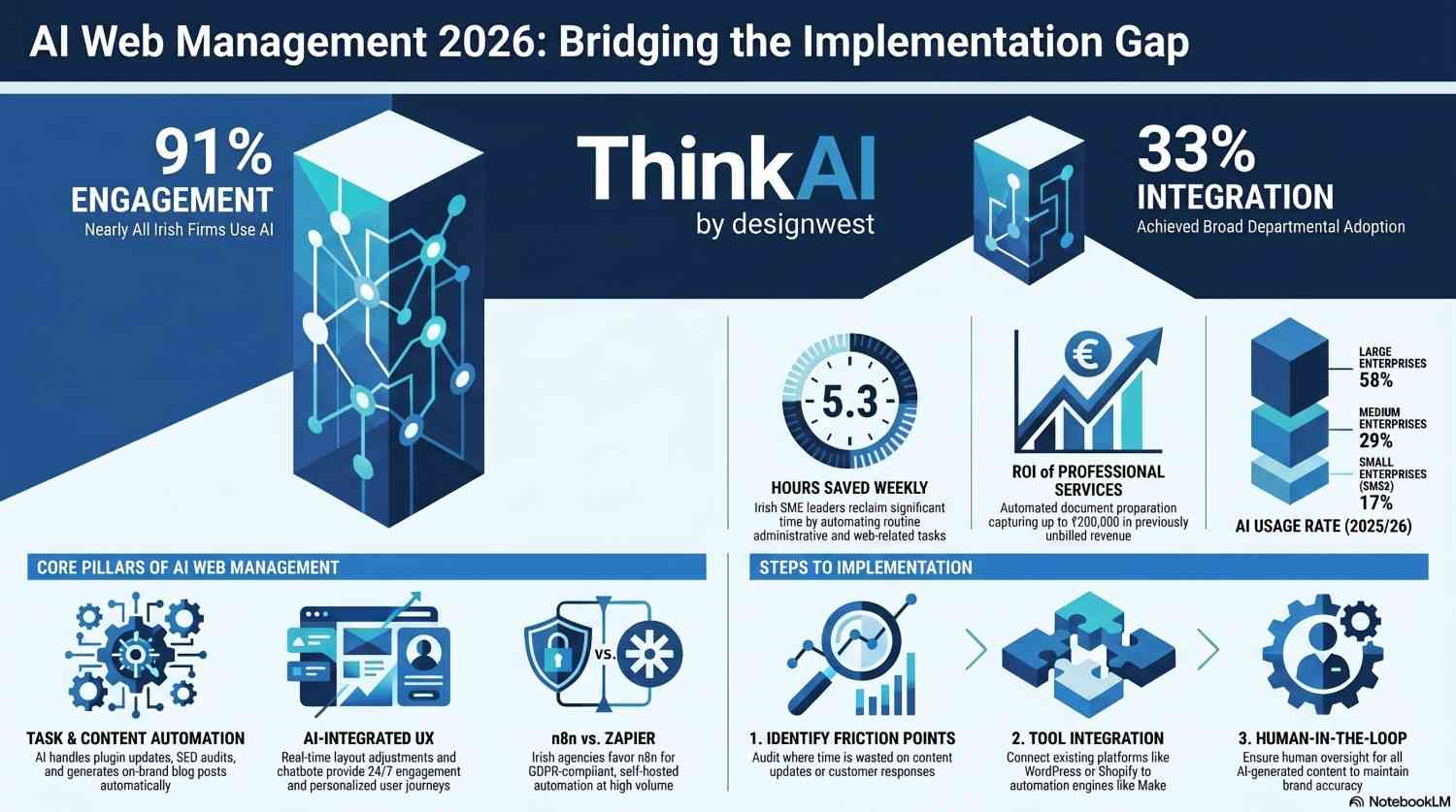
Ireland is well placed to benefit. According to recent research, 91% of Irish organisations report some form of AI use, up from 49% in 2024. Yet only 9 to 12% of Irish SMEs have moved beyond basic tools to deploy autonomous agents. That gap represents both a risk and an opportunity.
From Mayo to Dublin and Galway, Irish businesses are beginning to see what agentic systems can deliver: faster lead handling, automated invoicing, real-time customer support, and more. This blog covers the 10 defining agentic AI trends for 2026, the new pricing models changing how AI is bought, the frameworks powering these agents, and the practical steps Irish SMEs can take to get started.
Why Agentic AI Is Evolving Rapidly in 2026
The shift to agentic AI is not a gradual evolution. It is a step change. For years, AI tools sat at the edge of business operations, assisting with tasks like drafting emails or summarising documents. Now, with improved language models, richer data environments, and mature integration ecosystems, AI agents are moving into the core of how work gets done.
Gartner predicts that by end-2026, approximately 40% of enterprise applications will include built-in task-specific agents, up from under 5% in 2025. For Irish businesses, which have consistently ranked among Europe’s top AI adopters, 2026 is the year to move from experimentation to deployment.
What Is Driving Agentic AI Updates?
Several forces are combining to accelerate agentic AI updates right now:
- Improved AI models: Next-generation LLMs now reason over multiple steps and maintain context across long workflows.
- Increased data availability: Irish businesses have more customer, operational, and transactional data than ever before.
- Business demand for automation: With tight labour markets and rising input costs, 80% of Irish SMEs believe AI can transform their operations.
- Integration ecosystems: Platforms like n8n, Zapier, and Make now allow agents to connect directly with Xero, HubSpot, Stripe, and other tools Irish businesses already use.
Top 10 Agentic AI Trends to Watch
These are the defining agentic AI trends shaping business in Ireland and globally in 2026:
AI agents can now review live data and act on it without waiting for a human prompt. In Irish financial services, agents are already monitoring market conditions and executing pre-set strategies. Gartner predicts 15% of daily business decisions will be made autonomously by 2028.
Rather than single bots, businesses are deploying crews of agents with defined roles: a researcher, a planner, an executor. Frameworks like CrewAI and AutoGen make this possible without building from scratch, enabling Irish SMEs to run entire digital departments with a small team.
Generic AI is being replaced by agents trained for specific industries. Legal firms, retailers, and financial services businesses are seeing agents built for their exact compliance requirements and workflow logic. For price-sensitive SMEs in Mayo and Galway, this reduces both setup time and error rates.
Agents now operate on live data streams, not batch exports. A manufacturer in the west of Ireland can run an agent that monitors production IoT sensors and flags a fault the moment it appears, rather than catching it during a manual review the following day.
The most practical agentic AI update for most Irish SMEs is not building a new system, it is connecting AI to existing tools. Agents built on n8n or Zapier sit on top of HubSpot, Xero, and Stripe, automating what was previously done manually across three different screens.
No-code platforms are removing the engineering barrier entirely. A marketing manager in Dublin can now build an agent that monitors brand mentions and drafts responses without writing a line of code. This directly addresses the 62% skills gap reported by Irish SMEs.
Tools that once suggested are now taking action. The shift from Copilot to Agent means AI moves from personal productivity aid to operational engine. Platforms like Microsoft Copilot and Salesforce Einstein are actively making this transition in 2026.
Vendors are moving from per-user subscriptions to per-resolution pricing. Intercom, for example, charges per ticket resolved rather than per seat. For Irish SMEs that are cost-conscious, this model ties every euro spent directly to a business result.
With the EU AI Act taking full effect by August 2026, governance is no longer optional. Irish businesses using AI in recruitment, credit scoring, or customer profiling must maintain audit logs and ensure human oversight. The Data Protection Commission is actively monitoring compliance.
Agents are not replacing people. They are being designed to handle routine cases and escalate complex ones. In Ireland’s relationship-driven economy, this hybrid model matters. Customers still value human connection, and businesses need to design agents that protect that.

New Agent Pricing Models and Business Impact
New agent pricing models are changing how Irish businesses budget for AI. The three dominant structures in 2026 are:
- Usage-based pricing: You pay per action, API call, or token processed. Low barrier to entry but can create unpredictable costs if usage spikes.
- Subscription models: Fixed monthly fee per user or organisation. Predictable for SME budgets but less tied to actual value delivered.
- Outcome-based pricing: You pay only when the agent successfully completes a task. Intercom charges €0.99 per resolved support ticket. Sierra AI only charges for fully resolved issues without human escalation.
- n8n: A visual, low-code automation platform with native AI agent support. Critically, it supports self-hosting, which addresses the data sovereignty concerns of 84% of Irish technology leaders wary of foreign vendor control.
For Irish SMEs, outcome-based models are the most attractive. They eliminate the risk of paying for AI that delivers no measurable return. Early adopters report 8.3x more value relative to cost compared with traditional SaaS licences. The shift also forces vendors to build better agents, since they only get paid when the product works.
AI Agent Building Frameworks Powering Innovation
AI agent building frameworks are the engines underneath agentic systems. They provide the logic for how agents plan, reason, and act. The most relevant options for Irish businesses in 2026 are:
- LangGraph: The industry standard for enterprise-grade, high-stakes deployments. Preferred by Irish FinTech and legal firms where reliability and auditability are non-negotiable. Its checkpoint system means an agent can resume a failed 20-step process from where it stopped.
- CrewAI: Role-based and fast to deploy. CrewAI models agents like a team of specialists (Researcher, Planner, Executor) and is 5.7x faster to set up than most competitors. The practical choice for Irish marketing and sales teams.
- AutoGen (Microsoft): Conversation-based coordination between multiple agents. Strong for complex research or code execution tasks where agents need to negotiate and delegate.
- n8n: A visual, low-code automation platform with native AI agent support. Critically, it supports self-hosting, which addresses the data sovereignty concerns of 84% of Irish technology leaders wary of foreign vendor control.
For most Irish SMEs, the recommendation is to start with CrewAI or n8n for speed and accessibility, and graduate to LangGraph for any deployment where legal or financial compliance requires strict auditability.

Emerging Agentic AI Tools for Irish Businesses
Beyond developer frameworks, a growing set of agentic AI tools is available off the shelf. These tools allow Irish businesses to deploy agents without building from scratch:
- Intercom Fin: A reasoning-first customer support agent that resolves 70 to 85% of inbound queries without human involvement. Immediate ROI for any Irish business with a high-volume support function.
- HubSpot Breeze: CRM-integrated agents for prospecting, follow-up, and pipeline management. Removes the administrative burden from Irish sales teams and keeps contact records up to date automatically.
- n8n with AI nodes: Connects any AI model to 400+ business applications. A Mayo-based distributor used n8n to automate invoice processing against Xero, cutting per-invoice processing time from 6 minutes to 30 seconds.
- Sierra AI: Outcome-based agent platform for customer experience. Only charges for fully resolved issues, making it ideal for cost-conscious Irish retailers who need to prove ROI before committing.
The broader pattern is clear: agentic AI tools are becoming product categories in their own right. Within the next 12 months, choosing an AI agent will be as straightforward as adding a new software subscription to a business account.
How Irish SMEs Can Prepare for Agentic AI
A structured approach reduces risk and accelerates results. The following five steps apply to any Irish business considering agentic AI:
- Identify one high-value use case. Start with a process where even a 20 to 30% time saving has a direct commercial impact. Common entry points for Irish SMEs include lead qualification, invoice processing, and customer query handling.
- Start with accessible tools. Use no-code platforms like n8n or HubSpot AI before commissioning custom builds. Pilot projects typically cost between €5,000 and €10,000 and can be supported through Enterprise Ireland Innovation Vouchers or LEO training programmes.
- Train existing teams. AI fluency across operations, sales, and finance matters more than hiring new specialists. Skillnet and providers like ThinkAI offer accessible training for management and staff.
- Choose scalable, portable platforms. Avoid locking into a single vendor. Use widely supported frameworks such as n8n or HubSpot to ensure you can adapt as the EU AI Act and business requirements evolve.
- Monitor performance and maintain human oversight. Track time saved, error rates, and response times during a 6 to 10 week pilot. Assign a named person to review agent logs weekly. Never deploy autonomous agents in high-stakes areas, such as finance or legal, without a designated human approval gate.
Why ThinkAI Is Mayo's Trusted AI Partner
ThinkAI is a Mayo-based AI consultancy helping Irish businesses move from experimentation to production. With hands-on expertise in agentic workflows, integration platforms, and EU AI Act compliance, ThinkAI works with SMEs across Ireland to build practical, commercially focused AI strategies.
Whether you are looking to automate your first workflow or build a multi-agent system for your sales or finance team, ThinkAI provides the local knowledge and technical capability to get it done. Contact ThinkAI to request a consultation and start building your agentic AI roadmap today.
Key Takeaways
Legal and financial firms deploy AI chatbots Ireland solutions for:
- Agentic AI updates are accelerating in 2026, with agents moving from productivity aids into core operational systems for Irish businesses.
- The top 10 agentic AI trends span autonomous decision-making, multi-agent collaboration, no-code builders, and mandatory EU governance requirements.
- New agent pricing models, especially outcome-based pricing, reduce financial risk for Irish SMEs and tie cost directly to results.
- Frameworks like CrewAI, LangGraph, and n8n give Irish businesses accessible entry points into agentic AI without large capital investment.
- Irish SMEs should start small, identify one high-value process, and use Enterprise Ireland or LEO funding to pilot their first agentic workflow.
Frequently Asked Questions
Agentic AI refers to AI systems that can autonomously plan and complete multi-step tasks without step-by-step human instruction. Unlike basic chatbots that respond to individual prompts, agentic systems connect to business tools, reason over data, and execute actions to achieve a defined goal.
Traditional automation follows fixed rules: if X happens, do Y. Agentic AI can reason under uncertainty, interpret ambiguous inputs, and adapt when circumstances change. It uses language model intelligence rather than hard-coded logic, which makes it far more flexible across real business workflows.
2026 is the inflection point. Gartner projects 40% of enterprise applications will include built-in agents by year-end. Irish competitors in the UK and EU are already deploying these systems. Businesses that wait face a growing productivity and efficiency gap that becomes harder to close over time.
The primary barriers are skills shortages (cited by 84% of Irish firms), poor data quality (40%), and concerns around GDPR and EU AI Act compliance. Cost is also a factor, though new pricing models and government supports are reducing that obstacle significantly.
A pilot project typically runs between €5,000 and €10,000. Full SME production systems range from €25,000 to €50,000. Enterprise Ireland Innovation Vouchers (€5,000) can fund feasibility work, and Local Enterprise Office training programmes start from as little as €50.
Outcome-based pricing means you pay only when the AI agent successfully completes a task, such as €0.99 per support ticket resolved. For Irish SMEs, this model removes the risk of paying for AI that delivers no return and aligns vendor incentives with your business goals.
For most SMEs, CrewAI or n8n offer the fastest path to deployment. CrewAI is role-based and quick to set up for sales or marketing use cases. n8n is ideal for connecting AI to existing tools like Xero and HubSpot, and supports self-hosting for GDPR compliance.
The EU AI Act is in full effect from August 2026. Most common business agents (customer chatbots, scheduling tools) fall under limited risk and require basic transparency. High-risk uses in areas like credit scoring or HR screening require detailed audit logs, conformity assessments, and human oversight.
Yes, provided you conduct a Data Protection Impact Assessment (DPIA), ensure your AI vendor is GDPR-compliant, and can respond to data subject access requests. n8n’s self-hosting option is particularly useful for Irish businesses that want to keep data within their own infrastructure.
A Dublin consultancy deployed a CrewAI sales crew that reduced lead triage time by 80% and increased lead-to-meeting conversion by 22%. A Mayo-based distributor automated invoice processing with n8n, cutting per-invoice time from 6 minutes to 30 seconds and reducing errors to under 1%.
Research shows 60% of Irish firms expect headcount to fall by less than 10% as AI is adopted, with most roles shifting from execution to oversight. The more likely outcome is that staff are freed from repetitive tasks and can focus on higher-value work, client relationships, and decision-making.
A human-in-the-loop (HITL) model means an agent handles routine cases but escalates decisions above a set threshold to a human. For Irish businesses in legal, financial, or customer-facing roles, HITL is both a compliance requirement and a trust safeguard that preserves the human service quality clients expect.
If your data is fragmented across disconnected systems, inconsistent in format, or poorly documented, agents will underperform. Before deploying any agent, audit your core data sources, clean and standardise records, and ensure your primary business tools (CRM, accounting, stock) are connected via APIs.
A basic no-code agent using n8n or HubSpot can be live in days. A custom multi-agent system built on CrewAI or LangGraph typically takes 4 to 8 weeks from scoping to production. Plan for a 6 to 10 week pilot phase to measure ROI before scaling.
53% of Irish firms report measurable productivity gains from AI adoption. Early adopters of outcome-based pricing models report 8.3x more value relative to cost compared with traditional software licences. Even conservative implementations delivering 40% automation rates show 67% return on investment in year one.
Buy for common, well-defined needs such as customer support or lead handling. Build only when you have proprietary data or a unique workflow that gives your business a competitive advantage. Custom builds are more expensive and slower to deploy but deliver higher long-term value in the right contexts.
Multi-agent systems deploy a team of specialised agents that divide tasks between them, for example a researcher, a planner, and an executor working in sequence. You need multi-agent systems when the workflow is too complex for a single agent, or when different parts of the process require different expertise or data sources.
Enterprise Ireland offers Innovation Vouchers worth up to €5,000 for AI feasibility work. Local Enterprise Offices provide subsidised training and digitalisation grants. Skillnet Ireland funds sector-specific upskilling programmes. These supports are specifically designed to reduce the financial risk of early-stage AI investment for Irish SMEs.
Design agents to handle routine and repetitive interactions while routing anything requiring empathy, judgment, or complexity to a person. Build clear escalation rules into every customer-facing agent. Regularly review agent outputs for tone and accuracy, and ensure staff understand how to intervene when the agent reaches its limits.
Choose one process that is time-consuming, repetitive, and rule-based. Common starting points are customer FAQ handling, invoice matching, or lead qualification. Use a no-code tool to build a basic agent, set a 6-week measurement window, and track time saved and error rates. Once that delivers results, expand from there.
About the Author
Declan Foley is the founder of ThinkAI.ie and Creative Director at Designwest. He helps Irish businesses unlock growth through AI-powered strategy and digital innovation. Explore how ThinkAI can support your business at ThinkAI.ie.