

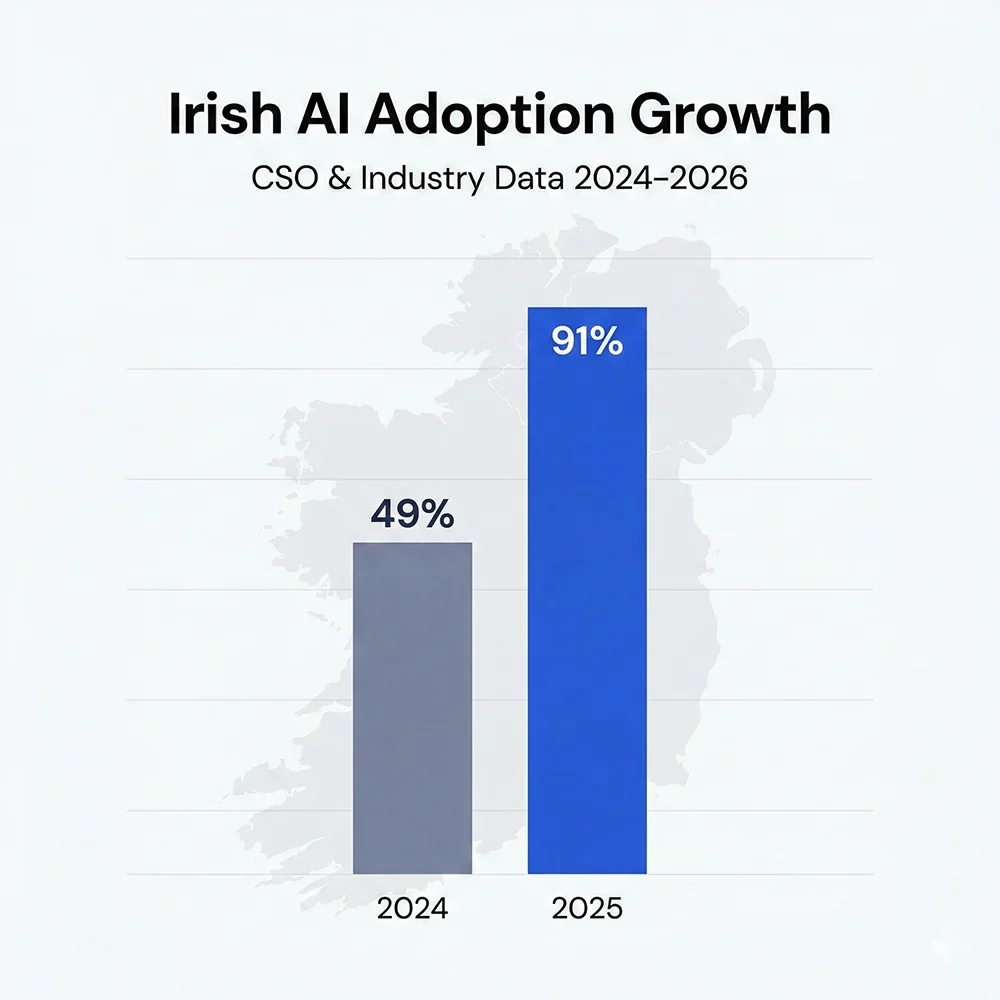
The digital landscape of the Republic of Ireland is currently navigating a period of unprecedented technological acceleration. By the first quarter of 2026, Ireland has emerged as a preeminent global leader in the adoption and diffusion of artificial intelligence, currently ranking fourth worldwide behind only Singapore, the United Arab Emirates, and Norway. This rapid ascent is not merely a statistical anomaly but the result of a concerted national strategy, robust digital infrastructure, and a highly skilled workforce that has embraced AI at a rate faster than the historical uptake of the internet, the personal computer, or the smartphone. Within the Irish business ecosystem, AI adoption has witnessed a near-doubling, surging from 49 percent in 2024 to an impressive 91 percent by early 2025. For Small and Medium Enterprises (SMEs) in the retail and hospitality sectors, this shift represents a critical inflection point. The transition from traditional digital operations to AI-enhanced workflows is no longer a luxury reserved for multinational corporations; it is an essential component for survival in a market where AI is projected to add at least $250 billion (€230 billion) to the national economy by 2035.
The Macro-Economic Context of AI Adoption in Ireland
The overarching trajectory of the Irish economy is increasingly intertwined with the success of its AI diffusion strategy. The Central Statistics Office (CSO) reports that as of 2025, over 20 percent of all Irish enterprises have integrated some form of AI into their daily operations, a significant increase from the 15 percent recorded in 2024. While the headline figures suggest a universal embrace of the technology, the underlying data reveals a nuanced “two-speed” economy. Large enterprises, defined as those with 250 or more employees, lead the charge with an adoption rate of 58 percent. In contrast, small enterprises—the backbone of the Irish retail and hospitality sectors—currently show an adoption rate of approximately 17 percent. This disparity creates a competitive vacuum that SMEs must urgently fill to avoid being marginalized by larger, data-driven rivals.
The economic implications of this technological shift are profound. Research conducted by Trinity College Dublin, in partnership with Microsoft Ireland, suggests that the “AI Economy” will be the primary driver of GDP growth over the next decade. This growth is facilitated by the widespread use of natural language generation, which is currently the most common application of AI in Ireland, utilized by 9 percent of all firms. This is followed closely by data mining (11 percent) and workflow automation (6.4 percent). For the retail and hospitality sectors, these specific technologies underpin the deployment of intelligent chatbots and digital assistants that are transforming the customer journey.
Comparative Technology Utilization by Enterprise Scale in 2025
The following table provides a granular view of how different sizes of Irish enterprises are leveraging technology, illustrating the digital infrastructure gap that SMEs are working to bridge.
| Metric / Technology | Small Enterprises (10-49 Employees) | Medium Enterprises (50-249 Employees) | Large Enterprises (250+ Employees) |
|---|---|---|---|
| Overall AI Utilization | 17% | 25% | 58% |
| Data Mining Applications | 11% (National Avg) | N/A | 35% |
| Workflow Automation | 6.4% (National Avg) | N/A | 29% |
| Fixed Broadband > 500 Mbps | 35% | N/A | 59% |
| Engagement in E-commerce | 35% | 50% | 54% |
| Utilization of Data Analytics | 28% (Transaction records) | N/A | N/A |
| Cloud-based Email Adoption | 64% (National Avg) | N/A | N/A |
Identifying the Adoption Gap and Strategic Barriers
Despite the clear economic incentives, Irish SMEs face substantial hurdles. A staggering 62 percent of SMEs cite a lack of internal AI skills as their primary barrier to adoption. Furthermore, a significant strategic deficit exists; while 50 percent of multinationals operating in Ireland have a formalized AI strategy, only 10 percent of domestic SMEs can say the same. This lack of planning often leads to “pilot purgatory,” where businesses experiment with isolated tools without integrating them into a cohesive operational framework.
The competitive risk is immediate. Businesses that implement AI-driven customer service solutions, such as chatbots, report a 40-45 percent reduction in routine call volumes. In the retail sector, AI personalization in email campaigns has been shown to improve performance by 7-38 percent. For an independent retailer on a high street in Cork or Galway, the inability to respond to customer inquiries at 2:00 AM—a task easily handled by a chatbot—means losing market share to larger competitors who offer 24/7 engagement.
Strategic AI Applications in the Irish Retail Sector
The Irish retail sector is currently undergoing a “personalization revolution.” By leveraging data from loyalty programs, online browsing patterns, and historical purchase records, AI enables even small retailers to offer a “high-touch” experience that was previously the domain of luxury department stores.
Omnichannel Integration and the Digital Assistant
Modern Irish consumers expect a seamless transition between physical and digital storefronts. AI chatbots are the glue of this omnichannel experience. A customer browsing a boutique’s website in Dublin should be able to ask a chatbot if a specific dress is available in their size at the retailer’s physical location in Limerick. This level of integration requires the chatbot to have real-time access to the store’s inventory management system.
Retailers such as Brown Thomas have already set the benchmark by integrating Salesforce’s AI-powered Commerce and Marketing Clouds. 6 This allows them to send automated, personalized wishlist reminders and tailored promotions based on a customer’s unique journey. For smaller retailers, tools like Shopify’s “Sidekick” and “Shopify Magic” offer similar capabilities, allowing them to generate product descriptions and analyze sales data using everyday language.
Enhancing In-Store Experiences with AI
The application of AI is not limited to the digital realm. Smart kiosks and tablet-based assistants are increasingly found on the shop floors of Irish retailers. These tools act as virtual personal shoppers; by entering a few preferences, a customer can receive styled outfit suggestions or meal pairings. Research indicates that 63 percent of Irish shoppers welcome budget-friendly product suggestions in-store, and 60 percent appreciate AI help in finding gifts within a specific price range. This data suggests that the “Irish dose of wit” and local knowledge, when combined with AI-driven precision, can create a powerful competitive advantage.
Operational Efficiency: The Back-Office Impact
Beyond customer-facing bots, AI is transforming the “mastery of the stockroom.” Inventory is often the largest tie-up of cash flow for Irish retailers. AI-powered demand forecasting can analyze past sales data, seasonal trends, and even local events (such as the Galway Races or Dublin Horse Show) to predict exactly what stock is needed. This reduces the incidence of stockouts—which can be cut by up to 40 percent—and carrying costs, which typically decrease by 20 percent.
Transformative AI Solutions for the Irish Hospitality Industry
Running a hospitality business in Ireland in 2026 involves navigating a “perfect storm” of rising payroll costs, persistent staff shortages, and fluctuating utility prices. AI is emerging not as a replacement for the “famous Irish welcome” but as a vital support system that empowers human staff to focus on guest experience.
The 24/7 Digital Concierge and Booking Agent
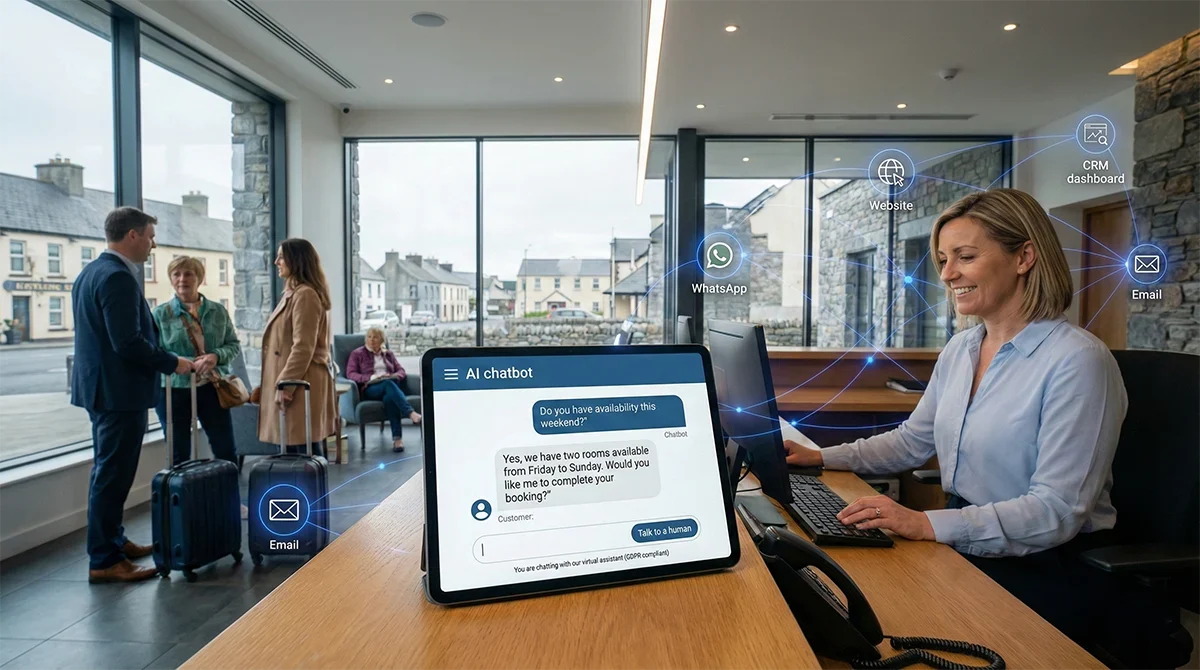
In the hospitality sector, a missed call or an unanswered email is a lost revenue opportunity. AI chatbots acting as 24/7 booking agents can handle the entire reservation process on a hotel’s website or social media channels. These agents are capable of answering specific questions about room amenities, parking facilities, or dietary options in multiple languages, which is essential for attracting international tourists from the US, France, Germany, and Spain.
| Hospitality Function | AI Chatbot Role | Tangible ROI Outcome |
|---|---|---|
| Reservation Handling | Guides users through the booking funne | >20% increase in direct bookings |
| Guest Services | Answers FAQs (check-in times, breakfast hours) | ~15 hours saved per week for front desk |
| Upselling | Proactively offers spa packages or late check-outs | Increased RevPAR and average guest spend |
| Multilingual Support | Communicates in French, German, Spanish, etc. | Enhanced accessibility for international guests |
Revenue and Yield Management
Static pricing in the modern hospitality market is a liability. AI-powered dynamic pricing tools act as an in-house revenue manager, constantly analyzing real-time demand, competitor pricing, and external factors like weather forecasts or local concerts. For an independent hotel in Killarney or a restaurant in Kinsale, these tools ensure that table and room rates are always optimized to maximize profitability during peak periods and maintain occupancy during the shoulder season.
Operational Automation in the Kitchen and Front-of-House
AI’s role extends into the operational heart of hospitality. Predictive inventory management can analyze sales data to forecast supply needs, significantly reducing food waste—a major cost factor for Irish restaurants. Furthermore, AI “co-pilots” can assist managers in creating staff rotas based on forecasted guest arrivals, ensuring that the team is never overstretched during busy periods, thus improving morale and reducing burnout.
Navigating the Regulatory Landscape: EU AI Act and GDPR
The deployment of AI chatbots in Ireland is governed by some of the most stringent regulatory frameworks in the world. The EU AI Act, which takes full effect in August 2026, alongside the existing General Data Protection Regulation (GDPR), creates a complex but necessary compliance environment.
The Role of the AI Office of Ireland
In early 2026, the Irish government formalized its enforcement infrastructure with the publication of the General Scheme of the Regulation of Artificial Intelligence Bill 2026. This bill establishes the “AI Office of Ireland” (Oifig Intleachta Shaorga na hÉireann) as an independent statutory body under the Department of Enterprise, Tourism and Employment. The office serves as the central coordinating authority and the “Single Point of Contact” for the European Commission.
The Irish model follows a “distributed” approach to supervision. Rather than a single agency overseeing all AI, existing sectoral regulators are empowered to supervise AI within their specific domains:
- The Data Protection Commission (DPC): Oversees the intersection of AI and personal data protection.
- The Central Bank of Ireland: Supervises AI in financial services (e.g., credit scoring).
- The Workplace Relations Commission: Monitors AI used in recruitment and human resources.
- Health Authorities: Regulate AI in medical and healthcare contexts.
Essential Transparency and Disclosure Obligations
Starting in August 2026, the AI Act mandates that users must be informed when they are interacting with an AI system, unless it is obvious from the context. For Irish SMEs, this means that every chatbot interaction must begin with a clear disclosure.
Furthermore, under the Consumer Rights Directive (CRD), chatbots cannot be the sole point of contact. Consumers must retain the right to contact a human trader directly and quickly via traditional channels like telephone or email. Traders are also held fully liable for the information provided by their chatbots; if a bot provides a misleading price or an incorrect product description, the business is legally accountable under the Product Liability Directive.
Prohibited and High-Risk AI Practices
The AI Act adopts a risk-based approach, and businesses must ensure their chatbots do not fall into “prohibited” categories. These include AI systems that deploy subliminal techniques to distort human behavior or systems that exploit the vulnerabilities of specific groups. While most retail and hospitality chatbots are considered “minimal risk,” those involved in credit scoring or recruitment are classified as “high-risk” and are subject to rigorous oversight, including mandatory human review and detailed technical documentation.
| Category of Risk | Penalty for Non-compliance | Regulatory Consequence |
|---|---|---|
| Prohibited AI Practices | Up to €35 million or 7% of global annual turnover | Immediate withdrawal from market |
| High-risk Non-compliance | Up to €15 million or 3% of global annual turnover | Mandatory corrective actions |
| Supplying Incorrect Info | Significant administrative sanctions | Loss of “Trusted AI” status |
Financial Supports and Grants for Irish SMEs
To encourage the adoption of AI and close the digital divide, several Irish agencies offer significant financial incentives. Navigating these supports is a critical first step for any SME considering AI deployment.
Enterprise Ireland: Digital Discovery and Implementation
Enterprise Ireland (EI) offers the “Digital Discovery” grant, which is specifically designed to help companies develop a roadmap for digital transition. The grant covers 80 percent of the project costs, up to a maximum grant of €5,000. This funding allows an SME to hire an external digital expert for 3 to 7 days to assess the company’s digital maturity and identify where AI can deliver the highest ROI.
For businesses ready to move beyond the discovery phase, EI offers the “Digital Process Innovation” grant, which can provide up to €150,000 in funding for the implementation of new technology and digital processes. This is particularly relevant for retailers looking to integrate sophisticated AI-driven warehouse automation or omnichannel logistics.
Local Enterprise Office (LEO) Supports
For smaller businesses with fewer than 10 employees, the Local Enterprise Offices provide the “Digital for Business” program. This initiative offers free digital assessments and can progress to “Business Expansion Grants” of up to €150,000 for more significant AI transformations. Additionally, the “Trading Online Voucher” remains a vital resource for SMEs looking to enhance their e-commerce platforms with AI features like product recommendation engines or search optimization.
Regional and Sectoral Initiatives
Other bodies also provide targeted support:
- InterTradeIreland: Offers "Innovation Boost" grants of up to €68,000 for cross-border collaborations involving AI.
- Údarás na Gaeltachta: Provides funding for businesses located in Gaeltacht regions, covering up to €150,000 for digital expansion.
- Skillnet Ireland: Offers subsidized training programs, such as the "Professional Academy Diploma in AI for Business," which cost as little as €500 for eligible private companies.
Human Capital: Upskilling and Training the Irish Workforce
The successful deployment of AI is 20 percent technology and 80 percent people. To address the 62 percent skills gap, Ireland has developed a comprehensive ecosystem for AI literacy and professional training.
Skillnet Ireland and Sectoral Training
Skillnet Ireland operates through various networks, such as Retail Ireland Skillnet and Industry 4.0 Skillnet, to provide industry-specific AI training. The “AI for You” course is a particularly effective introductory program that covers AI literacy and the requirements of the EU AI Act in a concise, 3-hour format. For leadership and technical staff, the “ICT Skillnet” provides subsidized access to Master’s degrees and Level 7 Certificates in AI through partnerships with the University of Limerick and the National College of Ireland.
Springboard+: Free Higher Education for Reskilling
The Springboard+ initiative is a cornerstone of the government’s strategy to future-proof the Irish workforce. It offers free or 90 percent subsidized courses in ICT and AI. For example, CCT College Dublin offers a “Diploma in Artificial Intelligence and Working into the Future”(Level 7), which is delivered online over three semesters to accommodate those already in employment. These courses are developed in consultation with industry leaders like Microsoft to ensure that the curriculum addresses real-world business needs.
Inclusive Skilling Programs
Specialized programs like “AI Skills 4 Women,” developed in collaboration with Microsoft and Founderz, aim to ensure that the benefits of the AI economy are shared inclusively. This 3-hour online course covers prompt engineering, AI ethics, and data analytics, lowering the barrier to entry for women in the tech sector.
Technical Implementation: Platforms and Integration
When moving to the deployment phase, Irish SMEs must choose between building custom solutions or utilizing established platforms. For most retail SMEs, a unified AI platform that integrates with their existing e-commerce stack is the most efficient route.
Comparing Popular AI Chatbot Platforms for SMEs
| Platform | Primary Strength | Ideal Use Case | Irish Relevance |
|---|---|---|---|
| Intercom | Advanced AI (Fin) & helpdesk suite | Tech-forward SMEs & SaaS | Irish-founded; massive local support base |
| Tidio | E-commerce automation (Lyro AI) | Small Shopify/WooComm erce stores | Affordable entry point for first-time adopters |
| Gorgias | Shopify-aware AI actions | High-volume Shopify support | Handles cancellations and order tracking natively |
| ThinkAI | Bespoke Irish-market solutions | Local retail and hospitality | Provides local strategy and GDPR-aware setup |
| Heyy | Multichannel unification | Businesses active on Instagram/WhatsApp | Preserves context across five different inboxes |
The "Central AI Brain" vs. Disconnected Apps
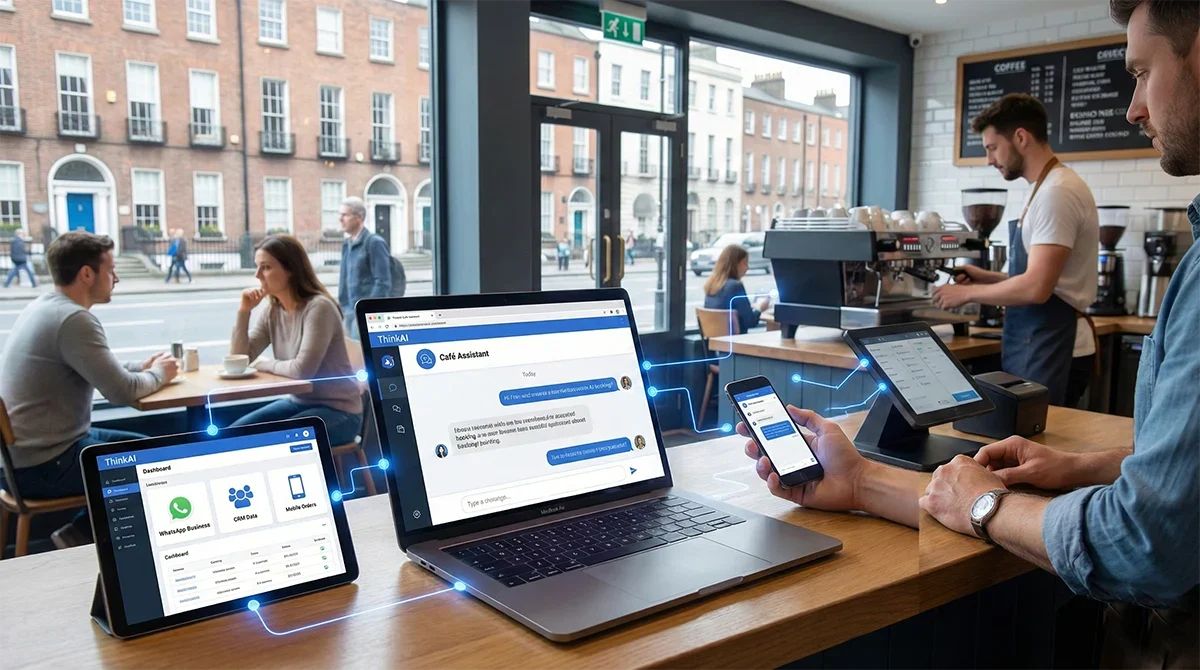
A common mistake for SMEs is “collecting tools” rather than “building a system”. A unified AI platform like Intercom or eesel AI acts as a central brain that connects to all the store’s information sources—past support tickets, Google Docs, and Shopify data. This allows the AI to perform complex tasks, such as looking up an order in Shopify and then cross-referencing it with a return policy in a PDF to provide a personalized, accurate response.
Integrating with ERP Systems: Sage Intacct and Beyond
For larger Irish SMEs, the chatbot must integrate with the back-office accounting and ERP systems. For example, the Stock2Shop integration bridges the gap between Sage Intacct and Shopify. This ensures that the chatbot always sees accurate pricing and stock levels directly from the ERP, preventing the risk of selling items that are actually out of stock. These integrations typically use webhooks and APIs to synchronize data automatically, reducing manual data entry and improving accuracy.
Conversational UX Design: Mastering the "Digital" Irish Welcome
The design of the chatbot’s interface and dialogue is where the brand’s personality is established. In Ireland, the tone of voice should reflect the company’s existing customer service standards.
Tone of Voice and Linguistic Nuances
The bot’s personality must be tailored to the audience. A financial services bot in Dublin should prioritize professional brevity and empathy, whereas a fashion boutique in Galway can afford to be more playful and enthusiastic. Consistency is paramount; if a bot switches from formal to casual mid-conversation, it can frustrate the user and erode trust.
Technical tips for a natural-sounding bot include:
- Implementing a "Think" Time: Providing a 2-second pause before the bot responds mimics human typing patterns and prevents the user from feeling overwhelmed by instant text.
- Using Typing Indicators: Visual cues like "..." let the user know the bot is processing their request.
- Avoid Idioms: For hospitality bots dealing with international guests, avoid local Irish idioms (e.g., Grand," "I will yea") that may not translate well or could lead to misunderstandings.
User Interface (UI) Elements for Engagement
A successful chatbot UI balances open-text input with guided buttons. Quick-reply buttons for common tasks (e.g., “Where is my order?” or “Check room availability”) accelerate the conversation and reduce the friction of typing, especially on mobile devices. Furthermore, the bot should always have a visible “Talk to a human” option to ensure that users do not feel trapped in an automated loop.
Step-by-Step Deployment Guide for Irish SMEs
To ensure a successful and compliant deployment, Irish SMEs should follow this rigorous seven-step roadmap.
Start by identifying the repetitive tasks that consume the most time for your staff. This could be answering questions about shipping times or processing restaurant bookings. Define clear, measurable goals for the pilot project, such as “reducing customer service emails by 25 percent” or “increasing direct weekend bookings by 15 percent”.
Apply for the Enterprise Ireland Digital Discovery grant or a LEO digital voucher to fund a feasibility study. 5 Work with an external expert to audit your current digital maturity and map out the necessary technical integrations.
“Good AI needs good data”. Before deploying any chatbot, ensure that your customer and product data is consolidated and error-free. If your inventory levels in your physical shop do not match your online store, the chatbot will provide incorrect information, leading to customer dissatisfaction.
Choose an AI platform that aligns with your specific needs (e.g., Shopify Magic for simple retail, Intercom for complex support, or ThinkAI for a custom Irish-market approach). Conduct a Data Protection Impact Assessment (DPIA) to ensure the implementation is GDPR-compliant and that user data is handled with appropriate security measures like encryption and pseudonymization.
Craft your bot’s personality and map out the “user intent” paths. Create fallback responses for when the bot doesn’t understand a query, and ensure the escalation path to a human agent is seamless. Test the bot with a small group of loyal customers or staff members to identify “dead-end” responses before a wider launch.
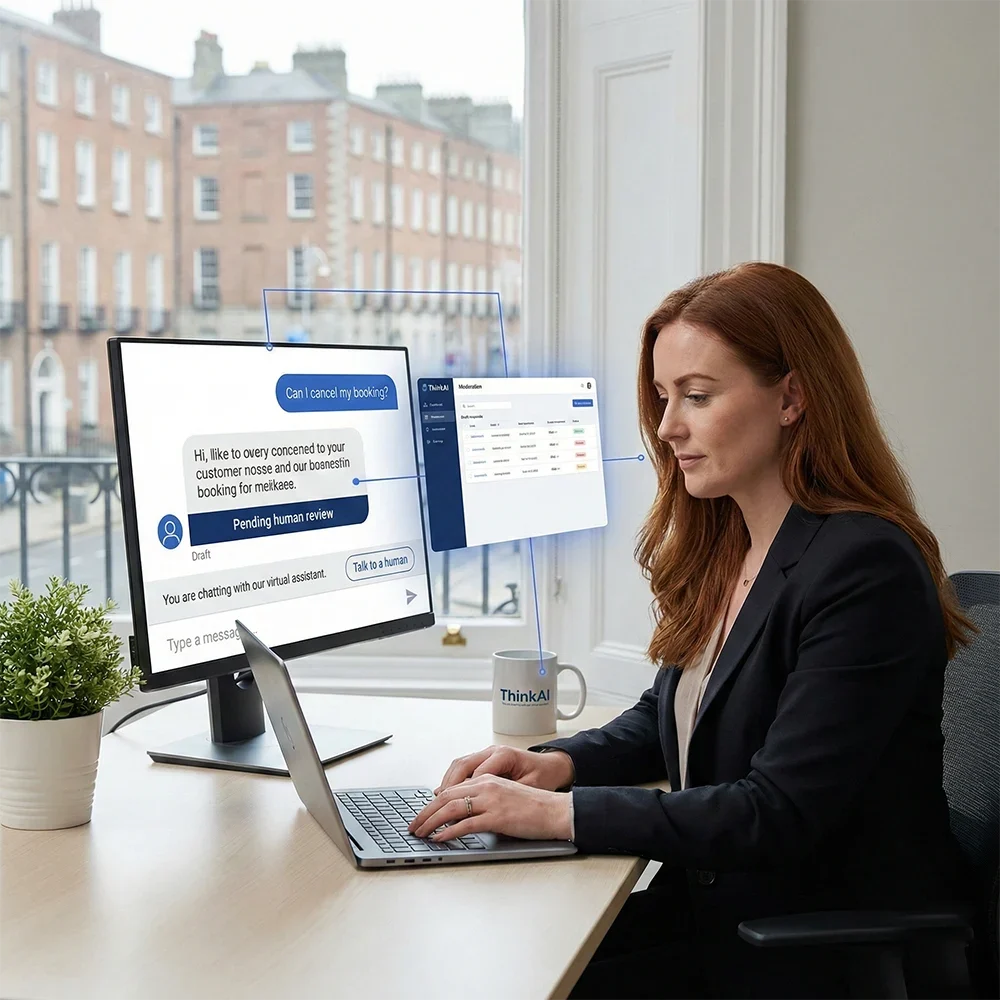
Deploy the bot in a pilot phase. Assign a team member to monitor interactions in real-time or through daily audits. This ensures that any AI “hallucinations” or errors are caught and corrected immediately, preventing them from impacting the broader customer base.
Review the KPIs established in Step 1. If the bot is meeting its targets, begin scaling to more complex use cases, such as handling refunds or integrating with your loyalty program. Use the conversational data collected by the bot to improve your website’s FAQ section and marketing strategies.
Technical Pitfalls and Risk Mitigation
Deploying AI is not without significant risks. Irish businesses must be proactive in managing these challenges to protect their reputation and legal standing.
"Shadow AI" and Internal Security
One of the most pressing risks in 2026 is “Shadow AI”—where employees use unapproved public AI tools to process sensitive company data. For example, a staff member might paste a customer’s personal details into a free online translator or content generator, potentially causing a GDPR breach. Businesses must provide clear usage policies and provide employees with access to approved, secure AI tools that ensure data privacy.
Bias and Discrimination in AI Systems
AI models can inadvertently replicate biases present in their training data. For an Irish SME, this could lead to discriminatory outcomes in recruitment bots or credit-scoring tools. The AI Act specifies that any AI-driven decision that significantly impacts a person’s rights must be transparent and auditable. Using a “co-pilot” model—where AI assists but humans make the final decision—is the recommended approach to mitigate this risk.
Hallucinations and the Product Liability Directive
Large Language Models (LLMs) can occasionally “hallucinate,” providing confident but factually incorrect answers. Under the new Product Liability Directive (applying from December 2026), Irish traders are responsible for all chatbot communications. If a chatbot offers a “free meal” due to an error in its logic, the business may be legally required to honor it or face penalties for misleading commercial practices. Regular monitoring and modest ongoing training of the bot are essential to minimize these errors.
Environmental and Ethical Considerations
The high energy consumption of AI models is an emerging concern. The Oireachtas Joint Committee on AI has recommended that AI development align with Ireland’s energy reduction goals. Furthermore, businesses must ensure that their digital tools do not exclude older customers or those with disabilities. The European Accessibility Act (applying from June 2025) requires that digital services, including chatbots, be accessible to all consumers regardless of their technical literacy or physical abilities.
The Future of AI in Ireland: From Chatbots to Agentic AI
As we move toward 2027, the technology is shifting from reactive “chat” to “Agentic AI.” These systems are not just answering questions; they are autonomous decision-makers capable of executing multi-step tasks across different business systems.
Autonomous Operations in Irish Retail
Instead of a pricing manager reviewing competitor data once a week, Agentic AI can adjust prices in real-time across an entire inventory. It can spot a rain forecast, trigger a restocking order for umbrellas, and launch a geo-targeted social media promotion without any human intervention. This level of agility will allow independent Irish retailers to compete with global giants on efficiency and price while maintaining their unique local identity.
Proactive Guest Management in Hospitality
In the hospitality sector, next-generation agents will notice unusual spending patterns in a guest’s loyalty account and proactively suggest budget-friendly adjustments or specialized packages before the guest even asks. They will handle arrivals and departures coordination, manage housekeeping schedules based on real-time room occupancy, and even predict potential maintenance issues—like a failing fridge compressor—before they result in service disruptions.
Nuanced Conclusions and Final Recommendations
The strategic deployment of AI chatbots represents the single most significant productivityopportunity for Irish retail and hospitality SMEs in the 2025-2026 period. However, success is not guaranteed by technology alone; it requires a disciplined approach to strategy, compliance, and human capital development.
The analysis of the current landscape leads to the following expert recommendations:
- Move Beyond Piloting: Irish SMEs must transition from "trying AI" to integrating it as a core business function with a dedicated strategy.
- Leverage the State Support Ecosystem: Ireland offers one of the most generous support structures in the EU. Failing to utilize Enterprise Ireland or LEO grants is a missed opportunity to de-risk technological investment.
- Prioritize Human-in-the-Loop Governance: AI should empower, not replace, the Irish workforce. Maintaining human oversight is the best defense against regulatory penalties and technical errors.
- Invest in Continuous Training: The 62 percent skills gap is a living challenge. Utilizing Skillnet and Springboard+ for ongoing staff development is essential to keeping pace with the rapid evolution of "Agentic AI".
By following this roadmap, Irish SMEs can bridge the digital divide, ensuring that the legendary “Irish Welcome” is supported by world-class, data-driven precision, securing their place in a prosperous and innovative AI-driven future.
FAQ: Irish Business Chatbot Deployment
Do I need coding skills to deploy a chatbot?
Not necessarily. Many platforms offerno-code visual builders. Technical support is usually only needed for complex integrations.
Works cited
- Ireland Ranks 4th Globally for AI Adoption, according to Microsoft’s new AI Diffusion Report, accessed February 23, 2026,
- Ireland Information Technology Emerging AI Opportunities, accessed February 23, 2026,
- More than 20% of businesses in Ireland used AI in 2025 – 01 …, accessed February 23, 2026, https://01webmasters.com/more-than-20-of-businesses-in-ireland-used-ai-in-2025/
- More than 20% of businesses in Ireland used AI in 2025 – The Echo, accessed February 23, 2026, https://www.echolive.ie/nationalnews/arid-41789138.html
- ai-adoption-irish-smes-2025 – St Ledger Marketing, accessed February 23, 2026, https://stledgermarketing.com/the-2025-ai-adoption-report-what-irish-smes-need-to-know-now/
- Generative AI in Ireland Retail: Innovation, Use Cases, accessed February 23, 2026, https://thinkai.ie/generative-ai-in-ireland-retail-innovation-compliance/
- AI for Retail Ireland | Smart Retail AI Solutions – ThinkAI, accessed February 23, 2026, https://thinkai.ie/ai-for-retail-ireland/
- How to integrate AI with Shopify: A complete guide – eesel AI, accessed February 23, 2026, https://www.eesel.ai/blog/how-to-integrate-ai-with-shopify
- How AI Is Helping Retail Companies in Ireland Cut Costs and Improve Efficiency, accessed February 23, 2026,
https://www.nucamp.co/blog/coding-bootcamp-ireland-irl-retail-how-ai-is-helping-retail-companies-in-ireland-cut-costs-and-improve-efficiency - AI for Hospitality Ireland | Smart AI Solutions – ThinkAI, accessed February 23, 2026, https://thinkai.ie/ai-for-hospitality/
- The Complete Guide to Chatbot GDPR Compliance – GDPR Local, accessed February 23, 2026, https://gdprlocal.com/chatbot-gdpr-compliance/
- Is Ireland setting the pace for AI governance in 2026? – VinciWorks, accessed February 23, 2026,
https://vinciworks.com/blog/is-ireland-setting-the-pace-for-ai-governance-in-2026/ - Digital Fairness Act Series: Topic 2 – Transparency and Disclosure …, accessed February 23, 2026,
https://www.insideprivacy.com/artificial-intelligence/digital-fairness-act-series-topic-2-transparency-and-disclosure-obligations-for-ai-chatbots-in-consumer-interactions/ - Article 5: Prohibited AI Practices | EU Artificial Intelligence Act, accessed February 23, 2026, https://artificialintelligenceact.eu/article/5/
- AI Grants Ireland 2026: Every Grant Compared | Deep Purple, accessed February 23, 2026, https://deeppurple.ai/blog/ai-grants-ireland-complete-guide
- Access Advice: Digital Discovery | Business Support – Enterprise Ireland, accessed February 23, 2026,
https://www.enterprise-ireland.com/en/supports/access-advice-digital-discovery - Digital Discovery – Enterprise Ireland, accessed February 23, 2026,
https://www.enterprise-ireland.com/documents/digital-discovery-brochure-2025-pdf-en-95028.pdf - Funding and grants | Business Support – Enterprise Ireland, accessed February 23,2026, https://www.enterprise-ireland.com/en/supports/funding-and-grants
- Professional Academy Diploma in AI for Business – Industry 4.0 Skillnet, accessed February 23, 2026,
https://industry4skillnet.com/programme/professional-academy-diploma-in-ai-for-business/ - Upskilling in Artificial Intelligence (AI) with Technology Ireland ICT …, accessed February 23, 2026, https://ictskillnet.ie/upskilling-in-artificial-intelligence/
- About Springboard+ – Springboard courses, accessed February 23, 2026, https://hea.ie/springboard
- Springboard courses, accessed February 23, 2026, https://springboardcourses.ie/
- Diploma in Artificial Intelligence and Working into the Future – HEA – Springboard+, accessed February 23, 2026, https://springboardcourses.ie/details/15041/diploma-in-artificial-intelligence-andworking-into-the-future
- Tidio vs Intercom: Which is the Better Tool for Customer Support?, accessed February 23, 2026, https://www.featurebase.app/blog/tidio-vs-intercom
- 10 Best AI Chatbots for Business Communication (2026) – Aloware, accessed February 23, 2026,
https://aloware.com/blog/best-ai-chatbots-for-business-communication - 10 Best AI Chatbots for Small Business 2026 | Compared & Ranked – Heyy, accessed February 23, 2026,
https://www.heyy.io/blog/best-ai-chatbots-small-business - 10 Best AI Chatbots for Ecommerce Brands in 2026 – Tolstoy, accessed February 23, 2026, https://www.gotolstoy.com/blog/ai-chatbots-for-ecommerce
- Top 5 AI Adoption Mistakes Irish Businesses Must Avoid – Think AI, accessed February 23, 2026,
https://thinkai.ie/top-5-ai-adoption-mistakes-irish-businesses-must-avoid/ - Stock2Shop – Sage Intacct Shopify integration, accessed February 23, 2026, https://marketplace.intacct.com/MPListing?lid=a2D6S00000i4NmRUAU
- Sage Intacct Integrations | Connect Your Apps with Zapier, accessed February 23, 2026, https://zapier.com/apps/sage-intacct/integrations
- UX Design Best Practices for Conversational AI and Chatbots – Neuron, accessed February 23, 2026,
https://www.neuronux.com/post/ux-design-for-conversational-ai-and-chatbots - UX design for chatbots: How to create human-like conversations, accessed February 23, 2026, https://www.uxdesigninstitute.com/blog/chatbot-ux-design/
- The Ultimate Guide to Human Chatbot Design: UX Strategies That Build Trust, accessed February 23, 2026,
https://www.elxchatbot.ai/blogs/how-to-design-human-like-chatbot-ux-language-tips - Chatbot Dev 1.7: Conversational Design Best Practices — From UX to Tone – Medium, accessed February 23, 2026,
https://medium.com/@isachinkamal/chatbot-dev-1-7-conversational-design-best-practices-from-ux-to-tone-53688891de78 - Chatbot UI UX Design Best Practices and Examples, accessed February 23, 2026,
https://lollypop.design/blog/2025/january/chatbot-ui-ux-design-best-practices-examples/ - How the EU AI Act Supplements GDPR in the Protection of Personal Data, accessed February 23, 2026,
https://www.inta.org/perspectives/features/how-the-eu-ai-act-supplements-gdpr-in-the-protection-of-personal-data/ - Oireachtas Joint Committee on Artificial Intelligence Publishes 85 …, accessed February 23, 2026,
https://www.williamfry.com/knowledge/oireachtas-joint-committee-on-artificial-intelligence-publishes-85-recommendations-for-irelands-ai-future/ - Understanding Agentic AI: A Game Changer for Irish Retailers | EY – Ireland, accessed February 23, 2026,
https://www.ey.com/en_ie/insights/ai/agentic-ai-revolutionising-irish-retail-operations - AI in hospitality: Use cases, applications, solution and implementation – LeewayHertz, accessed February 23, 2026, https://www.leewayhertz.com/ai-use-cases-in-hospitality/
Frequently Asked Questions
What is artificial intelligence (AI) and how can Irish SMEs use it?
Artificial intelligence (AI) enables businesses to automate tasks, analyze data, improve customer experiences, and increase operational efficiency. Irish SMEs commonly use AI for chatbots, automation, marketing, customer support, and business intelligence.
Why should Irish retail and hospitality businesses invest in AI?
AI helps retailers and hospitality businesses improve customer service, reduce manual work, increase sales opportunities, and operate more efficiently while remaining competitive in a rapidly evolving digital economy.
What are the most common AI applications used by Irish SMEs?
The most common applications include AI chatbots, workflow automation, customer service automation, data analysis, predictive forecasting, personalized marketing, and content generation.
How can AI improve customer experience in retail?
AI can provide personalized product recommendations, instant customer support, inventory updates, loyalty program insights, and tailored marketing campaigns that improve customer satisfaction and retention.
How does AI benefit the hospitality industry in Ireland?
AI supports 24/7 guest communication, booking assistance, multilingual customer support, automated inquiries, personalized guest experiences, and operational efficiency improvements.
Are AI chatbots worth it for small Irish businesses?
Yes. AI chatbots can answer customer questions around the clock, qualify leads, support bookings, reduce staff workload, and improve response times without significantly increasing operating costs.
What is the biggest barrier to AI adoption for SMEs?
Many SMEs face challenges related to budget constraints, lack of technical expertise, uncertainty about ROI, and the absence of a structured AI strategy or implementation roadmap.
How much does it cost for an SME to implement AI solutions?
Costs vary depending on the solution. Many businesses start with affordable AI tools and chatbot platforms, while larger AI automation projects require customized implementation and integration services.
Can AI help Irish businesses automate repetitive tasks?
Yes. AI can automate customer inquiries, appointment scheduling, booking management, inventory tracking, reporting, lead qualification, and various administrative processes.
Is AI adoption safe and compliant with GDPR in Ireland?
AI can be implemented in a GDPR-compliant manner when businesses choose appropriate platforms, maintain transparency, secure customer data, and establish proper governance procedures.
How can AI increase revenue for retail and hospitality SMEs?
AI improves conversion rates through personalization, automates customer engagement, identifies upselling opportunities, reduces operational inefficiencies, and helps businesses make better data-driven decisions.
What is the difference between AI automation and AI agents?
AI automation follows predefined workflows, while AI agents can make decisions, interact with systems, and complete multi-step tasks with greater autonomy across business operations.
Do Irish SMEs need an AI strategy before implementing AI tools?
Yes. A structured AI strategy helps businesses prioritize high-impact opportunities, avoid unnecessary spending, align AI initiatives with business goals, and achieve measurable ROI.
What is the first step for an Irish retail or hospitality business starting with AI?
The first step is conducting an AI readiness assessment to identify operational challenges, customer service gaps, automation opportunities, and areas where AI can deliver the highest business value.