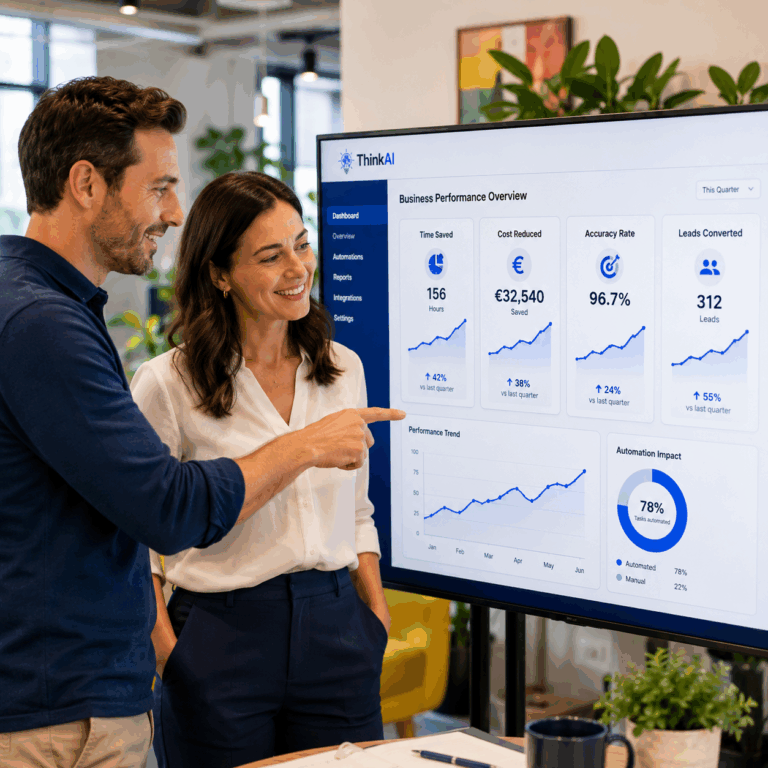


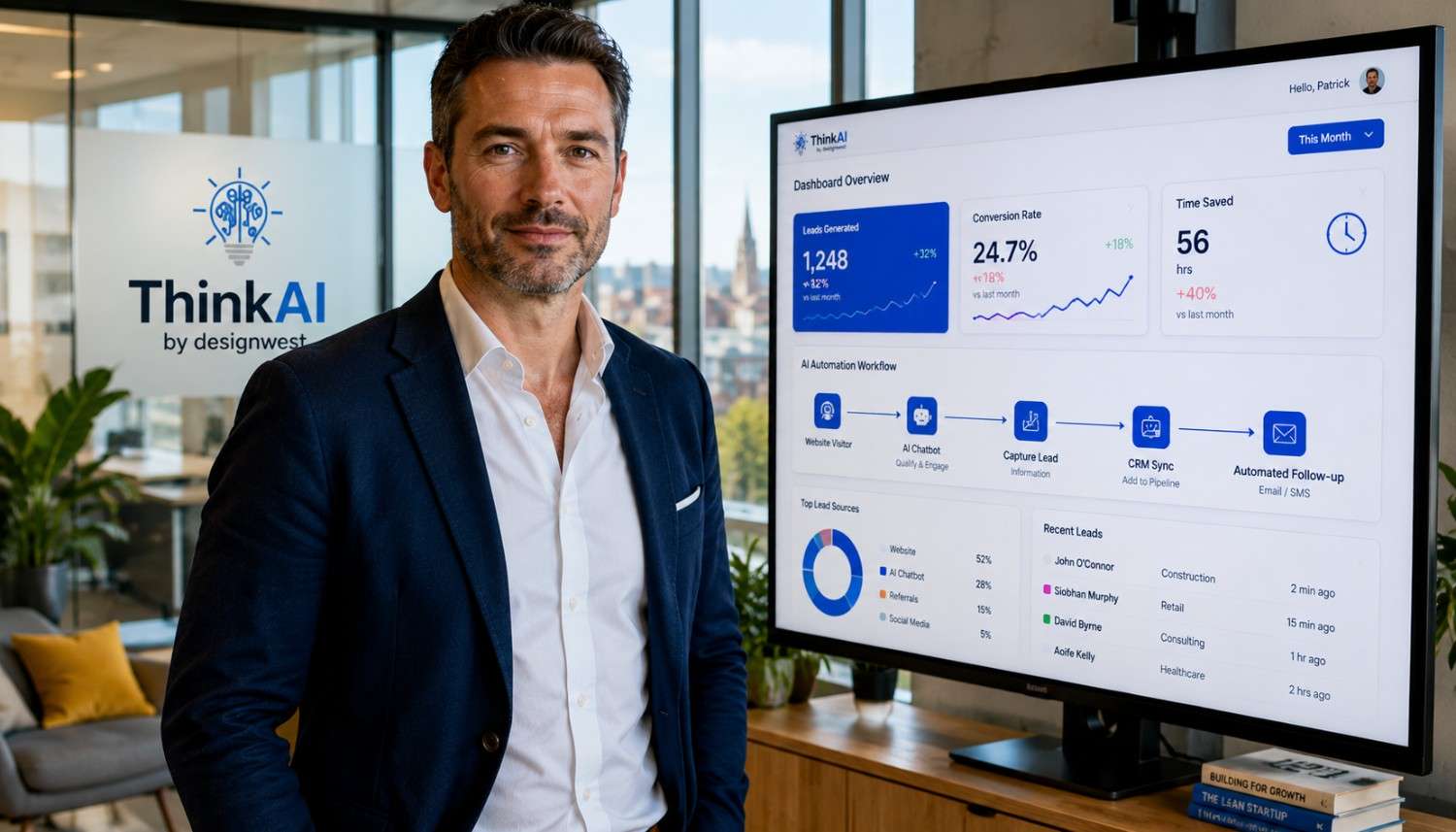
AI adoption refers to the process of integrating artificial intelligence tools into everyday business operations to automate tasks, improve decision-making, and increase efficiency. For Irish businesses, adoption does not require a technical background or a large budget , it requires a clear starting point and a structured plan. With 80% of Irish SMEs believing AI can transform their business but only a fraction having made meaningful progress, the gap between awareness and action is the single most important challenge to address in 2026.
So if 80% of Irish businesses already know AI can help them — what’s actually stopping them from doing something about it?
AI adoption is one of the biggest opportunities available to Irish businesses right now, and honestly, one of the most misunderstood. I talk to business owners across Mayo and beyond every week who know AI matters, but feel stuck between the fear of getting it wrong and the pressure of not getting started at all. If that’s where you are, this guide is for you.
The numbers are stark. A Google and Amárach Research survey of 400 Irish SMEs published in March 2026 found that 20% of businesses are still not using AI for any task whatsoever. Just 7% have fully integrated AI systems. Yet 80% believe it can positively impact their business and 65% expect it to drive growth in 2026. That gap , that gap between belief and action, is exactly where most Irish SMEs are sitting right now.
The reasons are understandable. Fear of making mistakes tops the list at 30%, followed by lack of skills at 27% and cost concerns at 24%. Sixteen percent simply don’t know where to start. These are real barriers, not excuses , and every one of them is addressable with the right approach. AI adoption doesn’t have to be a leap in the dark. It can be a series of small, deliberate steps that build confidence as they build results.
This guide covers what AI adoption actually means for a small Irish business, the most common challenges holding firms back, a practical step-by-step implementation approach, and the real results businesses across Ireland are already achieving. ThinkAI works with SMEs across Mayo, Dublin, and Galway to make this journey straightforward and commercially grounded.
What Is AI Adoption and Why It Matters for Irish Businesses
AI adoption means integrating artificial intelligence tools into your business operations , replacing manual, repetitive tasks with automated systems that handle them faster, more accurately, and without continuous human input. For most Irish SMEs, this does not mean building complex technology from scratch. It means connecting AI tools to the software you already use and letting them handle the work that currently consumes your team’s time.
The reason AI adoption matters for Irish businesses comes down to competitiveness. Research from Trinity College Dublin and Microsoft Ireland shows that AI adoption in Ireland has reached 91%, with AI projected to add at least €250 billion to the Irish economy by 2035. The Viatel and ThinkBusiness research found that the proportion of Irish SMEs with fully integrated AI systems is projected to more than double over the next 12 months, rising from 7% to 17%. Businesses still handling everything manually in 12 months will be operating at a measurable disadvantage.
The barriers are lower than most owners assume. Entry-level AI tools start from €20 to €100 per month. Enterprise Ireland Innovation Vouchers of up to €5,000 are available for feasibility work. A structured pilot project can be live and delivering results within four to six weeks.
How AI Is Transforming Everyday Business Operations
AI is changing day-to-day business operations in three core areas that are directly relevant to any Irish SME:
- Task automation: Routine tasks including invoicing, email routing, scheduling, data entry, and customer query handling are being completed automatically , freeing your team for higher-value work.
- Data-driven decision-making: AI tools process sales, stock, customer, and financial data in real time, surfacing insights that would previously take hours of manual analysis to produce.
- Efficiency at scale: AI systems handle increased volume , more leads, more orders, more queries, without proportionally increasing the cost or headcount required to manage them.
Common Challenges Irish SMEs Face in AI Adoption
The Google and Amárach Research survey identified four main barriers holding Irish businesses back. Understanding them clearly is the first step to getting past them.
Cited by 30% of Irish SME owners, this is the most common barrier nationally. In Mayo and the west of Ireland specifically, 24% of business owners cite this as their primary concern. The solution is not to wait until you feel ready , the solution is to start with a low-risk, clearly defined pilot on one process rather than an organisation-wide rollout.
27% of Irish businesses nationally, and 29% in the west, cite skills as their primary barrier. The tools available in 2026 are significantly more accessible than those of even two years ago , most require no coding at all. Skillnet Ireland training programmes and LEO workshops exist specifically to address this, and many are subsidised.
24% of Irish SMEs cite cost as a barrier. In reality, 60% of Irish businesses planning AI investment in 2026 expect to spend €10,000 or less. With Enterprise Ireland and LEO funding available to offset pilot costs, the financial barrier is considerably lower than most business owners assume.
16% of Irish SME owners simply don’t know where to begin. I’d argue this is the most solvable of all the barriers , with the right conversation and a clear process audit, a starting point can be identified in an hour.
Step-by-Step AI Implementation Strategy for Beginners
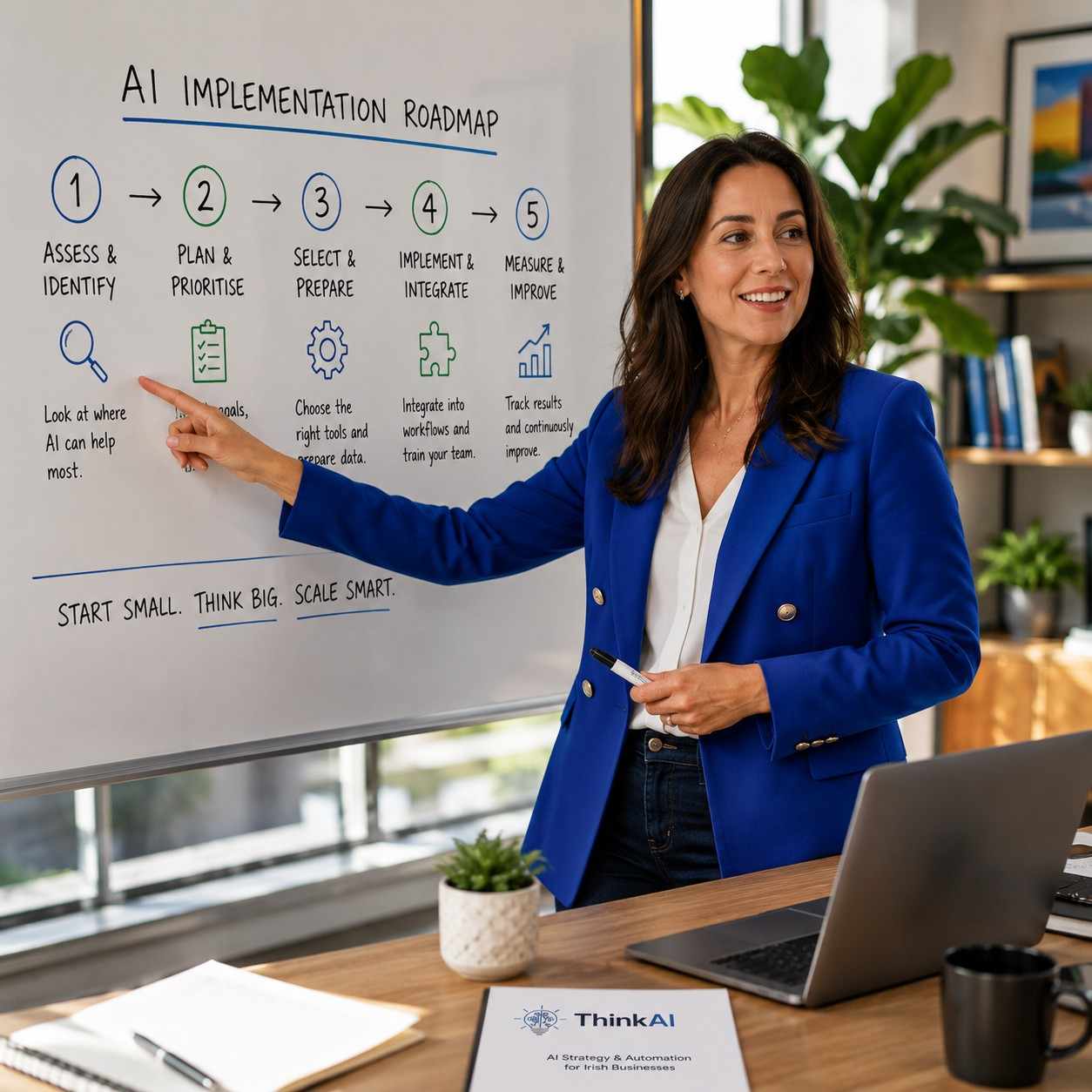
A structured AI implementation strategy removes guesswork and reduces risk. For Irish SMEs, the following five steps provide a practical and achievable path from first interest to live results.
- Identify your most time-consuming, repetitive tasks. List the five or six tasks that consume the most hours across your business each week. Anything that follows a predictable pattern , such as answering the same customer questions, entering data into multiple systems, processing invoices or sending follow-up emails, is a strong automation candidate.
- Set clear, measurable goals before choosing any tools. Define what success looks like in concrete terms: how many hours do you want to save, what error rate do you want to reduce, how quickly do you need to respond to leads? A goal of 'use AI' is too vague. A goal of 'reduce invoice processing time from 6 minutes to under 1 minute' gives you a real target and a measurable outcome.
- Choose tools that integrate with software you already use. The fastest path to live AI for most Irish SMEs is connecting an AI layer to existing tools , including Xero, HubSpot, Shopify and Gmail, using platforms like n8n, Zapier, or HubSpot AI. Avoid buying tools that require replacing your current software stack.
- Start with a pilot project on one process. Pick one workflow, automate it, and measure results over four to six weeks. A Dublin professional services firm that started with lead qualification automation recovered 15 hours of staff time per week from a single deployment. That result made the case for everything that followed. Piloting before scaling is the most important principle of any sound AI implementation strategy.
- Scale gradually using evidence. Once your pilot delivers measurable results, use those results to make the case for the next automation. Assign an internal AI champion to own the rollout. Apply for Enterprise Ireland Innovation Voucher or Skillnet funding to support upskilling as the programme expands.
Real Examples of AI Business Solutions in Ireland
AI business solutions are already delivering measurable commercial results across different sectors in Ireland. These three examples show what is achievable with a focused, well-implemented approach.
A Dublin retail chain with 12 locations implemented AI across four functions following a structured training and implementation programme. Inventory management AI reduced stockouts by 42% while lowering overall inventory costs. A customer recommendation engine increased average basket value by 27%. Staff scheduling AI improved labour efficiency by 18%. Predictive maintenance reduced equipment downtime by 36%. The overall return on the combined training and implementation investment was 215%.
A Galway-based retailer deployed an AI workflow built on n8n and Shopify to monitor stock levels, trigger reorders automatically, handle customer queries around the clock, and draft social media content based on local demand signals. The result was a 12% increase in revenue during promotional weekends and an 80% reduction in manual admin and social media time.
A Mayo-based distributor processing 500 supplier invoices per month used an n8n automation workflow to read invoice PDFs, match them to purchase orders in Xero, and flag discrepancies to the finance team. Processing time per invoice fell from six minutes to 30 seconds. The error rate dropped from 10% to under 1%, eliminating the VAT reclaim losses and payment delays that had previously resulted from manual input mistakes.
Key Benefits of AI Business Automation
The commercial case for AI business automation is now backed by substantial evidence from Irish and international research. The primary benefits for Irish SMEs are:
- Time savings of 15 to 25 hours per employee per week through administrative and workflow automation , the equivalent of adding a part-time resource without the associated employment cost.
- Cost reduction of 20 to 40% on operational processes. Customer service automation alone delivers 40 to 60% savings in support costs, with ROI typically achieved within two to four months.
- Improved accuracy. Automated systems do not make transcription errors or miss follow-ups. Invoice error rates in Irish deployments have fallen from 10% to under 1% following automation.
- Scalability without headcount growth. AI business automation allows an Irish SME to handle more leads, orders, and queries simultaneously without proportionally increasing staff costs.
- Faster, better-informed decisions. AI tools surface live operational data so business owners can act on what is happening now, not on last week's manually compiled report.
Why ThinkAI Is Mayo's Trusted AI Strategy Consulting Partner
ThinkAI is a Mayo-based AI consultancy providing AI strategy consulting, implementation support, and custom AI solutions to Irish SMEs. Whether you’re taking your first steps into AI or ready to scale an existing programme, ThinkAI builds practical, commercially focused solutions around how your business actually operates , not how a generic platform assumes it does.
Services cover the full journey from initial strategy and tool selection through to custom workflow design, CRM integration, GDPR compliance, and ongoing optimisation. ThinkAI works with businesses across Mayo, Dublin, Galway, and beyond, with deep knowledge of the Irish market, the funding supports available, and the compliance requirements that matter.
I’ll be straight — AI adoption isn’t something you can keep putting on the long finger. The businesses that start now, even small, are building an advantage that compounds. The ones that wait are watching that gap widen. The good news is that in Ireland right now, the tools are accessible, the funding is there, and the starting point is simpler than most people think. ThinkAI is here to help you find it.
Contact ThinkAI to request a consultation and start your AI adoption journey with a clear plan and a local expert alongside you.
Key Takeaways
- 80% of Irish SMEs believe AI can benefit their business, but 20% are still not using it for any task. The gap between belief and action is the defining challenge of 2026.
- The top barriers to AI adoption in Ireland are fear of making mistakes (30%), lack of skills (27%), and cost (24%) , all directly addressable with the right approach.
- A structured AI implementation strategy starting with one pilot project is the most reliable path to measurable results for any Irish SME.
- Irish businesses in retail, professional services, and distribution are achieving 215% ROI and saving 15 to 25 hours per week through targeted AI automation.
- Enterprise Ireland, Local Enterprise Offices, and Skillnet Ireland all provide funding and training supports to reduce the cost and risk of AI adoption.
Frequently Asked Questions
AI adoption means integrating AI tools into your business operations to automate tasks, improve decision-making, and increase efficiency. The best starting point is identifying one repetitive, time-consuming task , such as answering customer queries, processing invoices or qualifying leads, and deploying a focused AI solution to handle it. Start small, measure results, and expand from there.
Entry-level AI tools start from as little as €20 to €100 per month. A structured pilot project with external support typically costs €5,000 to €10,000. Enterprise Ireland Innovation Vouchers provide up to €5,000 for feasibility work, and Digitalisation Vouchers offer up to €9,000 for digital transformation consultancy. Most Irish SMEs recoup their initial AI investment within three to six months.
No. The majority of AI tools available in 2026 are designed for non-technical users. No-code platforms like n8n, Zapier, and HubSpot AI use visual interfaces that require no coding. Tools like ChatGPT and Microsoft Copilot are conversational, meaning staff can use them within minutes of signing up. For more complex implementations, working with a specialist like ThinkAI removes the need for in-house technical expertise entirely.
A basic AI automation workflow using a no-code platform can be live within one to two weeks. A structured pilot project from scoping to deployment typically takes four to six weeks. A full AI implementation strategy covering multiple business functions takes three to six months when executed in phases. The most important factor is starting , and even a single automation delivering measurable results builds the confidence and evidence to expand.
The most common mistakes are trying to automate too many things at once, underestimating the importance of clean data, and failing to involve staff early in the process. Poor data is the leading cause of underperforming AI tools. Resistance from staff is also a key barrier , and businesses that frame AI as a tool that frees people from repetitive tasks, rather than a replacement for them, achieve faster adoption and better results.
An AI implementation strategy is a structured plan that defines which business processes you will automate, which tools you will use, how you will measure success, and in what order you will roll out changes. For Irish SMEs, a simple one-page strategy covering your first three to six months is sufficient to start. A strategy prevents wasted investment on tools that don’t fit your needs and ensures each phase builds on the previous one.
The most accessible and commercially proven tools for Irish SMEs are: Microsoft Copilot and ChatGPT for general productivity and content; HubSpot AI for sales and CRM automation; n8n and Zapier for connecting business tools and building workflows; Xero’s AI features for accounting automation; and Intercom or Tidio for AI customer support. The right choice depends on where you are losing the most time and which tools you already use.
Research consistently shows that AI shifts roles rather than eliminates them. The Google and Amárach Research survey of 400 Irish SMEs found that the most common concern about AI is making mistakes, not job losses. Businesses that deploy AI typically free existing staff from repetitive work so they can focus on higher-value tasks , including customer relationships, strategy and business development. The firms seeing the strongest results treat AI as an addition to the team, not a replacement.
Enterprise Ireland Innovation Vouchers provide up to €5,000 for AI feasibility studies. Digitalisation Vouchers offer up to €9,000 for digital transformation consultancy. Local Enterprise Offices provide subsidised advisory support and training grants. Skillnet Ireland funds AI upskilling programmes for existing staff. The government has appointed Ireland’s first Minister for Artificial Intelligence and committed to publishing a sectoral AI Adoption Strategy in 2026 with defined targets per industry.
Yes , and arguably more so. Research from Amárach shows that one-third of micro-businesses with under 10 employees are not yet using AI at all, compared to just 7% of larger SMEs. Smaller businesses that adopt AI now gain a meaningful efficiency and responsiveness advantage over peers still doing everything manually. Every hour saved has a proportionally greater impact on a lean team.
AI business automation means using AI-powered tools to complete business tasks without manual input at every step. Examples include: an AI tool that reads incoming emails and routes them to the right person; an automated workflow that matches supplier invoices to purchase orders in Xero; a chatbot that handles customer queries around the clock; or a system that generates weekly sales reports automatically from CRM data. Each saves hours per week across the business.
Start by listing your three most time-consuming, repetitive tasks. Then look for tools specifically designed to handle those tasks that integrate with software you already use. Avoid buying tools based on features alone , the best AI tool for your business is the one that solves a specific, measurable problem within your existing workflow. If you’re unsure, a one-hour AI strategy consulting session with ThinkAI can map your needs and recommend the right starting point.
AI strategy consulting involves working with a specialist to assess your business processes, identify the highest-value automation opportunities, select the right tools, and build a phased implementation plan. You need it when you’re unsure where to start, when previous AI experiments haven’t delivered results, or when you want to scale beyond basic tools into connected, multi-step automation systems. For Irish SMEs, working with a local consultant who understands the Irish market and GDPR requirements is particularly valuable.
Set a clear baseline before you start. Track time saved per task, error rates before and after automation, lead response times, customer query resolution times, and cost per process. Review these metrics at four weeks and eight weeks after going live. For most Irish SMEs, the most meaningful early indicators are hours saved per week and reduction in manual errors , both directly measurable and both making the ROI case for scaling to the next process.
Most common SME uses of AI , including productivity tools, chatbots, scheduling and admin automation, fall under the limited or minimal risk categories of the EU AI Act and require basic transparency measures. Higher-risk uses in areas like HR screening or credit scoring require more detailed documentation and human oversight. All AI tools handling personal data must comply with GDPR. The EU AI Act reaches full enforcement in August 2026.
Published benchmarks show that Irish SMEs deploying AI in customer service achieve 40 to 60% cost reductions with ROI within two to four months. Administrative automation delivers 15 to 25 hours saved per employee per week. A Dublin retail chain reported 215% ROI on combined AI training and implementation investment. A conservative starting estimate for a focused pilot project is 100 to 150% return in year one, with results improving as the system scales.
Digital transformation is the broader process of moving business operations to digital platforms , such as websites, cloud software and e-commerce. AI adoption is a more specific step within that journey, focusing on using artificial intelligence to automate, predict, and optimise. Most Irish SMEs have already completed basic digital transformation. AI adoption is the next layer: it takes the digital tools you already use and adds intelligence and automation to them.
Involve staff early. Explain that the goal is to remove the tasks they find most repetitive and time-consuming, not to reduce headcount. Identify one or two team members who are naturally curious about technology and make them internal AI champions. Run a short pilot on a low-risk process and show the results. Visible wins build confidence faster than any training course. Skillnet Ireland also offers sector-specific AI literacy training that can be funded for existing staff.
Yes. In most cases AI tools sit on top of the software you already use, connecting and automating the spaces between them. Platforms like n8n and Zapier integrate with over 400 business applications including Xero, HubSpot, Shopify, Gmail, and Microsoft 365. Rather than replacing your existing stack, AI enhances it by removing the manual steps your team currently performs between different tools.
Choose one process that is repetitive, rule-based, and takes up a meaningful amount of your team’s time each week. Write down exactly how it works today, from start to finish. That documentation is the foundation for building your first AI automation. If you want expert guidance on where to start, contact ThinkAI for a consultation and we’ll identify the highest-value AI adoption opportunity for your specific business.
About the Author:
Declan Foley is the founder of ThinkAI.ie and Creative Director at Designwest. He helps Irish businesses unlock growth through AI-powered strategy and digital innovation. Explore how ThinkAI can support your business at ThinkAI.ie.