

How much should a small Irish business budget for AI in the first year if it wants a useful result rather than an expensive experiment?

There is no responsible single figure. Paying for an existing AI tool is fundamentally different from improving a workflow, connecting AI to business systems or building a custom application. A sensible plan separates discovery, testing, implementation and ongoing operation, with the next commitment dependent on evidence from the previous stage.

Start with the business problem, not the tool
The first budget decision is not which software to buy. It is which process is worth improving, what information it uses and what a worthwhile result would look like.
The Central Statistics Office reported that 20.2% of Irish enterprises used AI in 2025. The figure was 17.2% for small enterprises, compared with 57.7% for large enterprises. The most common uses included data mining, natural-language generation and workflow automation or decision support. See the CSO’s 2025 enterprise AI figures.
That does not mean every small business needs an enterprise-scale programme. It means the starting point should be specific: reduce repetitive administration, improve enquiry handling, organise information, support sales or make an internal process easier to manage. Before setting a budget, define the current process, the systems and data involved, the human checks required, the risk of failure and the measure that will show whether the work is worthwhile.
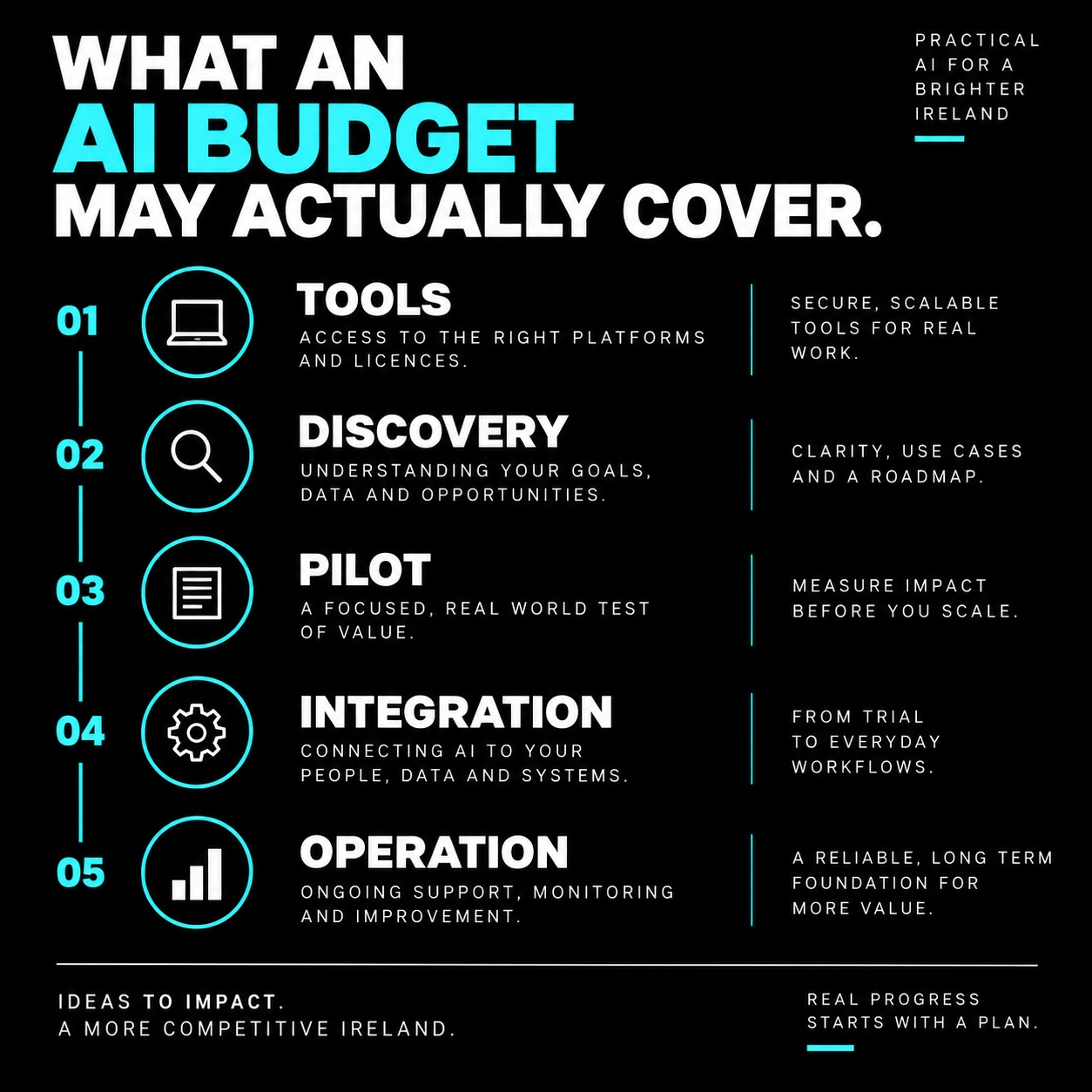
What an AI budget may actually cover
- Tools and subscriptions: an existing product such as ChatGPT or Copilot, plus user access and usage limits.
- Discovery and strategy: process mapping, use-case selection, data review, risk assessment and a practical roadmap.
- Configuration or a pilot: adapting an existing tool to one workflow, preparing controlled data, testing outputs and training users.
- Automation: connecting process steps with suitable checks and fallback procedures.
- Integration: linking AI to a CRM, ERP, website, document store or other live system.
- Custom development: a bespoke system where existing tools cannot meet the need.
- Operation: usage, monitoring, human review, security, maintenance, support and later changes.
These items are not interchangeable. A monthly software subscription may be enough for individual productivity, but it does not cover safely integrating AI into a customer or operational process. Separate upfront costs from ongoing costs. Upfront work may include discovery, data preparation, configuration, integration, testing, documentation and training. Ongoing costs may include software or API usage, monitoring, human review, support, security updates and maintenance.
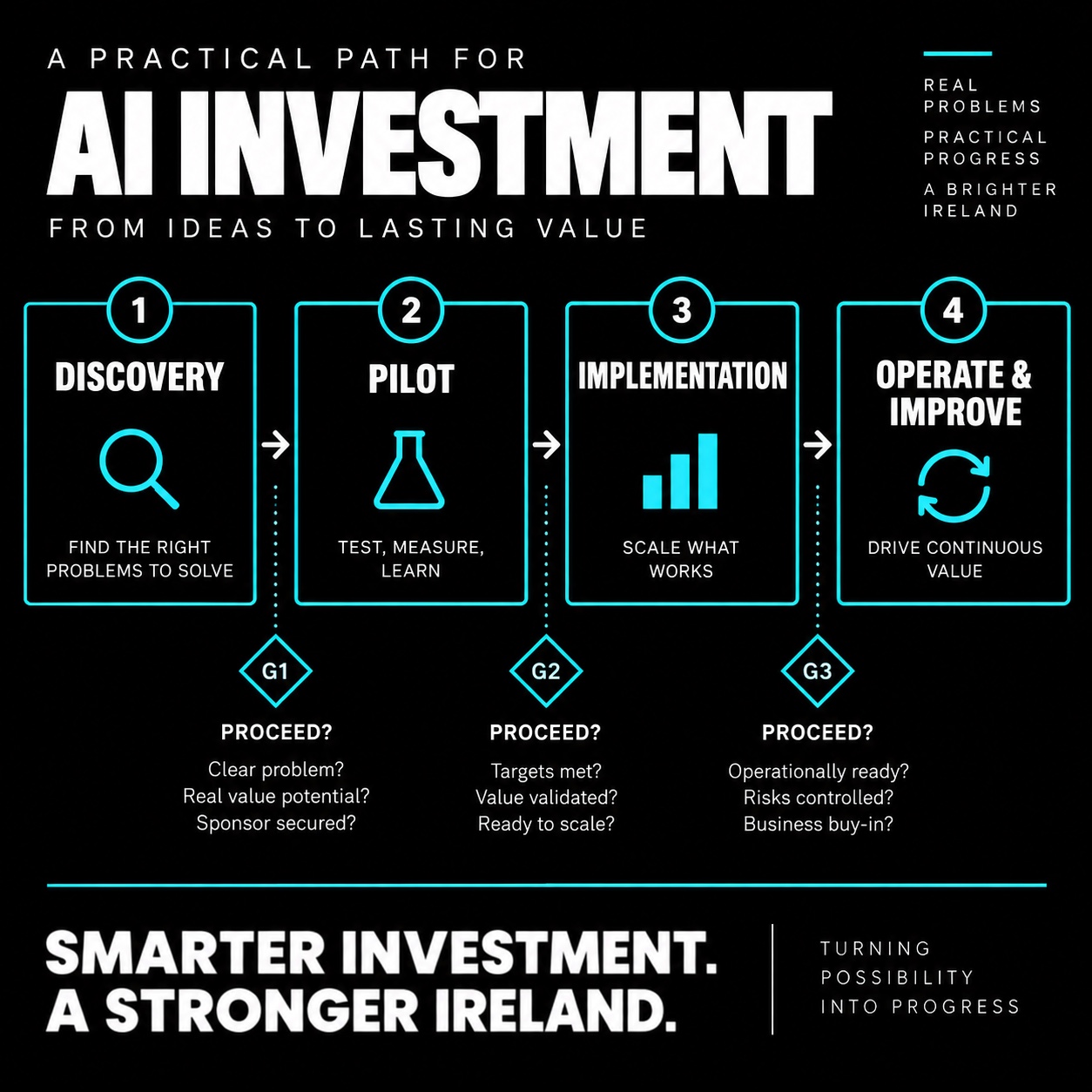
A practical four-stage AI budget
1. Discovery and definition
The first stage establishes whether the opportunity is real. The output should identify the use case, expected benefit, risks, owner, success measure and next decision. It should also say when not to proceed. Enterprise Ireland’s AI Discovery support is one official route businesses can investigate. Confirm current eligibility and terms directly before including support in a budget.
2. Pilot and proof
Choose one workflow, a limited user group and a defined review period. Use representative but controlled data, document the human checks and compare the result with the existing process. Budget for configuration, data preparation, testing, training and review time. A pilot should produce a decision to stop, refine or proceed.
3. Implementation and integration
Costs rise when AI must connect to live systems or influence customer-facing work. Allow for permissions, data flows, authentication, exception handling, monitoring, security review and fallback procedures. Decide who owns the system after launch and include time for staff questions and documentation.
4. Support and improvement
An AI project is not finished when it goes live. Plan for quality checks, usage review, staff support, workflow refinement, security updates and a regular decision about whether the system is still earning its place.
Use budget gates instead of one large commitment
- Understand: define the problem, options and risks.
- Test: run a narrow pilot with a measurable outcome.
- Decide: review evidence before wider implementation.
- Operate: fund ownership, monitoring, support and improvement.
This approach makes the budget conditional. A business can stop after discovery if the case is weak, or stop after a pilot if the result does not justify a larger build. The existing guide on the cost and value of AI development provides useful context, but this article focuses specifically on staged budgeting for a smaller first-year decision.
Connect the budget to a measurable result
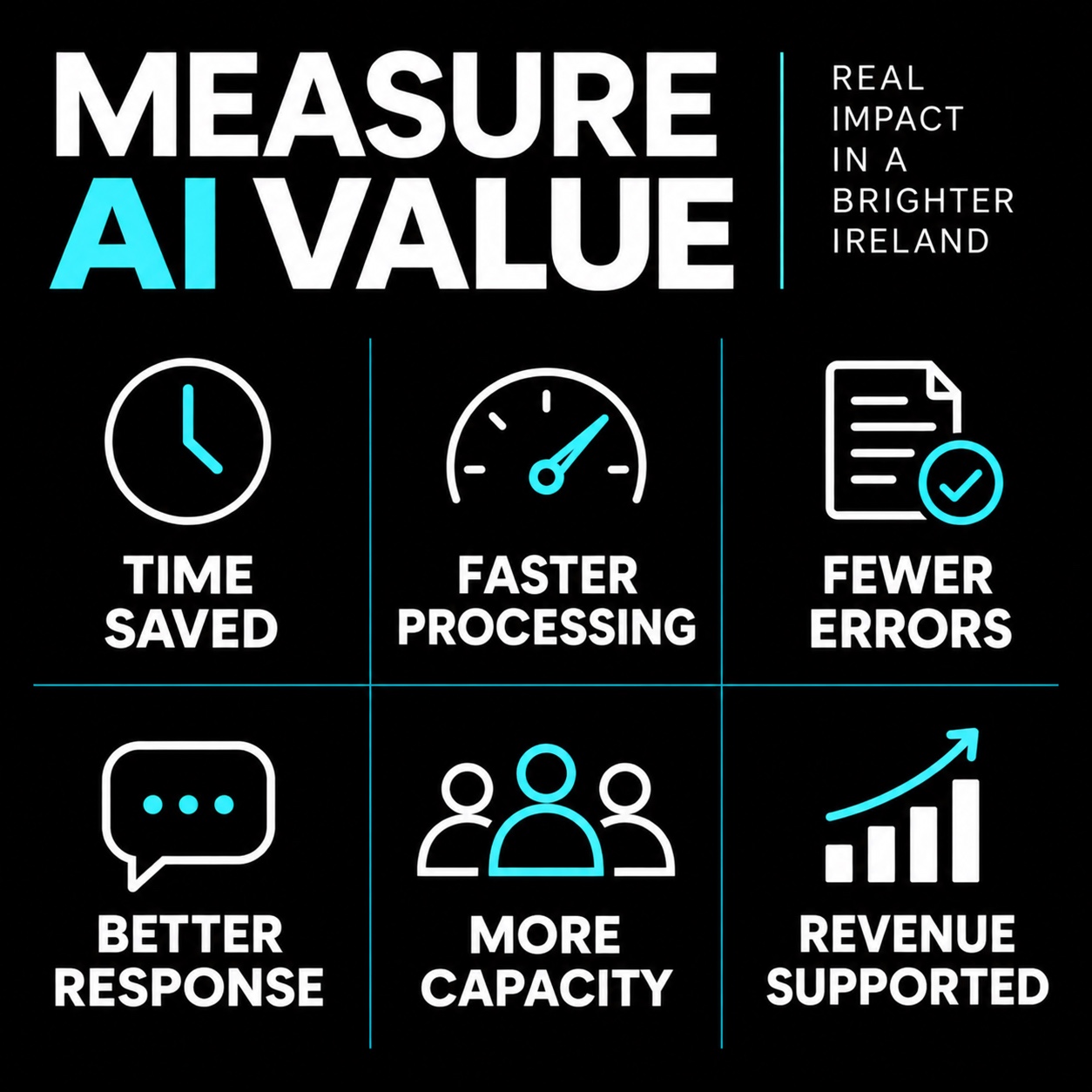
Return on investment should be discussed before implementation. Useful measures might include staff hours saved, faster processing, fewer errors, improved response times, better lead handling or additional capacity. Do not claim that AI automatically reduces headcount or creates savings. Saving employee time has commercial value only when that capacity can be redeployed productively. Treat any worked calculation as an illustration, not a guaranteed return.
Include governance in the estimate
If personal or commercially sensitive information is involved, budget for access controls, data handling, retention, human review and security. The Data Protection Commission’s guidance on AI and data protection explains why organisations need to understand what data an AI product receives, where it goes and how it is used.
The European Commission’s AI Act guidance is an official reference, but this article is not legal advice. The relevant obligations depend on the system, its use and the organisation’s role. Confirm the current position before making a compliance decision.
The right budget is the one you can operate
The right first-year AI budget is the smallest controlled commitment that can answer a real business question. It should show what is being tested, what is included, who checks the result, what happens when it fails and what ongoing cost is acceptable.
ThinkAI helps Irish businesses assess practical AI opportunities, define sensible roadmaps and move from a clear business problem to a controlled implementation. Request a consultation if you need help deciding which level of investment makes sense.
Frequently asked questions
Is there a standard price for AI implementation in a small Irish business?
No single price applies. The cost depends on the process, data, integrations, users, risk and support required. A staged estimate is more useful because it shows what each commitment delivers.
Should a small business start with a chatbot?
A chatbot is only one option. It may suit a business with a clear customer-service use case and well-maintained information, while another business may benefit more from internal search, document handling or workflow automation.
Can Irish businesses get help with AI discovery?
Some businesses may be eligible for supports such as Enterprise Ireland’s AI Discovery or other digital programmes. Check current eligibility, application requirements and terms with the relevant official body before relying on support.
What should I ask an AI consultant before agreeing a budget?
Ask what problem is being solved, what each stage includes, what assumptions the estimate makes, who owns the system after launch, how quality and data protection will be handled, and what happens if the pilot does not justify wider rollout.
About the author
Declan Foley is founder and creative director of ThinkAI, working across design, websites, creative direction and practical AI integration.
