

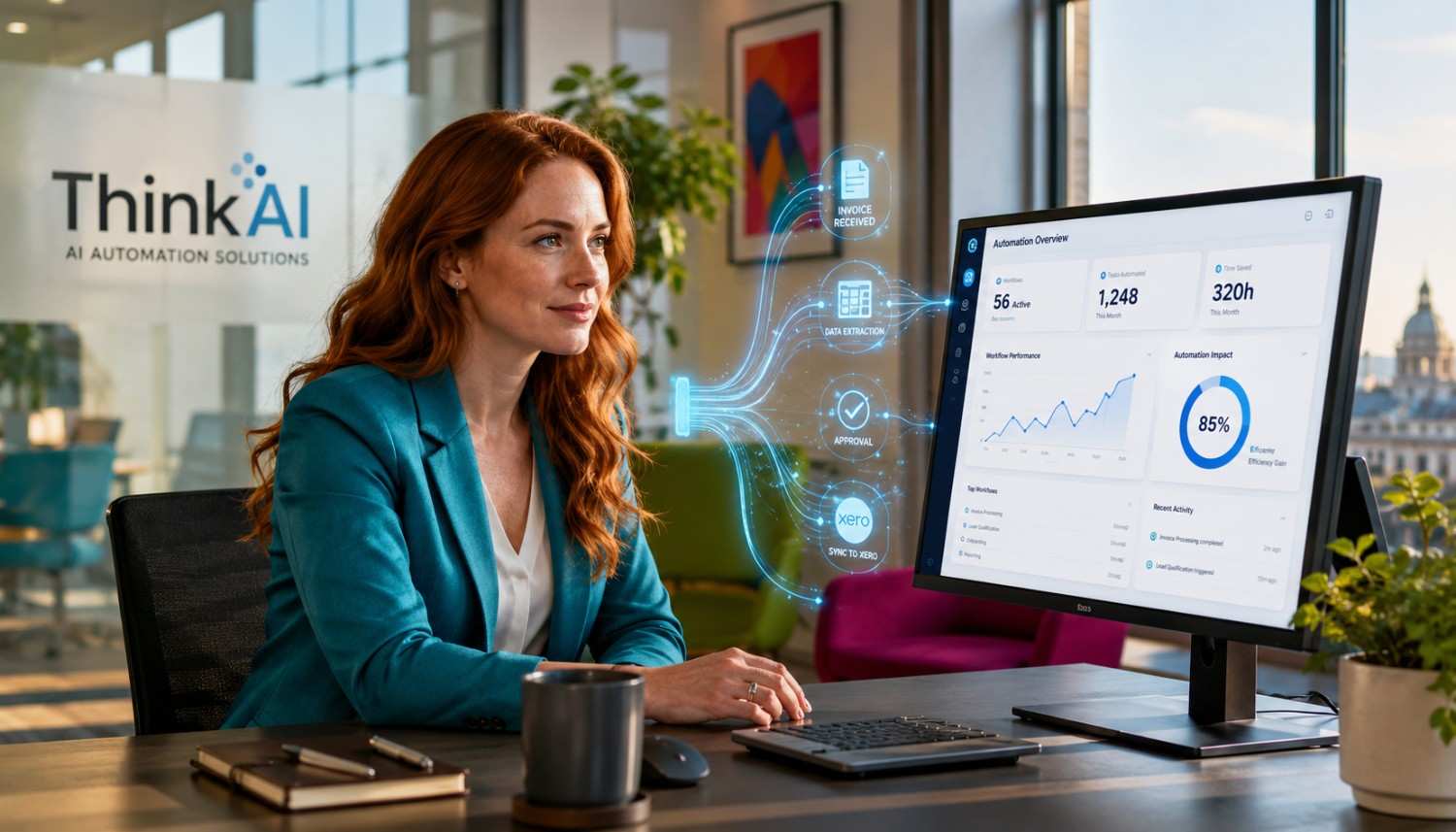
AI automation for SMEs Ireland refers to the use of intelligent software tools to handle repetitive, time-consuming tasks such as data entry, customer follow-up, invoicing, and scheduling, without continuous human input. Irish SMEs currently lose an average of nine hours per week to manual administration alone, and businesses deploying targeted AI automation are recovering 15 to 25 hours per employee per week. With the right tools and a clear starting point, any Irish SME can begin saving meaningful time within weeks.
AI automation for SMEs Ireland is no longer a future-facing technology. It is a practical, commercially accessible toolkit that Irish businesses are using right now to reclaim hours lost to repetitive admin, slow follow-ups, and disconnected systems. The question is no longer whether AI can help, but how quickly you can start.
The scale of the problem is well documented. According to the Irish SME HR Report 2025, Irish businesses spend an average of nine hours per week on manual HR administration alone, equating to more than 58 working days per year and up to €22,000 in annual productivity loss. Separate research from Monzo found that 55% of Irish SME owners cite expense management as their single most time-consuming task, while financial admin across the sector could be costing Ireland over €2.1 billion a year in lost productivity.

At the same time, the opportunity has never been clearer. A 2026 survey by OpenAI found that 89% of Irish SME leaders are now using AI tools at work, saving an average of 5.3 hours per week from basic use alone. Businesses that move beyond simple tools into connected AI workflow automation are reporting savings of 15 to 25 hours per employee per week. That is the difference between a business that is surviving and one that is scaling.
This blog covers what AI automation for SMEs in Ireland actually involves, where businesses are losing the most time, the real-world results others are achieving, and the practical steps to get started. ThinkAI works with Irish businesses across Mayo and beyond to build these systems from the ground up.
What Is AI Automation for SMEs Ireland?
AI automation for SMEs Ireland means using software powered by artificial intelligence to complete tasks that would otherwise require manual effort from a person. Rather than replacing your team, it removes the work that slows them down, allowing staff to focus on judgement, customer relationships, and growth.
In practical terms, this includes tools that automatically respond to customer enquiries, match invoices to purchase orders, qualify incoming leads, schedule appointments, generate reports, and trigger follow-up emails based on customer behaviour. None of these tasks require a specialist. Most can be set up using no-code platforms that connect to tools Irish businesses already use, such as Xero, HubSpot, Shopify, and Gmail.
The shift from manual to automated workflows does not require a large upfront investment. The average cost of integrating an AI solution for an SME has dropped by 80% between 2023 and 2026, from approximately €15,000 to around €3,000, according to McKinsey research. Entry-level tools cost as little as €20 to €100 per month, with ROI typically achieved within one to three months for administrative automation. This makes advanced technologies increasingly accessible to SMEs that previously relied on robotic process automation or manual workflows.
How AI Workflow Automation Works in Daily Business Tasks
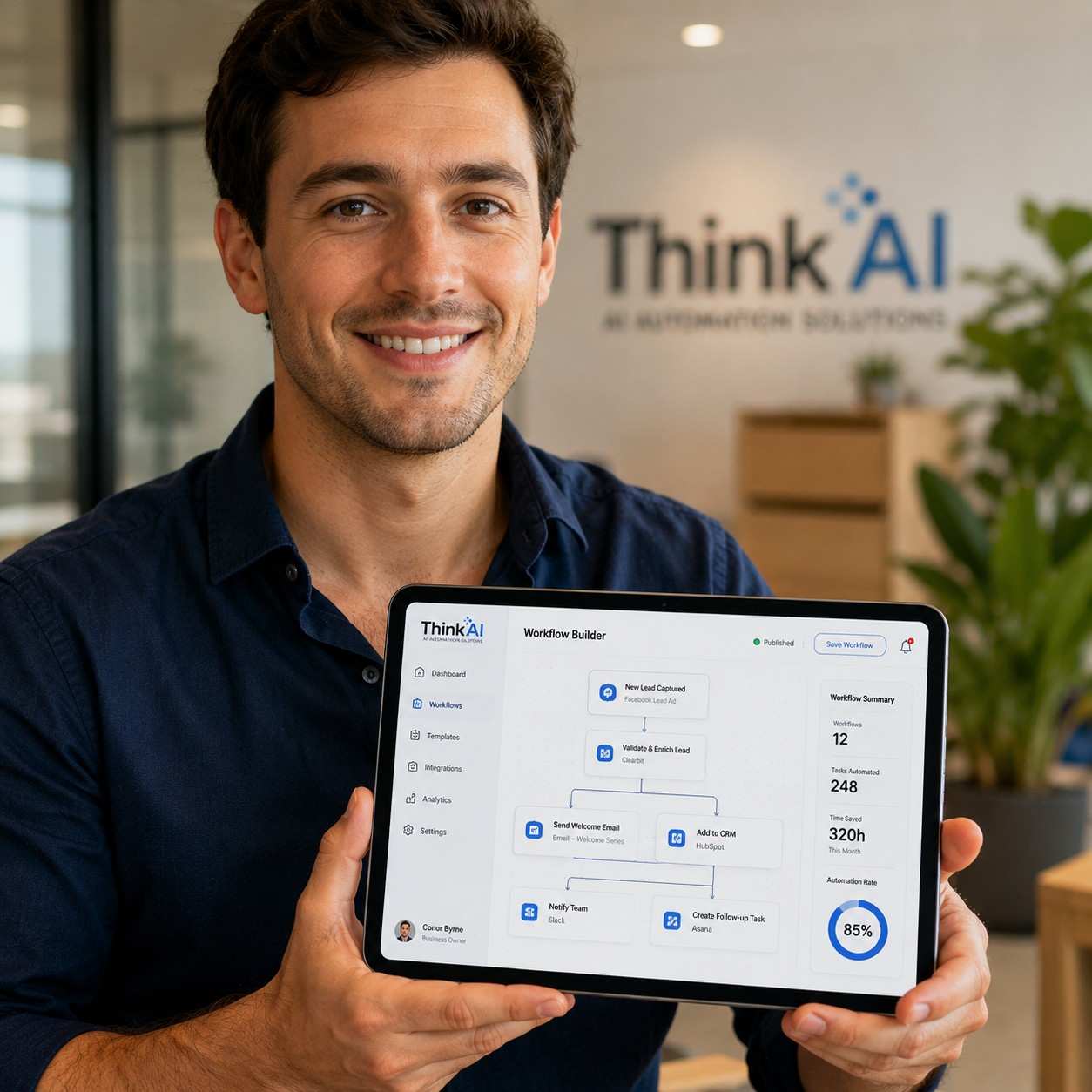
AI workflow automation works by setting up trigger-and-action sequences that run automatically when a specific event occurs. For example: a new enquiry arrives on your website, the AI qualifies it based on set criteria, updates your CRM, and sends a personalised reply, all within seconds and without any human involvement.
Common daily tasks that AI workflow automation handles for Irish SMEs include:
- Routing and responding to inbound emails and website messages
- Logging data from forms, bookings, or transactions directly into your CRM or accounts software
- Sending automated follow-up sequences after a consultation, purchase, or enquiry
- Generating weekly reports from data already held in your existing tools
- Scheduling appointments and sending reminders without staff involvement
Where Irish SMEs Lose Time Without Automation
Manual processes create invisible drains on time that accumulate across every department. The impact is most visible in four core areas.
Research from HRLocker found that 73% of Irish SMEs regularly enter the same employee or customer data into multiple systems. Every duplicated entry is a margin for error and a drain on staff time. In finance and operations, this compounds: invoices get delayed, errors occur, and VAT reclaim opportunities are missed.
Answering the same customer questions, sending the same follow-up emails, and completing the same weekly reports consumes hours that could be spent on billable work or business development. The Monzo Money Pulse research found that chasing payments from customers and suppliers ranks among the top three most time-consuming tasks for Irish SME owners.
When leads are handled manually, response times suffer. A slow reply to an inbound enquiry is often a lost sale. Automated follow-up sequences ensure every lead receives an immediate response, regardless of when they make contact.
Most Irish SMEs use between four and eight different software tools, with no connection between them. Staff act as the manual glue, copying information from one platform to another. Integration platforms like n8n, Zapier, and Make resolve this by connecting tools so data flows automatically between them.
Real Examples of Business Automation with AI in Ireland
Business automation with AI is already delivering measurable results for Irish SMEs across different sectors. The following examples illustrate the kinds of outcomes that are achievable with a focused, well-implemented approach.
A Galway-based clothing retailer used an AI automation workflow built on n8n and Shopify to monitor stock levels, automatically trigger reorder notifications, and send personalised marketing messages based on purchase history and local weather data. The result was a 12% increase in auxiliary revenue during promotional weekends and an 80% reduction in time spent on manual social media drafting. Staff previously spending several hours per week on these tasks were redirected to customer service and in-store operations.
A Dublin-based professional services firm handling 100 or more inbound leads per week deployed an AI sales workflow using CrewAI and HubSpot. The system qualified leads automatically, enriched contact data, and sent personalised meeting invites to qualified prospects within minutes of their initial enquiry. Response times dropped from hours to under two minutes. Conversion from initial lead to booked meeting increased by 22%, and the equivalent of 15 hours of partner time per week was recovered.
A Mayo-based distributor processing 500 supplier invoices per month used an n8n automation workflow to read invoice PDFs, match them to purchase orders in Xero, and flag any discrepancies to the finance team. Processing time per invoice dropped from six minutes to 30 seconds, and the manual error rate fell to under 1%. Across 500 invoices monthly, this represented over 40 hours saved each month in the finance function alone.
Steps to Implement AI Automation for SMEs Ireland
Implementing AI automation for SMEs in Ireland does not require a technical team or a large budget. A structured, step-by-step approach reduces risk and delivers results faster. ThinkAI’s AI integration services follow this framework with every client.
Key Compliance Obligations
1. Identify your most repetitive tasks.
Start by listing the five or six tasks that consume the most time each week across sales, admin, finance, and customer service. Focus on anything rule-based, repetitive, and data-driven. These are your strongest automation candidates.
2. Choose the right tools for your starting point.
For most Irish SMEs, no-code platforms such as n8n, Zapier, or HubSpot AI are the fastest route to live automation. If you are already using Xero, HubSpot, or Shopify, these platforms integrate directly. Start with one workflow, not five.
3. Use AI integration services to connect your existing tools.
You do not need to replace the software your team already uses. AI integration services build the connections between your existing tools so data flows automatically, without manual re-entry. Enterprise Ireland Innovation Vouchers of up to €5,000 are available to support this kind of feasibility work.
4. Test workflows before going live.
Run your automation on a small batch first. Check that data is moving correctly, errors are being flagged, and the output matches what a human would produce. Adjust prompts and logic before scaling.
5. Scale once you have a result.
Once one workflow is delivering measurable time savings, expand to the next process. Skillnet Ireland offers training programmes to help existing staff build confidence with AI tools so that scaling does not depend solely on external support.
Why ThinkAI Is Mayo's Trusted AI Partner
ThinkAI is a Mayo-based AI consultancy that builds practical AI automation solutions for Irish SMEs. Rather than selling generic software subscriptions, ThinkAI designs custom workflows tailored to how your business already operates, connecting the tools you use and automating the tasks that are costing you the most time.
Services range from initial AI strategy support to full implementation of multi-step automation systems across sales, finance, operations, and customer service. All solutions are built with GDPR compliance and EU AI Act requirements in mind, so you can scale with confidence. Whether you are starting with your first automated workflow or ready to connect your entire business stack, ThinkAI provides the local expertise and hands-on delivery to get it done.
Key Benefits of AI Automation for SMEs Ireland
The commercial case for AI automation is now backed by solid data from Irish and international research. The primary benefits fall into five categories.
- Time savings of 20 or more hours per week. Administrative automation alone saves between 15 and 25 hours per employee per week according to observed SME case studies. For an owner or manager currently spending two hours a day on tasks that could be automated, that is 10 hours per week returned to revenue-generating activity.
- Cost reduction. SMEs using AI achieve an average of 23% savings on operational costs through automation of repetitive tasks. Customer service automation alone delivers a 40 to 60% reduction in support costs, with ROI typically achieved within two to four months.
- Improved accuracy. Automated systems do not make transcription errors, miss VAT entries, or forget to follow up. The Mayo-based distributor example above saw its invoice error rate fall from 10% to under 1% following automation.
- Faster decision-making. Generative AI for businesses is also delivering value in analysis and reporting, helping managers access the data they need in seconds rather than building reports manually.
- Scalability without headcount growth. Automated workflows allow an Irish SME to handle increased volume, whether in leads, orders, or customer queries, without proportionally increasing staff costs.
Key Takeaways
- AI automation for SMEs Ireland is already in use across retail, professional services, and manufacturing, delivering time savings of 20 or more hours per week.
- Irish SMEs lose an average of nine hours per week to manual HR and admin tasks alone, with financial admin costing the sector over €2.1 billion annually in lost productivity.
- No-code platforms like n8n and Zapier, combined with tools already in use such as Xero and HubSpot, are the fastest route to live automation for most Irish businesses.
- Enterprise Ireland Innovation Vouchers and Skillnet training programmes are available to reduce the cost and risk of getting started.
- Scalability without headcount growth. Automated workflows allow an Irish SME to handle increased volume, whether in leads, orders, or customer queries, without proportionally increasing staff costs.
Frequently Asked Questions
1. What is AI automation for SMEs in Ireland?
AI automation for SMEs in Ireland means using intelligent software to handle repetitive business tasks such as data entry, invoice processing, customer follow-up, and scheduling, without manual input. These systems connect to tools already in use, including Xero, HubSpot, and Shopify, and run automatically once configured. The goal is to free staff from low-value tasks so they can focus on work that drives growth.
2. How many hours per week can AI automation actually save?
Research shows that administrative automation alone saves between 15 and 25 hours per employee per week. Irish SMEs currently lose an average of nine hours per week to manual HR admin alone, with some losing over 16 hours. Businesses that move from basic AI tool use to connected workflow automation report saving 20 or more hours across the business each week.
3. How much does it cost to start with AI automation in Ireland?
Entry-level tools cost between €20 and €100 per month. A pilot project designed and implemented by an AI consultant typically runs from €5,000 to €10,000. Enterprise Ireland Innovation Vouchers of up to €5,000 are available to fund feasibility work, which can significantly offset the initial investment.
4. What tasks are best suited to AI automation for Irish SMEs?
The best starting points are tasks that are repetitive, rule-based, and data-driven. Common examples include invoice matching, lead qualification, customer follow-up emails, appointment scheduling, report generation, and responding to standard customer enquiries. These tasks are high-volume, low-complexity, and directly measurable.
5. Do I need technical staff to implement AI automation?
No. Most AI automation tools available in 2026 are no-code or low-code platforms designed for non-technical users. Platforms like n8n and Zapier use visual workflow builders where you connect apps and set up triggers without writing any code. ThinkAI also provides full implementation support so you do not need in-house technical expertise to get started.
6. What is AI workflow automation and how is it different from basic AI tools?
AI workflow automation is a connected series of automated actions that runs across multiple tools in sequence. Unlike a standalone AI tool that helps with a single task, workflow automation links your entire business process, for example, from a customer enquiry through to CRM update, follow-up email, and calendar booking, all without any manual steps between them.
7. Is AI automation GDPR-compliant for Irish businesses?
Yes, when implemented correctly. Irish businesses must ensure that any AI tool handling personal data uses GDPR-compliant infrastructure, conducts a Data Protection Impact Assessment where required, and limits data processing to what is necessary. EU-based or self-hosted platforms like n8n offer strong data sovereignty controls, which is important for businesses wary of sending sensitive data to foreign servers.
8. What AI integration services does ThinkAI offer?
ThinkAI provides end-to-end AI integration services covering workflow design, tool selection, system connection, testing, and ongoing optimisation. Services include connecting existing tools like Xero, HubSpot, and Shopify to AI automation layers, building custom lead qualification and customer service workflows, and providing strategy support to help businesses identify their highest-value automation opportunities.
9. How long does it take to see results from AI automation?
For simple workflows such as email automation or invoice processing, first results are typically visible within two to four weeks of going live. ROI on administrative automation is usually achieved within one to three months. More complex multi-step workflows connecting several tools may take four to eight weeks to design, test, and deploy.
10. Will AI automation replace my staff?
No. Research consistently shows that AI automation shifts roles rather than eliminating them. The Irish SME context is particularly clear on this: most businesses deploy automation
to handle low-value repetitive tasks so that existing staff can focus on higher-value work including strategy, customer relationships, and business development. AI handles the admin; your team handles the judgement.
11. What tools do Irish SMEs typically use for AI automation?
The most commonly deployed tools among Irish SMEs are n8n, Zapier, and Make for workflow automation; HubSpot and Salesforce for CRM-integrated AI; Xero for accounts automation; Intercom and Tidio for AI customer service; and OpenAI and Claude for generative AI tasks. The right combination depends on your existing tech stack and the processes you want to automate first.
12. What is business automation with AI versus traditional automation?
Traditional automation follows fixed, pre-defined rules. Business automation with AI adds a reasoning layer, allowing the system to handle variation, interpret unstructured inputs like emails or documents, and adapt to changing conditions. This means AI automation works on messy, real-world inputs rather than only clean, perfectly formatted data.
13. What funding supports are available for AI automation in Ireland?
Enterprise Ireland offers Innovation Vouchers worth up to €5,000 for AI feasibility studies. Local Enterprise Offices provide digitalisation grants and subsidised training. Skillnet Ireland funds sector-specific upskilling programmes that cover AI tool adoption for existing staff. These supports are designed to reduce the financial risk of early-stage AI investment for Irish SMEs.
14. What is generative AI for businesses and how does it fit into automation?
Generative AI for businesses refers to AI tools that can create content, draft communications, summarise documents, and generate data-driven reports. In an automation context, generative AI sits inside your workflows to produce personalised emails, process natural language inputs from customers, and generate output that a rule-based system alone could not produce. Tools like ChatGPT and Claude are commonly used in this way.
15. How do I choose between n8n, Zapier, and Make for my business?
Zapier is the most accessible starting point for non-technical teams wanting to connect popular apps quickly. Make offers more visual workflow design and is stronger for complex branching logic. n8n is the most powerful and supports self-hosting, which is important for Irish businesses with strict data sovereignty requirements. ThinkAI can help assess which platform fits your current needs and future scale requirements.
16. Can AI automation help with customer service in an Irish SME?
Yes. AI-powered customer service tools can handle between 70 and 85% of standard enquiries automatically, providing instant responses 24 hours a day. For Irish businesses where out-of-hours enquiries are common, this prevents lost leads and improves customer experience. Automation handles the routine; your team handles the relationships that require a personal response.
17. What are the most common mistakes Irish SMEs make when starting with AI automation?
The most common mistakes are trying to automate too many things at once, underestimating the importance of data quality, and not measuring results against a clear baseline. Poor data is the primary reason AI automations underperform: if your records are spread across spreadsheets and email threads, clean and centralise them before deploying automation. Start with one workflow, prove the ROI, and expand.
18. How does AI automation improve accuracy and reduce errors?
Automated systems do not make transcription errors, forget to follow up, or miss fields when entering data. Research from Irish use cases shows that invoice processing errors dropped from 10% to under 1% following automation with n8n and Xero. In customer communications, automation ensures every lead receives a consistent, timely response with the correct information.
19. Is AI automation only for larger Irish businesses?
No. AI automation is now accessible and cost-effective for businesses of any size. The tools most commonly used by Irish SMEs require no technical expertise to set up and cost a fraction of what they did three years ago. In fact, smaller businesses often benefit more because every hour saved has a proportionally greater impact on a lean team.
20. Where should I start if I want to implement AI automation for my Irish SME?
Start by identifying the single most time-consuming, repetitive task in your business and build one automation workflow around it. Measure the time saved over four to six weeks, then expand. If you are unsure where to begin, contact ThinkAI for a consultation. ThinkAI will map your current processes and identify the highest-value automation opportunities specific to your business.
About the Author:
Declan Foley is the founder of ThinkAI.ie and Creative Director at Designwest. He helps Irish businesses unlock growth through AI-powered strategy and digital innovation. Explore how ThinkAI can support your business at ThinkAI.ie.