

Artificial intelligence has officially moved from “innovation theatre” to a critical, competitive capability for companies across the Republic. In 2025, official data revealed that roughly one-fifth of Irish enterprises utilized AI, a significant jump from 15% just a year prior. However, this momentum has also exposed a widening capability gap, as large enterprises adopt at nearly three times the rate of smaller firms. For leaders in the West, AI adoption Ireland is no longer a choice between “if” and “when”—it is a matter of “how” to do it responsibly while securing a measurable return on investment.
At ThinkAI, we see that staying ahead in the Irish market requires more than just installing a new tool; it requires a strategic alignment with local supports and European regulations. This guide provides a pragmatic roadmap for Irish SMEs and mid-market firms to move from ad-hoc experimentation to a fully operationalized AI capability.
From Experimentation to Value: AI for Irish Businesses
For many businesses in Galway and beyond, the initial excitement of generative AI has met the reality of implementation barriers. Common challenges include skills gaps, messy data foundations, and uncertainty regarding the EU AI Act. We advocate for moving beyond “bolted-on” AI toward a model where intelligence is integrated into your core business processes.
Sustainable advantage in the Irish market doesn’t come from the tools themselves—which any competitor can buy—but from the system you build around them. This includes your proprietary data, fast learning loops, and, most importantly, the human expertise embedded in your workflows.
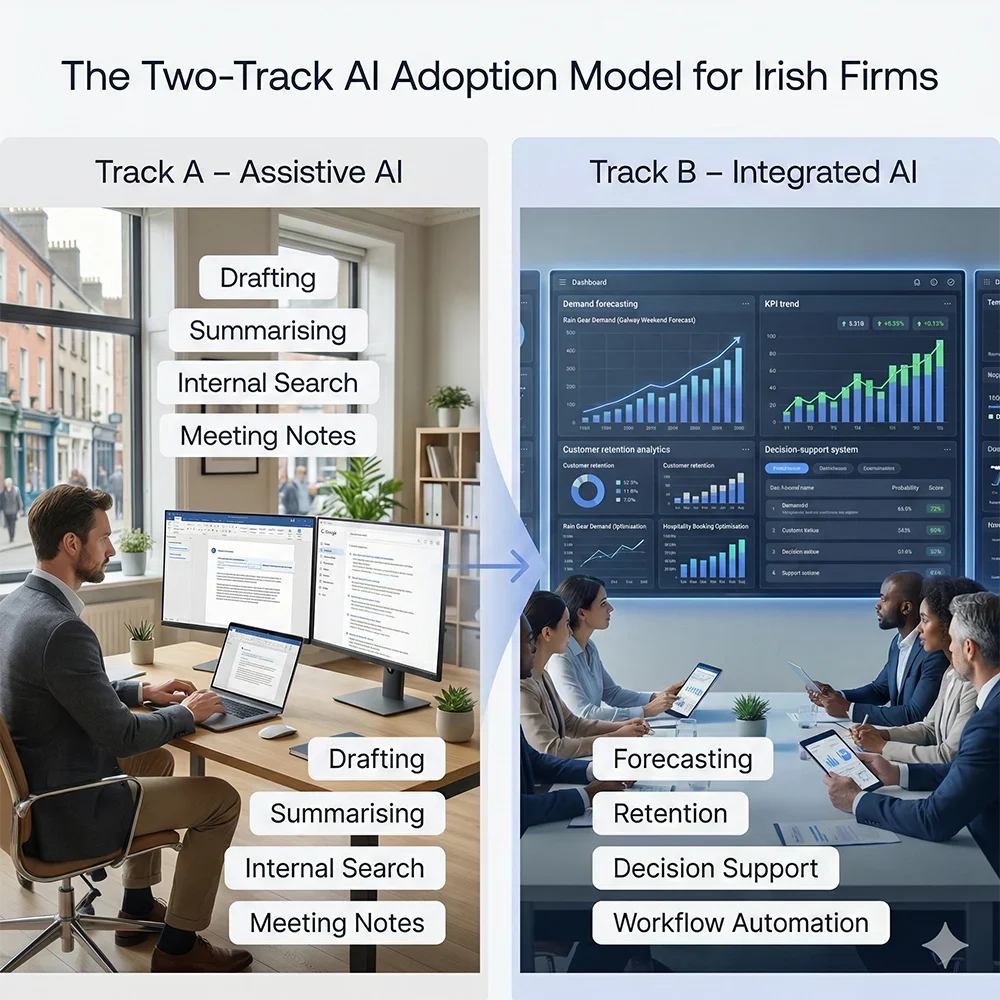
A Two-Track Adoption Model
To move fast without creating uncontrolled risk, we recommend a parallel approach
- Track A (Assistive AI): Focus on low-integration tasks like drafting, summarizing, and internal knowledge search to build immediate literacy
- Track B (Integrated AI): Focus on core processes like demand forecasting, proactive customer retention, and decision-support systems
Galway’s Innovation Ecosystem as a Strategic Advantage
Galway has successfully transitioned from a global MedTech leader to a premier hub for applied data science and AI. Local firms have access to a dense network of innovation hubs that provide the “test-before-invest” environments essential for small businesses.
- The PorterShed: Home to over 65 tech start-ups, this hub facilitates the AI Venture Forge, Ireland's first accelerator dedicated exclusively to AI.
- Galway City Innovation District: Projects like the Bowling Green development are set to house hundreds of tech entrepreneurs, fostering a peer-learning environment.
- Regional Talent: The University of Galway and the Insight Centre for Data Analytics ensure a steady stream of research-connected talent for the West.
Funding the Frontier: Grants for AI Strategy for SMEs
One of the best ways to stay ahead is to use Ireland’s robust support landscape to de-risk your early AI work. You don’t have to fund your digital transformation in isolation.
For firms with 1–50 employees, LEO Galway is the primary entry point.
- Digital for Business: Offers three days of free expert consultancy (worth approx. €2,700) to create your AI roadmap
- Grow Digital Voucher: Provides up to €5,000 at 50% matched funding for software, training, and configuration.
- Technical UI: Implement a 2-second "think time" and typing indicators to mimic human patterns.
For larger or export-focused SMEs, the Digital Discovery support funds early-stage investigation with grants covering up to 80% of costs (maximum €5,000). Once validated, businesses can move toward an AI Prototype stage to build working open-source solutions before full operationalization.
Navigating EU AI Act Compliance for Businesses
In the Irish and EU landscape, “trustworthy AI” is a commercial differentiator. The EU AI Act is explicitly risk-based, meaning most common business uses—like chatbots or productivity tools—will face minimal obligations.
However, certain sectors must be vigilant. Use cases involving recruitment or credit scoring are classified as “High Risk,” requiring stricter documentation and human oversight. Under Irish law, prohibited AI practices (such as certain types of biometric categorization) take effect from February 2025.
If your AI processes personal data, GDPR remains central. The Data Protection Commission (DPC) warns that pasting customer data into unmanaged tools without contractual controls is a major pitfall. A safe operational pattern is to classify your data into tiers—Public, Internal, and Confidential—and define which tools are permitted for each.
High-Impact AI Use Cases for Irish Sectors
How does AI for Irish SMEs look in practice? Based on recent market data, the highest ROI
typically comes from the “messy middle” of customer and operational journeys.
Galway-developed solutions like the BRISK AI platform are already eliminating friction in high-traffic environments. Smaller retailers are using “Predictive Creativity” to forecast trends, generating marketing visuals tailored to a predicted wet weekend in the West to optimize promotional spend on rainproof gear
Firms are utilizing AI for document processing, extracting structured data from invoices and purchase orders to reduce manual errors. In legal and finance, internal knowledge-base acceleration allows staff to search through vast policy documentation in seconds rather than hours.
For West of Ireland businesses, AI can handle multilingual content creation and review response workflows, ensuring that international visitors receive high-quality communication without the need for a massive back-office team
Building a Minimum Viable AI Operating Model
To turn “trying AI” into a repeatable capability, Irish firms need structure, not just software. You don’t need a massive team, but you do need named responsibilities:
- Executive Sponsor: To set priorities and own business outcomes.
- Data Lead: To own access, quality, and retention rules.
- IT/Security Lead: To manage vendor reviews and incident readiness.
- Change Champion: To drive training and feedback loops among staff.
Training should focus on AI literacy—understanding the benefits, risks, and safeguards—rather than just learning how to type into a prompt box.
AI, SEO, and the Human-in-the-Loop Requirement
For Galway companies that publish content, the search landscape has changed. We are now in the era of Large Language Model Optimization (LLMO). The goal is to be the “canonical source of truth” that an AI cites when a user asks a question.
Google’s systems aim to reward original, high-quality content regardless of how it is produced, but they place a massive premium on E-E-A-T (Experience, Expertise, Authoritativeness, and Trustworthiness). AI-generated content that lacks human expertise or local nuances will likely rank poorly.
The ThinkAI standard: Use AI to accelerate your first drafts, but ensure every piece of content includes local examples, factual checks, and clear authorship.

Frequently Asked Questions (FAQ)
Start with “Assistive AI” for productivity—such as drafting, summarizing, and internal knowledge search. Measure time saved or cycle-time reduction within a 6–10 week pilot to prove value before moving to deeper integrations.
Adoption is real and growing. Official figures show that 20% of Irish enterprises used AI in 2025, up from 15% in 2024. Large enterprises are leading the way, with 58% already utilizing the technology
Yes, but they are risk-based. Most low-risk business applications (like marketing copy assistants) have few or no obligations. High-risk uses like recruitment screening or credit scoring face much stricter requirements.
According to a regional study for the West, the primary barriers are skills gaps, data readiness issues, cost/ROI uncertainty, and regulatory ambiguity. Many firms experiment but lack a structured approach to training and workflows.
Yes, provided you meet your GDPR obligations. This involves understanding the tool’s data processing model, ensuring transparency, and conducting a Data Protection Impact Assessment (DPIA) where appropriate.
Perform a Data Protection Impact Assessment (DPIA), get explicit user consent, and ensure your AI vendors are compliant.
Adopt a lightweight toolkit: create an AI use policy, maintain an AI register of tools used, use a vendor risk checklist, and establish a human review process for high-impact outputs.
Key supports include LEO Galway’s Grow Digital Voucher and Enterprise Ireland’s Digital Discovery grant. Additionally, CeADAR serves as Ireland’s national AI hub for “test-before-invest” initiatives.
Costs vary by complexity: a simple proof-of-concept pilot typically costs between €5,000 and €10,000, while full-scale production systems for SMEs generally range from €25,000 to €50,000.
Buy for common needs like customer support drafting or analytics dashboards to gain speed. Build only when you have proprietary data or unique workflows that offer a significant competitive “moat”.
Only if it is thin or designed solely to manipulate rankings. Google rewards high-quality, people-first content; the key is transparency about your creation process and maintaining strong E-E-A-T signals.
Yes, Enterprise Ireland and LEOs provide funding for upskilling as part of their larger operationalization grants. The government also offers a “one-stop-shop” AI Skilling Platform to identify training programs.
While generative AI creates content, Agentic AI can make autonomous decisions and execute multi-step workflows, such as autonomously handling stock replenishment or managing complex customer service queries.
A practical benchmark: if an AI pilot doesn’t improve a measurable KPI—like time saved, error rate, or cost per ticket—within 6 to 10 weeks, it likely wasn’t the right use case to start with.
Prohibited AI practices are banned from February 2024/2025. Most other obligations become fully applicable 24 months after the Act’s entry into force, with additional time granted for high-risk systems.
Yes, it can increase your attack surface through risks like prompt injection or data leakage. A strong national cybersecurity posture is considered a prerequisite for trustworthy AI in Ireland.
AI-driven predictive analytics can forecast stock requirements based on local events—like the Galway Races—and weather patterns, significantly reducing overstock and stockouts.
It involves AI analyzing historical data, social media, and weather forecasts to determine which products will trend. For example, a Galway boutique can generate marketing concepts for rainproof gear exactly when a wet weekend is predicted.
An AI Champion is a trained staff member within a specific function (e.g., HR, Finance) who leads adoption and shares peer learning, which is a highly effective training pattern for SMEs.
Yes, it can draft job descriptions and interview guides. However, using AI for candidate screening is considered “High Risk” under the EU AI Act and requires heavy human oversight and legal review.
LLMO is the practice of structuring your website data so that AI models like ChatGPT or Perplexity can easily interpret and cite your information as a “source of truth”.
The Irish national digital strategy has set an ambitious target of 75% of enterprises using AI by 2030.
Under Enterprise Ireland guidelines, consultants must be solution-agnostic—meaning they cannot be an employee or an existing IT provider for your company. We recommend comparing at least three experts.
It is an Enterprise Ireland support that funds the first 30–90 days of discovery, training, and proof-of-concept work to validate value before you scale.
The focus in Ireland is on “AI Generalists”—professionals who oversee and direct AI agents. Roughly 63% of Irish employment is exposed to AI, making upskilling essential for resilience.
Your “minimum viable” governance should include an incident handling and escalation
process specifically for AI-related cybersecurity and privacy responses.
Conclusion: Securing Your Competitive Edge in 2026
The divide between AI exploration and business transformation is where the competitive battle is currently being fought. For Galway and Irish companies, the opportunity is to move beyond the “no craic” phase of experimental chatbots and build an intelligent operating model that compounds over time.
By leveraging state supports like LEO and Enterprise Ireland, prioritizing human-in-the-loop workflows, and maintaining a strict focus on EU compliance, you can turn AI into shared infrastructure for your growth. The future of Irish enterprise is intelligent, localized, and compliant. If you want to explore how AI can work for your business, you can book an AI strategy consultation with ThinkAI to get started.