

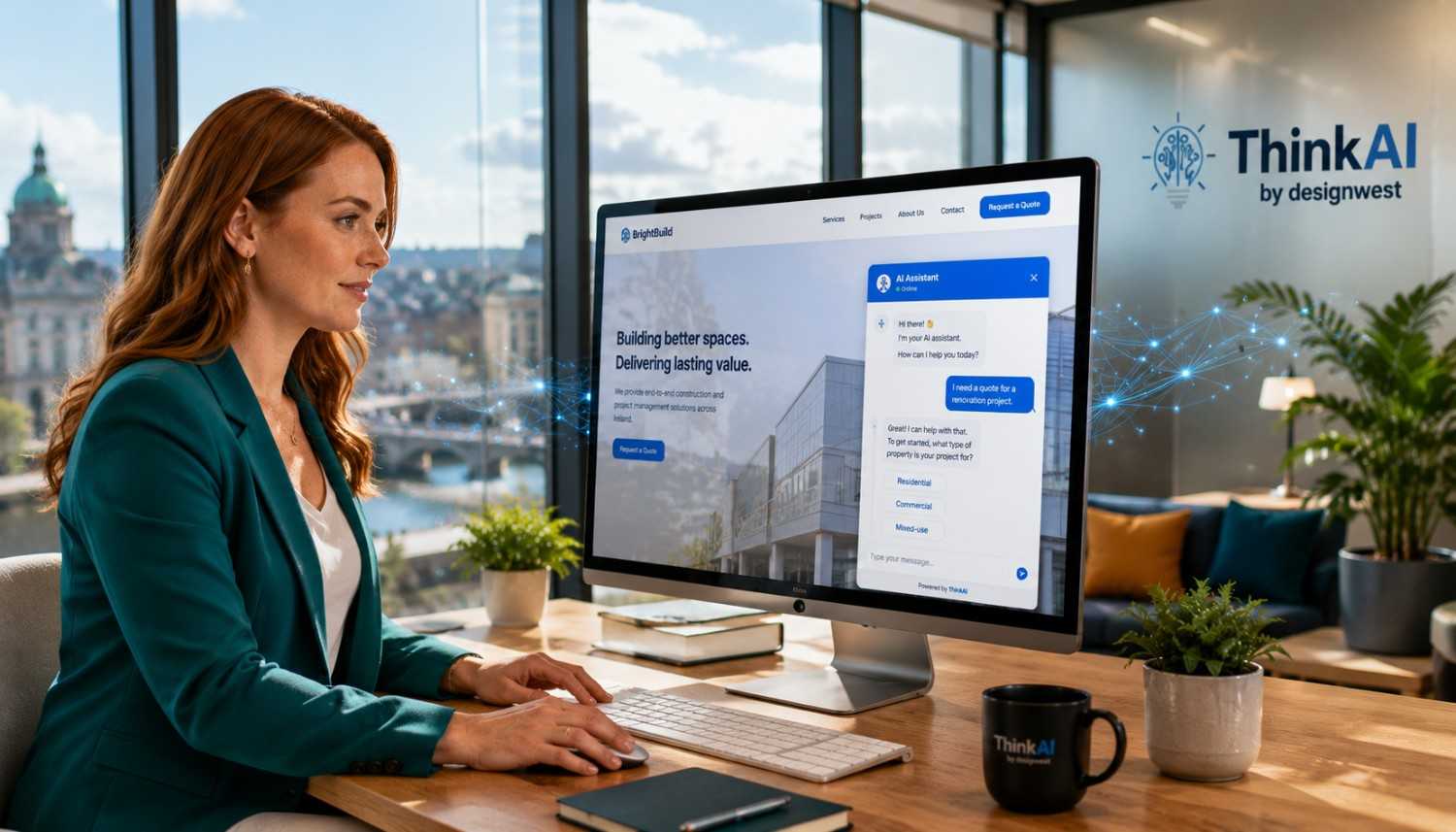
An AI chatbot for lead generation is a software tool that engages website visitors in real-time conversation, qualifies their interest through intelligent questions, collects contact details, and routes qualified prospects to your sales team or CRM automatically. Unlike static contact forms that convert at 2 to 3%, AI chatbot-led funnels convert at 2.4 times that rate. For Irish businesses losing leads outside business hours or to slow manual follow-up, a well-deployed chatbot is one of the most commercially direct automation investments available.
AI chatbot for lead generation is one of the most direct routes to improving website performance for Irish businesses, and the results are no longer theoretical. Every day, Irish SMEs are losing leads to slow response times, out-of-hours website traffic, and contact forms that visitors abandon before completing. A well-configured AI chatbot solves all three problems simultaneously, engaging visitors the moment they land, qualifying their interest, and capturing their details around the clock.
According to research from AgentHub.ie, Irish SME staff lose up to 30% of their working time to admin rather than serving clients. Meanwhile, around 30% of inbound queries arrive outside business hours, going straight to voicemail or an unanswered contact form. For any business spending money on website traffic, that is a significant revenue leak. AI chatbots stop that leak.
This blog covers what AI chatbots for lead generation actually do, why Irish businesses are adopting them at speed, the real results being achieved across different sectors, and the practical steps to get one live on your website. ThinkAI builds custom chatbot solutions for Irish SMEs across Mayo and beyond.
What Is an AI Chatbot for Lead Generation?
An AI chatbot for lead generation is a conversational tool that sits on your website and engages visitors in real-time. Unlike a basic live chat window that waits for a human agent, or a rigid scripted bot that only handles a narrow set of keywords, a modern AI chatbot uses natural language understanding to hold meaningful conversations with visitors, answer their questions, and guide them through a qualification process.
The key difference between a traditional contact form and an AI chatbot is engagement. A form asks a visitor to stop, fill in fields, and wait. A chatbot meets them where they are, responds to what they are already asking, and collects the same information conversationally. That difference in experience produces a measurable difference in results. Research consistently shows chatbot-led funnels convert at 2.4 times the rate of static forms, with B2B businesses reporting up to 55% more high-quality leads through conversational capture.
For Irish businesses that cannot afford to staff a live chat function around the clock, an AI chatbot delivers 24/7 coverage at a fraction of the cost, capturing leads on evenings, weekends, and bank holidays when no staff are available.
How AI Chatbots Capture and Qualify Leads
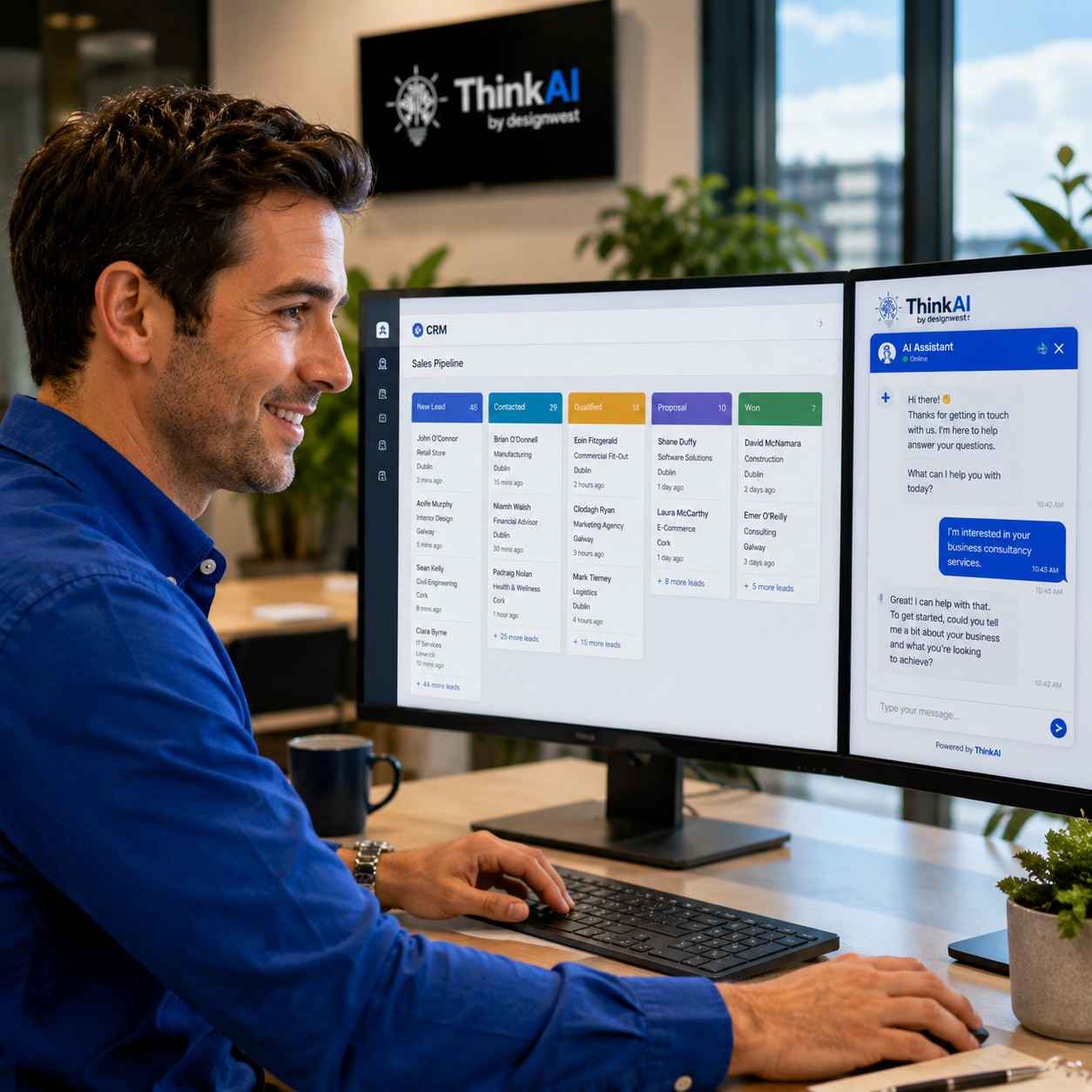
AI chatbots capture and qualify leads through a structured but conversational process. When a visitor lands on a key page such as a service page, pricing page, or homepage, the chatbot initiates a conversation based on their behaviour. From there, the qualification process unfolds in four steps:
- Asking questions: The chatbot gathers context by asking about the visitor's needs, timeline, and budget in a natural, conversational way rather than presenting a form.
- Collecting data: Contact details including name, email, phone number, and company are captured mid-conversation and stored automatically.
- Lead scoring: The chatbot assesses the visitor's answers against pre-set criteria and assigns a priority level, distinguishing high-intent prospects from general enquiries.
- Routing leads: Qualified leads are passed directly to your CRM, your sales team's inbox, or a booking calendar, with full conversation context included so no information is lost.
Why Irish Businesses Are Adopting AI Chatbot Integration
AI chatbot integration has moved from a nice-to-have to a competitive necessity for Irish SMEs. Three factors are driving adoption across sectors from professional services to retail and hospitality.
First, customer expectations have changed. More than 50% of customers now expect businesses to be available 24/7, according to research from SlickText. For an Irish SME operating standard office hours, that expectation creates a gap that competitors are beginning to fill with automation. Businesses that respond to an enquiry within five minutes are 21 times more likely to convert that lead than those who wait an hour.
The shift is visible in the data. Four in ten Irish SME AI users are now automating tasks through AI tools, according to the OpenAI 2026 survey. Among those that have moved beyond basic use to connected workflow agents, the productivity gains are measurably larger. Irish firms that have deployed agents in customer service report 40 to 60% reductions in support costs, with ROI achieved within two to four months.
Second, staffing pressure is making manual lead handling unsustainable. Irish SMEs face real skills shortages and rising employment costs. AI chatbot integration allows businesses to handle significantly higher volumes of website enquiries without adding headcount. The chatbot manages qualification, scheduling, and initial responses, freeing staff to focus on higher-value work.
Third, the cost of AI chatbot solutions has dropped sharply. Entry-level chatbot platforms now start from as little as €20 to €100 per month. Custom solutions tailored to specific Irish business requirements are achievable within budgets that were unthinkable three years ago. With 57% of companies reporting significant ROI from chatbot deployment within the first year, the commercial case for Irish businesses is clear.
Real Examples of Lead Generation Chatbots in Ireland
Lead generation chatbots are already delivering measurable results across different business types in Ireland. The following three examples illustrate the outcomes businesses are achieving.
A Kerry-based family hotel deployed an AI chatbot on its website to handle room availability enquiries, pricing questions, and direct booking requests around the clock. Previously, these enquiries went unanswered outside office hours, with potential guests booking elsewhere. Following deployment, the hotel reduced inbound phone calls by 45% and increased direct booking conversions by 28%, without hiring additional staff. The chatbot also upsold room upgrades and dining packages during the booking conversation, increasing average booking value.
A Dublin professional services firm integrated an AI chatbot on its website’s service and contact pages. Before deployment, website lead conversions sat at 3%. Following AI chatbot integration, that figure increased to 8%. Response times dropped from four hours to three minutes, and repetitive admin tasks across the team reduced by over 50% as the chatbot handled qualification, FAQ responses, and initial scheduling autonomously. The firm captured a significant volume of leads that had previously gone cold due to slow follow-up.
A Dublin solicitor’s office deployed an AI chatbot to handle inbound legal enquiries, qualify prospective clients, and schedule consultations. Prior to deployment, lead response times averaged six hours, and a large proportion of after-hours enquiries were never followed up. After implementation, response times dropped to under 20 minutes, booked consultations increased by 30% within three months, and the firm captured 35% more new clients from after-hours website traffic. The chatbot also reduced email volume significantly by handling routine queries directly.
Steps to Implement an AI Chatbot for Lead Generation
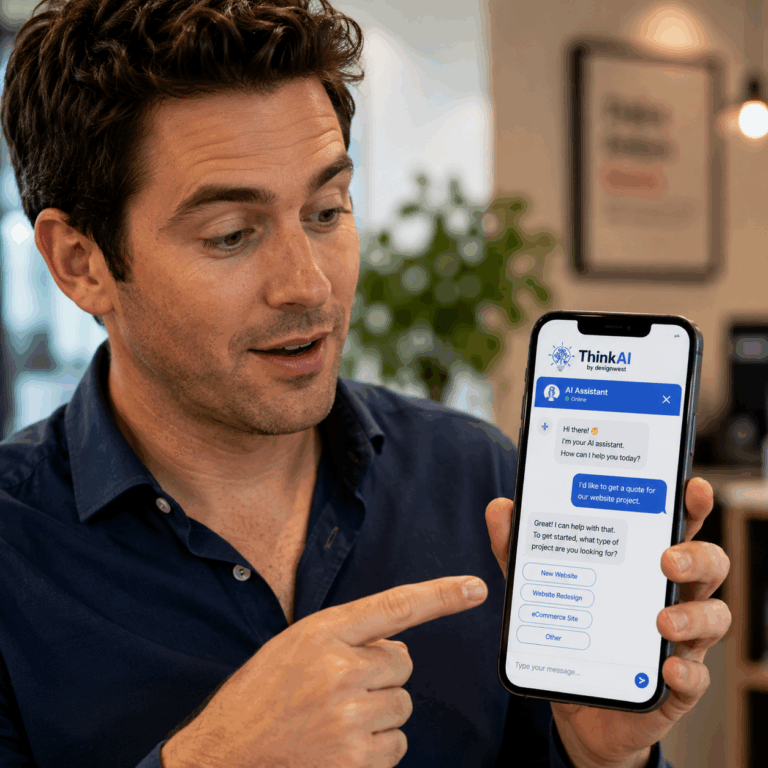
Implementing an AI chatbot for lead generation does not require technical expertise or a lengthy project timeline. Most Irish SMEs can have a chatbot live within two to four weeks using the following five steps.
Start by looking at where visitors currently land and where they drop off without converting. Service pages, pricing pages, and the homepage are the most common entry points for lead intent. These are the pages where a chatbot will have the greatest immediate impact.
Be specific. Do you want it to book consultations, qualify purchase intent, answer FAQ queries, or capture contact details for follow-up? A chatbot with a clear single goal outperforms one trying to do everything at once. Define your primary conversion action before designing the conversation.
Map out the questions the chatbot will ask, the responses it will give, and the decision points that determine whether a visitor is a qualified lead or a general enquiry. Keep conversations short, friendly, and outcome-focused. Aim for qualification within three to five exchanges.
Connect the chatbot to HubSpot, Salesforce, or whatever CRM your team already uses so qualified leads flow in automatically with full context. If booking is a goal, connect to your calendar tool so prospects can self-schedule without any staff involvement.
Track your chatbot’s conversion rate, drop-off points, and after-hours lead capture percentage from week one. Review conversation logs weekly for the first month to identify where the flow can be improved. Most chatbots reach their best performance within four to six weeks of live deployment.
Key Benefits and AI Chatbot ROI for Businesses
The commercial case for AI chatbot deployment is backed by strong data from both global research and Irish market evidence. The primary benefits for Irish SMEs are:
- Increased lead capture. Chatbots produce 20 to 35% more leads than websites relying on static forms alone. Businesses that have deployed conversational lead capture report up to 55% more high-quality leads compared to traditional form-based approaches.
- 24/7 availability. AI support automation means your website works as a lead capture engine around the clock. For Irish businesses losing 30% of enquiries to out-of-hours website traffic, this is an immediate and measurable revenue recovery.
- Reduced manual effort. AI support automation handles qualification, FAQ responses, scheduling, and CRM updates without staff involvement, freeing your team for higher-value work and reducing the admin burden that currently accounts for up to 30% of Irish SME working time.
- Higher conversion rates. Chatbot-led funnels convert at 2.4 times the rate of static forms. In professional services specifically, businesses report 25 to 35% increases in consultation bookings following chatbot deployment.
- Strong AI chatbot ROI. The average first-year ROI on an AI chatbot for lead generation sits between 148% and 200%, with payback periods of three to six months for properly integrated systems. 57% of companies report significant ROI within the first year of deployment.
Why ThinkAI Is Mayo's Trusted AI Partner
ThinkAI is a Mayo-based AI consultancy that designs and builds custom chatbot solutions for Irish businesses. Every chatbot ThinkAI deploys is built around the specific goals, audience, and existing tools of the individual business, not adapted from a generic template.
From initial conversation flow design through to CRM integration, GDPR compliance, and ongoing optimisation, ThinkAI handles the full implementation. Whether you are a professional services firm in Dublin, a retailer in Galway, or a trades business in Mayo, ThinkAI builds solutions that fit how Irish businesses actually work and the customers they serve.
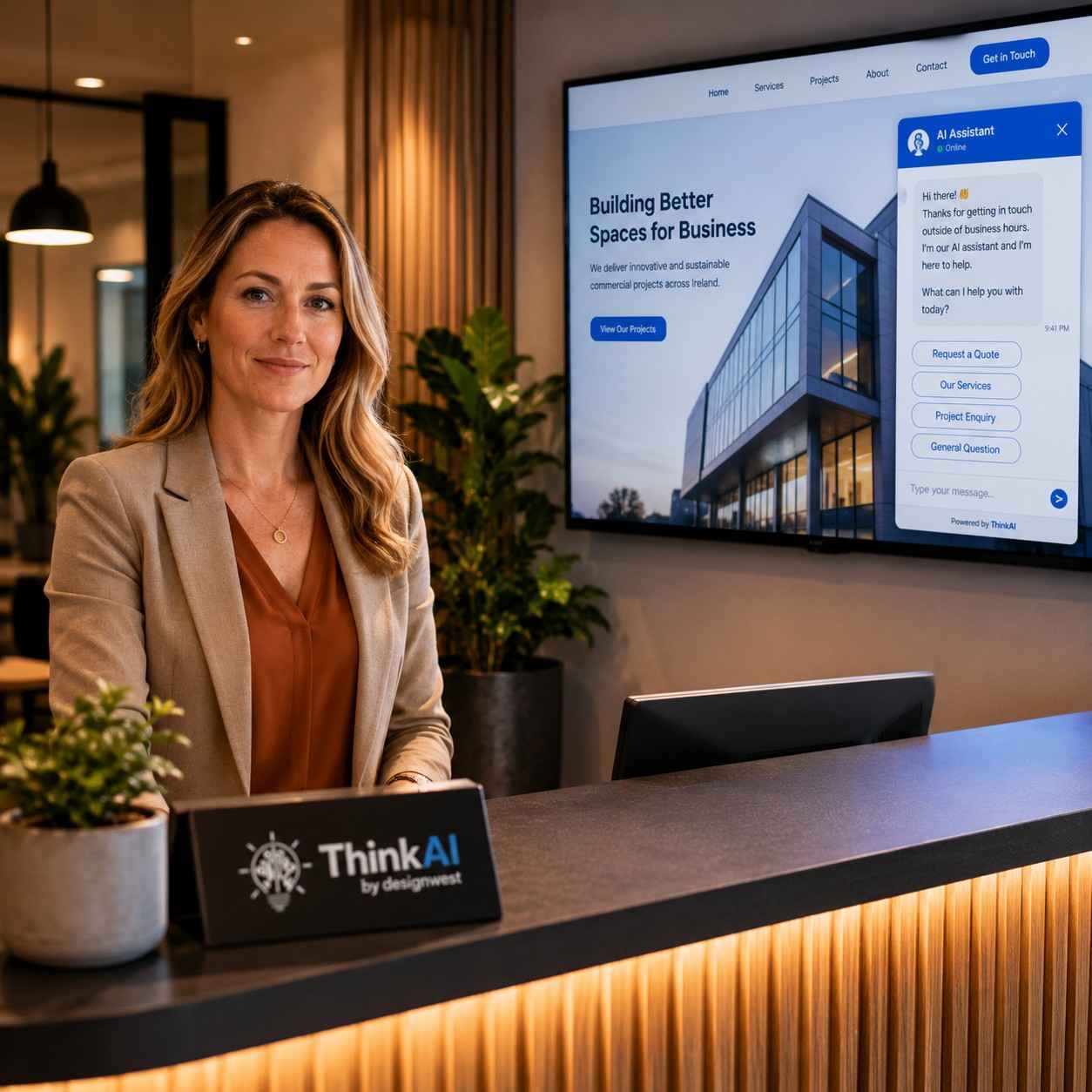
Contact ThinkAI to request a consultation and find out how an AI chatbot can start generating leads for your business from day one.
AI chatbot for lead generation is one of the highest-ROI investments an Irish SME can make in its website right now. Businesses that are still relying on static forms and manual follow-up are losing leads every day to competitors who respond faster, qualify better, and never go offline. Whether your goal is to book more consultations, capture more product enquiries, or simply stop losing after-hours traffic, an AI chatbot delivers results that are measurable from the first week. ThinkAI is here to help Irish businesses make that shift.
Key Takeaways
- AI chatbots for lead generation convert at 2.4 times the rate of static contact forms and produce 20 to 35% more leads for businesses that deploy them correctly.
- Around 30% of Irish SME enquiries arrive outside business hours. A 24/7 chatbot captures this traffic that currently goes unanswered.
- Irish businesses across hospitality, professional services, and legal have already achieved 28 to 35% increases in conversions and bookings following chatbot deployment.
- First-year AI chatbot ROI sits between 148% and 200% for properly integrated systems, with most businesses reaching payback within three to six months.
- Implementation takes two to four weeks for most Irish SMEs and does not require in-house technical expertise when working with a specialist like ThinkAI.
Frequently Asked Questions
An AI chatbot for lead generation is a conversational tool on your website that engages visitors in real time, asks qualifying questions, collects their contact details, and routes them to your CRM or sales team automatically. Unlike a static contact form, it responds instantly to what the visitor is asking and guides them through the qualification process naturally, without requiring a human to be available.
Contact forms ask visitors to stop browsing and fill in fields, which most people abandon. AI chatbots meet visitors in the moment, responding to their existing questions and collecting information conversationally. Research shows chatbot-led funnels convert at 2.4 times the rate of static forms, and B2B businesses report up to 55% more high-quality leads through conversational capture compared to traditional form-based approaches.
Entry-level chatbot platforms start from €20 to €100 per month. Custom-built chatbot solutions tailored to your specific Irish business typically range from €1,500 to €5,000 for initial development. Most businesses reach positive ROI within three to six months, with first-year returns of 148 to 200% for properly integrated systems.
Most Irish SMEs have a basic chatbot live within two to four weeks. A custom-built solution with CRM integration and tailored conversation flows takes four to six weeks from initial scoping to launch. Ongoing optimisation then runs continuously in the background as the chatbot learns from actual conversations.
Yes, that is one of its primary commercial benefits. Around 30% of website enquiries arrive outside standard business hours. An AI chatbot engages those visitors instantly, qualifies their interest, and captures their contact details so your team can follow up the next morning with fully qualified leads rather than a cold inbox.
AI chatbot integration means connecting your chatbot to the business tools you already use, including your CRM, booking calendar, email system, and website platform. Once integrated, leads captured by the chatbot flow automatically into HubSpot, Salesforce, or whatever CRM you use, with full conversation context included. No manual data transfer is required.
Published benchmarks show first-year ROI of 148 to 200% for properly integrated AI chatbot systems, with payback periods of three to six months. 57% of companies report significant ROI within the first year. For Irish businesses in professional services, increases of 25 to 35% in consultation bookings have been reported within the first three months of deployment.
Yes. You define the qualifying criteria, such as budget, timeline, service type, or location, and the chatbot assesses each visitor’s answers against those criteria during the conversation. High-intent prospects are flagged and routed to your sales team immediately. General enquiries are handled with FAQ responses or directed to relevant content, without wasting your team’s time.
Yes, when implemented correctly. The chatbot must clearly identify itself as an automated system, obtain consent before collecting personal data, and process that data in accordance with GDPR requirements. ThinkAI builds all chatbot solutions with GDPR compliance built in, including data storage within EU borders and compliant privacy notice integration.
Professional services including solicitors, accountants, and consultants benefit from lead qualification and appointment booking automation. Retail and e-commerce businesses benefit from product queries and upselling. Hospitality businesses benefit from direct booking capture. Any Irish business spending money on website traffic that currently uses a static contact form as its only conversion tool stands to gain significantly.
AI chatbots handle routine and structured queries automatically. For complex, sensitive, or high-value conversations, they escalate to a human team member with full context from the chatbot conversation included. This hybrid model means your team only handles conversations that genuinely require human judgement, while the chatbot manages everything else.
Intercom and HubSpot AI are the most commonly used platforms by Irish businesses for CRM-integrated chatbots. Tidio offers a strong option for e-commerce businesses with a high AI resolution rate of 67%. For businesses wanting a custom-built solution, ThinkAI designs chatbots from the ground up using platforms that integrate directly with existing Irish business tools.
Yes. When integrated with your calendar tool such as Calendly or Google Calendar, the chatbot can check availability, present options to the visitor, and confirm bookings without any manual involvement. This is particularly valuable for Irish professional services firms where consultation scheduling is a core part of lead conversion.
No. AI chatbots handle the high-volume, repetitive, and routine interactions that currently consume significant staff time. Your team remains responsible for complex, high-value, and relationship-driven conversations. The result is that staff spend more time on work that requires their expertise, not less time in the business.
The key metrics to track are conversion rate from chat to qualified lead, after-hours lead capture percentage, drop-off points in the conversation flow, average time to qualification, and CRM update accuracy. Most platforms provide dashboards for these metrics. Set a baseline before you launch and review performance weekly for the first six weeks.
A rule-based chatbot follows fixed decision trees and only responds to exact keywords or button selections. It breaks down when a visitor asks something outside the script. An AI chatbot uses natural language understanding to interpret intent, handle variation in how questions are asked, and hold contextually aware conversations. For lead generation, AI chatbots significantly outperform rule-based ones in both conversion rate and visitor experience.
Yes. Many modern chatbot platforms including Intercom and Tidio support multi-channel deployment across website, WhatsApp, Facebook Messenger, and Instagram. For Irish businesses where customers already communicate through WhatsApp, extending lead capture to that channel can further increase the volume of qualified enquiries captured outside business hours.
AI support automation through chatbots means the chatbot resolves standard queries including product questions, pricing, availability, and booking status without any human input. Research shows modern AI chatbots resolve between 68 and 85% of routine inbound queries automatically. Only the remaining complex cases are escalated to your team, significantly reducing the volume of calls and emails that staff need to handle manually.
Prioritise the pages where visitors have the highest purchase or enquiry intent. These are typically your service or product pages, pricing page, homepage, and contact page. Avoid deploying the chatbot on every page from day one. Start where the traffic has the clearest intent, prove conversion results, and expand from there.
The first step is to identify which part of your website lead capture is currently weakest: is it after-hours traffic, slow response times, low form conversion rates, or poor lead quality? That answer determines where the chatbot should be deployed first and what its primary goal should be. Contact ThinkAI for a consultation and we will map your current conversion journey and recommend the right chatbot solution for your specific business.
About the Author:
Declan Foley is the founder of ThinkAI.ie and Creative Director at Designwest. He helps Irish businesses unlock growth through AI-powered strategy and digital innovation. Explore how ThinkAI can support your business at ThinkAI.ie.