

Staying Ahead with AI Technology in Dublin and Mayo
Artificial Intelligence (AI) is no longer a futuristic concept reserved for tech giants; it is here on Irish soil, reshaping how we do business from Dublin’s Silicon Docks to the shores of Mayo. In 2026, the Irish business landscape is defined by a profound technological shift, with AI adoption surging to 91%—nearly double the rate from 2024. This rapid uptake signals that your competitors, whether they are a tech startup in Dublin or a family-run manufacturer in Mayo, are likely already using AI technology to gain a competitive edge.
At ThinkAI, we believe that staying ahead with AI technology means more than just using the latest tools. It requires a strategic, human-centric approach that balances innovation with responsibility. Whether you are a retailer in Castlebar or a fintech lead in the capital, this guide provides the roadmap to navigate the Irish AI ecosystem, secure funding, and ensure compliance with the latest European regulations.
The Two-Speed Economy: AI Adoption Dublin and Mayo
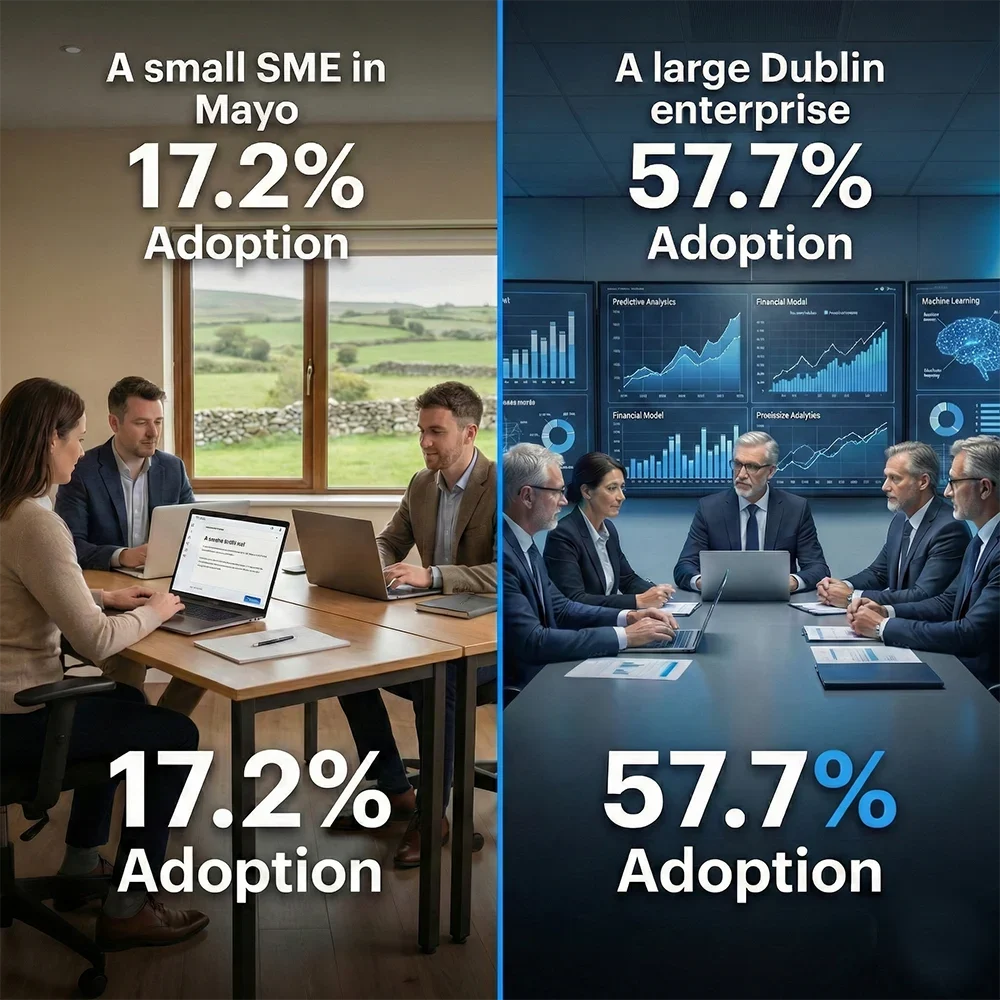
Ireland currently ranks 4th globally for AI adoption and 2nd in Europe per capita, behind only Norway. However, a “data mining divide” exists between multinational corporations and indigenous firms. Large enterprises (250+ employees) lead the way with a 57.7% adoption rate, primarily focusing on data mining and predictive analytics. In contrast, small enterprises (10-49 employees) have an adoption rate of approximately 17.2%, often limited to basic generative tasks like natural language generation for marketing.
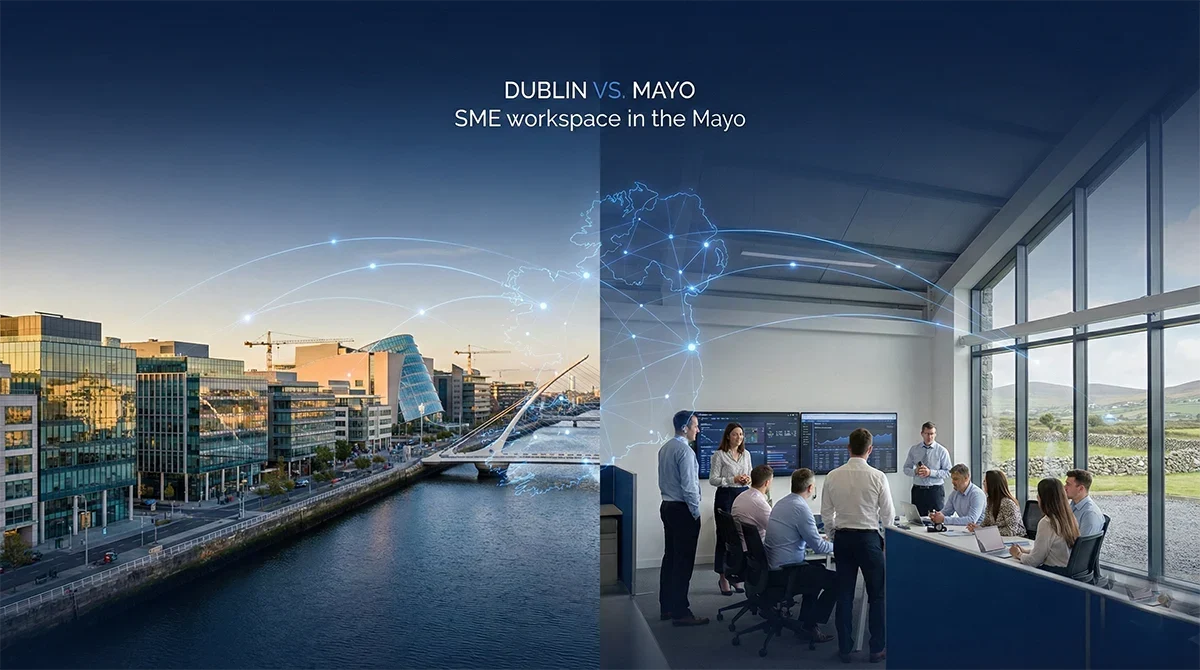
The disparity in adoption highlights a significant competitive opening for proactive leaders. While Dublin serves as the primary engine for AI research and fintech innovation, Mayo is establishing itself as a leader in applied AI for manufacturing, engineering, and agribusiness. Regional hubs like the Atlantic Technological University (ATU) iHub in Castlebar have already nurtured over 750 jobs by providing startups with high-speed broadband and technical mentorship.
Sectoral Transformations: How AI Empowers Irish SMEs
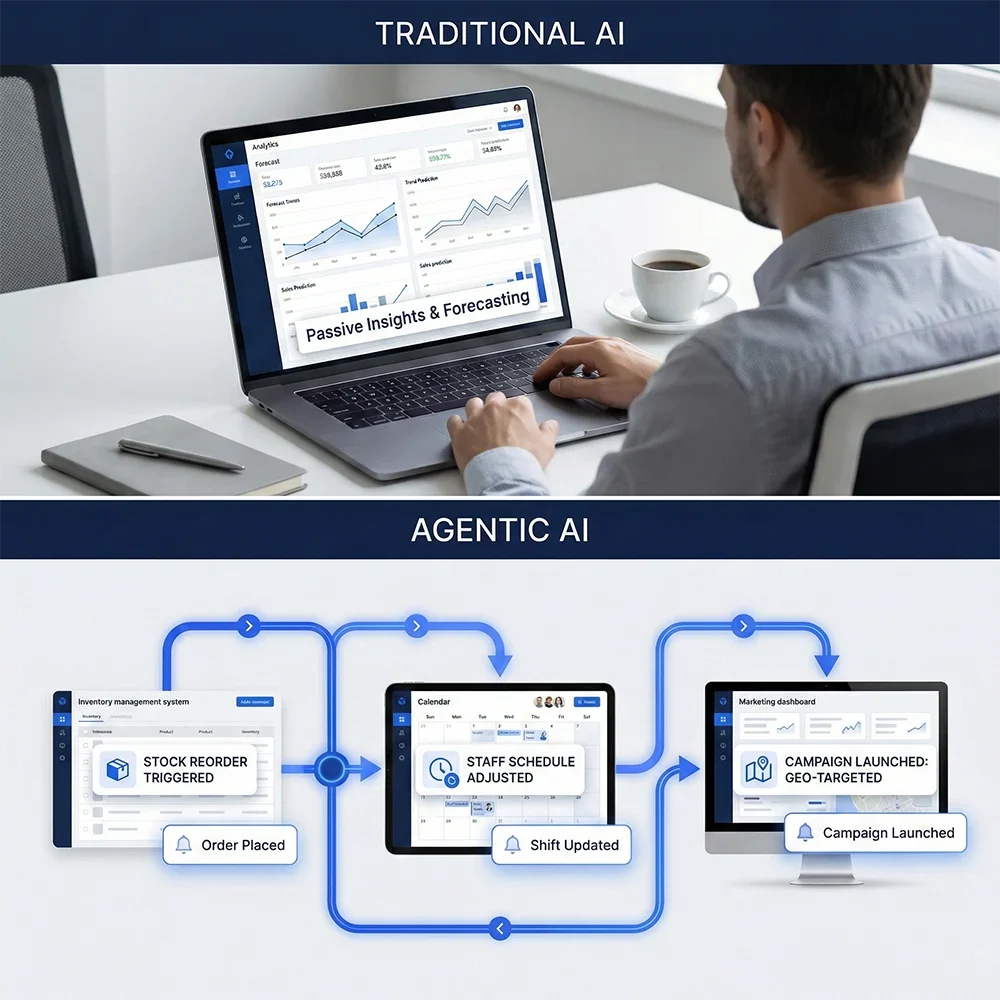
Irish retailers are moving from “Traditional AI”—which merely predicts trends—to “Agentic AI”. While traditional models might forecast a rise in umbrella sales during a rainy week in Galway, Agentic AI can independently trigger supplier orders, adjust staff schedules for the busy period, and launch geo-targeted promotions without manual intervention.
In the hospitality sector, AI has moved from a curiosity to a commercial necessity. AI-powered booking agents are particularly effective, with studies citing increases in direct bookings of over 20% by capturing “missed call” opportunities $24/7$.
Legal and accounting firms in Dublin and Mayo are leveraging AI to automate “task volume,” allowing staff to focus on higher-impact activities like strategic judgment.
- Legal: AI research tools parse millions of documents to flag risky clauses in contracts.
- Accounting: Machine learning models in software like Xero or QuickBooks auto-categorize expenses and reconcile accounts, saving hours of manual data entry.
Navigating the EU AI Act and GDPR Compliance
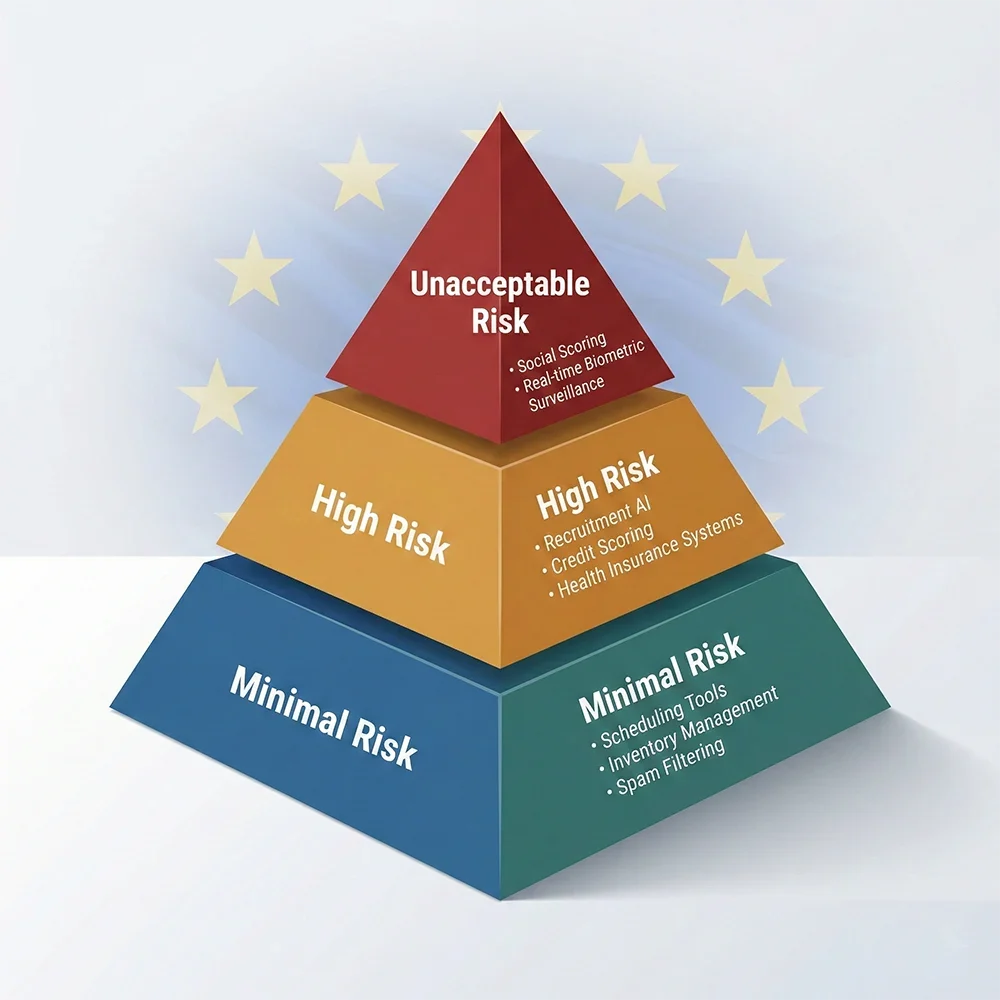
As Irish companies integrate AI, they must navigate a multi-layered regulatory environment. The EU AI Act, which entered into force in August 2024, adopts a risk-based approach.
- Minimal Risk: Tools for scheduling, inventory, and spam filtering fall here and have no additional legal obligations.
- High-Risk: Systems used in recruitment, credit scoring, or health insurance face strict obligations regarding human oversight and transparency
- Unacceptable Risk: Social scoring and real-time biometric surveillance are strictly prohibited.
Furthermore, GDPR continues to apply to all AI implementations. If your AI processes personal data, you must comply with requirements for consent, data minimization, and transparency. At ThinkAI, we advocate for “Human-in-the-Loop” (HITL) processes—ensuring that no AI runs on autopilot for critical decisions.
Funding Your AI Journey: Grants for Irish SMEs
One of the most significant advantages for Irish companies is the availability of public funding to offset AI adoption costs.
| Agency | Grant Type | Max Amount | Use Case |
|---|---|---|---|
| LEO | Grow Digital Voucher | €5,000 | Software, hardware, training |
| Enterprise Ireland | Digital Discovery | €6,300 (80% funded) | Strategy & roadmap |
| Enterprise Ireland | Innovation Voucher | €10,000 | University collaboration |
| IDA Ireland | LeanTransform | Custom | Large-scale transformation |
The “stacking” of grants is a sophisticated strategy utilized by successful firms. A business might start with a free Local Enterprise Office (LEO) assessment, progress to an Enterprise Ireland implementation grant, and finally use R&D tax credits (covering 25% of costs) to recoup further expenses
AI-Powered SEO and LLM Optimisation (LLMO)
Visibility in the age of AI means being discoverable by “answer engines”. Consumer behavior is shifting toward conversational queries like, “Find a family-run hotel in Kerry with a $24/7$ chatbot”. To stay ahead, your content must be optimized for Large Language Models (LLMO).
- AEO (Answer Engine Optimization): Structure content using FAQ sections and clear headings so AI assistants like ChatGPT can extract direct answers
- Structured Data: Implement FAQPage schema markup (JSON-LD) to explicitly label questions and answers for search engine bots.
- Local Context: Use Irish-specific terms like "AI for Irish SMEs" or "Mayo tourism automation" to signal relevance to local queries.
- Chatbots for Operations: Beyond customer chatbots, some retailers use internal “AI assistants” for staff. For example, an AI Slackbot that lets store managers query stock levels or order status by typing a question, saving time on routine inquiries.
- E-E-A-T: Cite credible sources (CSO, Enterprise Ireland) and mention real-world experience to build trust with both humans and AI models.
Building an AI-Ready Culture: The Human Element
Technology is only half the battle; for AI to deliver real benefits, you need an AI-ready culture. Leaders must frame AI as an opportunity to offload drudgery rather than a threat to jobs.
- Upskilling: Skillnet Ireland is receiving €54.2 million in Budget 2026 to address AI skill gaps. Programs like the "Certificate in Foundations of AI" help non-technical staff become "AI champions".
- Governance: Surprisingly, 79% of Irish businesses lack a formal AI policy. A simple one-pager outlining "dos and don'ts" for tools like ChatGPT is a vital first step in preventing "shadow AI" and data leaks.
FAQ: Common Questions about AI for Irish Businesses
No; simple AI tools like chatbots or inventory optimizers can save a small business in Mayo hours of work each week.
ROI comes from increased productivity, boosted sales (e.g., through website recommendations), or labor costs saved via automation.
Yes; the Digital Discovery Grant (EI) and the Grow Digital Voucher (LEO) provide significant funding for strategy and software.
Focus on your pain points—tasks that are repetitive or data-heavy—and consult an expert using a Digital Discovery Grant.
AI typically replaces repetitive tasks, allowing staff to move into higher-value, human-centric roles.
Perform a Data Protection Impact Assessment (DPIA), get explicit user consent, and ensure your AI vendors are compliant.
It is a regulation that classifies AI by risk; most SME uses (like marketing analytics) fall into the low-risk category.
Yes; “shadow AI” occurs when employees use non-vetted tools (like free ChatGPT) which can lead to governance gaps and data leaks.
Not necessarily; many off-the-shelf AI solutions are “plug and play” and don’t require in-house technical expertise.
It means a person oversees AI outputs to ensure quality, ethics, and legal compliance before a final decision is made.
Yes; AI can research keywords and help you structure content for voice assistants and “answer engines”.
Answer Engine Optimization involves structuring content (using FAQs and schema) so AI models can easily cite your business.
Skillnet Ireland offers subsidized coursesranging from basic workshops to a National MSc in AI.
Standalone tools like chatbots can be live in a week, while custom integrations typically take 3-4 months.
Yes; culturally rooted projects like Gaeilgeoir AI are helping Irish SMEs support native-speaking communities.
Yes; AI energy management systems can reduce enterprise energy use by up to 66%.
It’s a €10,000 voucher from Enterprise Ireland to collaborate with universities on AI research or prototyping.
AI is used for predictive maintenance on farm equipment and autonomous systems for logistics and monitoring.
Unlike traditional AI, Agentic AI can act autonomously to achieve complex goals like ordering stock without human intervention.
Yes; AI agents capture revenue $24/7$, while integrated systems save an average of 36 working days per year on manual entry.
o be established by August 2026, this office will coordinate AI governance and host a “regulatory sandbox” for testing.
It’s a safe environment where companies can test innovative AI systems under supervision before market deployment.
Only if your AI is classified as “high-risk” under the EU AI Act (e.g., used in recruitment or credit scoring).
Be transparent with customers about AI involvement and establish an “AI Ethics Statement” on your website.
Absolutely; it acts as a force-multiplier for solopreneurs by handling admin, marketing, and customer service.
ChatGPT for content, Grammarly for writing, and Canva’s AI features for quick marketing graphics.
Yes, but human review is essential to ensure accuracy and professional ethics compliance.
Yes; if trained on biased data, AI can discriminate. HITL and fairness testing are necessary mitigations.
An Enterprise Ireland grant that covers 80% of costs (up to €6,300) for hiring an expert to build an AI roadmap.
Communicate early, involve them in pilots, and celebrate time-saving wins publicly.
Conclusion: Take the First Step with ThinkAI
The landscape of artificial intelligence in Ireland is characterized by a rapid surge in adoption and a highly supportive regulatory framework. By 2026, the transition from “Traditional AI” to “Agentic AI” has created massive opportunities for efficiency, while regional hubs in Mayo have successfully localized high-tech manufacturing.
For Irish companies to stay ahead, AI must be viewed as a strategic transformation of the business model, not just a solitary software installation.
Would you like me to book a strategy or compliance workshop for your team to begin your AI journey responsibly?