



Executive summary
VacantHomes.ie needed a faster, more reliable way to turn citizen reports of vacant properties into clean, actionable data for local authorities. Manual intake via phone and unstructured emails was slow, error-prone, and costly. ThinkAi.ie delivered a conversational AI platform that automates intake, validates addresses against authoritative sources, creates standardised case files, and routes them automatically to the correct council contacts. The outcome was a step-change in performance and service quality.
At a glance:
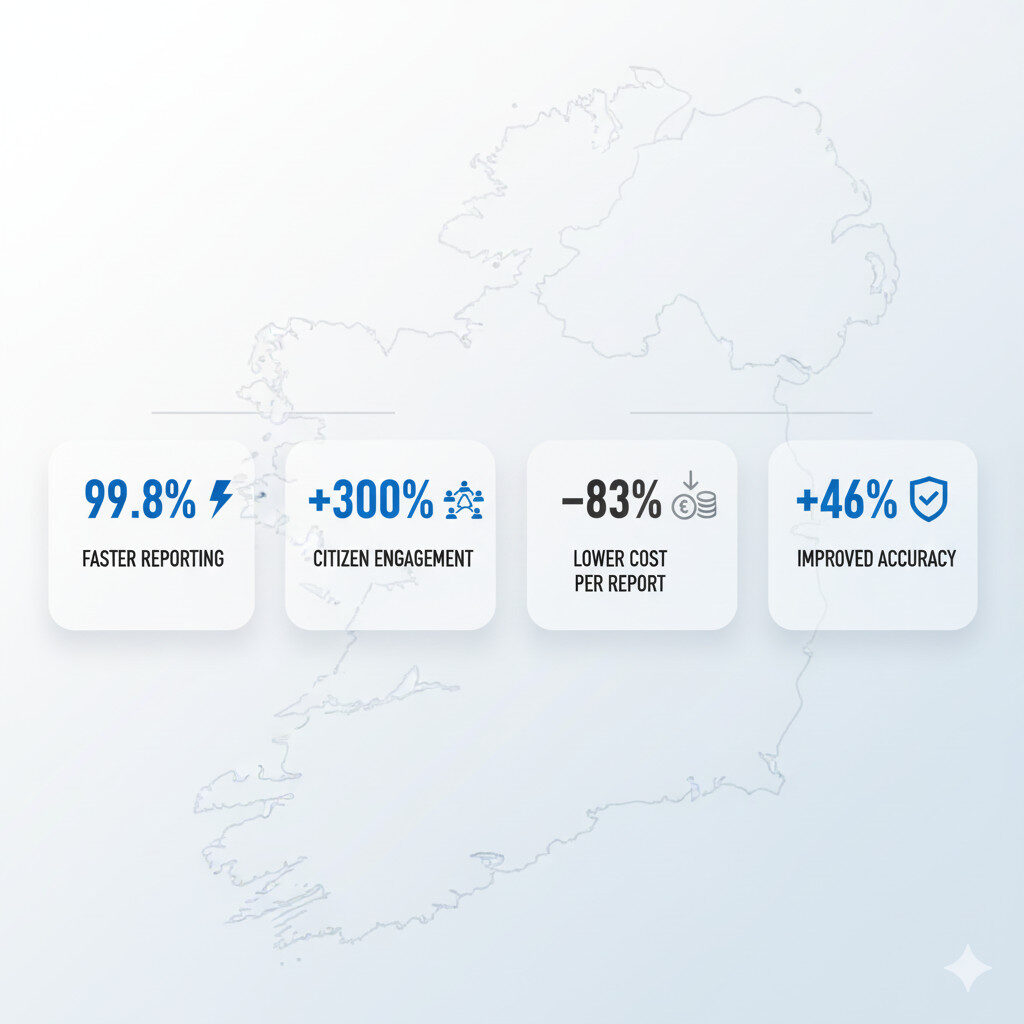
- 99.8% reduction in average time to log a report
- +300% increase in citizen engagement
- −83% operational cost per report
- +46% improvement in data accuracy
- Time-to-action cut from weeks to 24–48 hours
This project supports Ireland’s digital transformation goals by moving a priority public service to a secure, data-driven, citizen-centric model.

The client
VacantHomes.ie is a national initiative that channels citizen reports of vacant or derelict properties to the relevant local authority, helping return homes to use and supporting housing supply across Ireland.
The challenge
The legacy process could not keep pace with demand:
- Manual intake from calls and unstructured emails meant staff transcribed and normalised data by hand.
- Inaccurate or incomplete reports often lacked precise addresses or valid Eircodes.
- Lengthy lag to action as verification and hand-offs took days or weeks.
- No central source of truth for real-time visibility or analytics.
- High processing cost per report due to repetitive admin work.
The operational drag limited throughput, transparency, and impact at a time when faster progress was essential.
Objectives
- Make reporting simple for citizens on web or mobile.
- Capture structured, validated data by default.
- Reduce time-to-action for councils.
- Lower cost per report while improving accuracy.
- Provide a secure, real-time analytics view across Ireland.

The solution: a conversational AI platform for citizen-led intelligence
ThinkAi.ie designed an end-to-end pipeline that turns natural-language reports into verified, standardised cases ready for immediate action.
How it works
- Natural Language Processing (NLP/NLU): Extracts entities and intent from free-text submissions, such as street names, towns, Eircodes, property condition, and duration of vacancy.
- Automated validation: Cross-checks locations against authoritative datasets and corrects common spelling and formatting issues. Assigns a confidence score and enriches the record.
- Standardised case creation: Generates a complete case file with description, validated address/Eircode, map link, and confidence score.
- Smart routing: Sends the case to the correct contact within the relevant local authority’s housing team.
- Analytics dashboard: Provides real-time heatmaps, trends by county, and exportable reports for management and policy teams.
- Accessibility and inclusion: Plain-language prompts and mobile-friendly UX support broad participation. Irish-language support is available where required.
Citizen experience
- Simple web form or mobile flow: Submit a report in everyday language.
- Instant confirmation: A clear summary with the option to add a photo or refine details.
- Privacy-first: GDPR-aligned handling with transparent consent messaging.
Operational experience
- Queue-free intake: Cases arrive validated and standardised.
- Traceable workflow: Clear audit trail from submission to council action.
- Search and filters: Staff can slice data by county, status, and timeframe in seconds.
Implementation approach
- Discovery and mapping: Workshops with VacantHomes.ie to capture process rules, data requirements, and council routing logic.
- Design and prototyping: UX prototypes and test submissions using realistic citizen phrasing.
- Model tuning: Iterative improvements on entity extraction and address validation.
- Systems integration: Secure ingestion, case store, authority routing, and analytics.
- Pilot and iterate: Soft launch, feedback loops, and performance tuning.
- Go-live and training: Short, practical sessions for staff with quick-reference guides.
Results
Within six months, VacantHomes.ie moved from manual processing to a responsive, data-driven service.
| KPI | Before | After | Impact |
|---|---|---|---|
| Average time to log a report | 48 hours | 5 minutes | 99.8% faster |
| Accuracy of initial data | 65% | 95% | +46% improvement |
| Citizen engagement | 150 per month | 600 per month | +300% |
| Operational cost per report | €15 | €2.50 | −83% |
| Time-to-action for councils | 2–3 weeks | 24–48 hours | −93% |
Client perspective:
“The headline is speed, but the lasting value is accuracy and trust. Our team now focuses on analysis and action rather than admin, and local authorities receive clean, actionable cases almost immediately.”
Governance, security, and compliance
- GDPR aligned: Purpose limitation, data minimisation, and clear consent flows.
- Access controls: Role-based permissions with audit logging.
- Data security: Encryption in transit and at rest, least-privilege architecture, and regular reviews.
- Retention policy: Configurable retention and deletion schedules agreed with the client.
Why it works
- Citizen-first design: Natural language over rigid forms.
- Structured by default: Validation and enrichment cut rework.
- Automation where it matters: Routing and case building remove bottlenecks.
- Real-time insight: Shared visibility drives faster, better decisions.
Reuse across Irish public services
The same pattern can support other services in Ireland:
- Environmental reporting: Illegal dumping, water quality, fallen trees.
- Infrastructure faults: Potholes, street lighting, transport issues.
- Community safety: Anti-social behaviour reports to community policing units.
Each use case benefits from conversational intake, validation, routing, and analytics, with local policy and privacy controls intact.
Calls to action
- Discuss your service challenges: Talk to our team about a discovery sprint.
- See a live demo: Explore the reporting flow and analytics dashboard.
- Explore our capabilities: Learn how conversational AI modernises public services in Ireland.
Frequently asked questions
How does conversational AI improve reporting for Irish public services?
It lets people report in plain language, then converts that into structured, validated data. Staff receive ready-to-use cases rather than raw messages, which speeds action and reduces errors.
Can this integrate with local authority systems?
Yes. The platform exports standardised case data and can connect to common CRMs, case management tools, or secure email routing as required.
What about data accuracy when citizens provide vague locations?
Entity extraction plus address validation and enrichment correct typical issues and assign confidence scores. Low-confidence records can be flagged for rapid human review.
Is the platform GDPR compliant?
Yes. It follows GDPR principles with consent messaging, purpose limitation, configurable retention, access controls, and audit logging.
How long does implementation take?
A focused discovery and pilot can run in 6–10 weeks, followed by a staged rollout depending on integrations and governance requirements.
Can the system support Irish language submissions?
Yes. Irish-language prompts and intake can be enabled to support bilingual services.
What training do staff need?
Most teams need short onboarding sessions covering dashboard use, export options, and exceptions handling. The UI is intentionally simple.
How are reports routed to the correct council contact?
Routing rules map validated locations to the appropriate authority and contact channel, with fallbacks for edge cases.
What if someone reports the same property multiple times?
De-duplication checks compare address entities and metadata. Suspected duplicates are merged or flagged before dispatch.
Can citizens attach photos?
Yes. Images can be added during submission, stored securely, and included in the case file sent to the authority.
What measurable improvements should we expect?
Typical gains include faster intake, higher data accuracy, reduced processing cost, and shorter time-to-action. VacantHomes.ie achieved all four at meaningful scale.
Does the platform work on mobile?
Yes. The citizen flow is fully responsive and designed for quick submissions on mobile devices.
How do we manage sensitive or personally identifiable information?
Collection is minimised, encryption is applied in transit and at rest, and access is restricted by role. Policies are agreed during discovery.
How are analytics presented to non-technical users?
Dashboards focus on plain-language filters, heatmaps, and exportable summary reports. No technical knowledge required.
What happens if address confidence is low?
The system prompts for clarification or routes the case to a triage queue with clear indicators for quick correction.
Can this reduce call volumes to existing helpdesks?
Yes. A self-serve reporting flow absorbs common submissions, freeing staff for complex cases and outreach.
How are changes in council contacts or territories handled?
Routing tables are configurable through admin controls, with versioning and audit history.
What does success look like after 6–12 months?
Higher throughput, cleaner data, faster action, and clearer visibility across counties. The service becomes simpler for citizens and more effective for staff.
On-page SEO checklist for this case study
- One H1 only.
- Primary keyword themes: conversational AI Ireland, public service reporting, VacantHomes.ie case study, digital transformation Ireland.
- Include “Ireland”, “Irish public services”, “local authorities”, and county mentions where natural.
- Add Article and FAQPage
schema. - Optimise meta title and description as above.
- Descriptive image alt text, for example: Vacant property reporting dashboard for Irish local authorities.
- Internal links to /services, /contact, and relevant sector pages.
Short author note for the page footer (optional)
ThinkAi.ie designs conversational AI and automation for Irish public services and regulated industries. We focus on measurable outcomes, privacy, and user-centred design.
If you want this turned into a CMS-ready version with meta fields, image slots, and FAQ schema JSON-LD, say the word and I’ll format it exactly for your site templates.
