

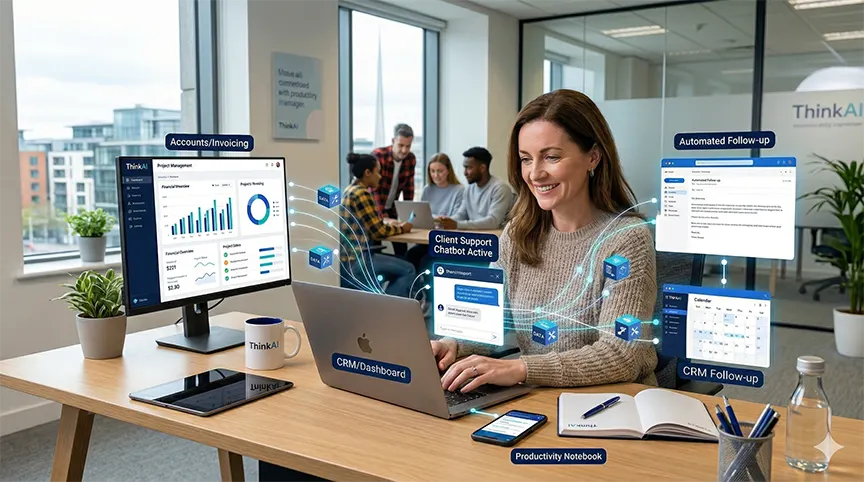
AI agent integration means connecting AI systems to the tools your business already uses so they can trigger actions, move information, draft responses, and support decisions across real workflows. For Irish SMEs, that matters because the real value is not another standalone chatbot. It is reducing admin, speeding up service, and improving operations in a way that still stays compliant with GDPR, aligned with the EU AI Act, and manageable for real teams in places like Mayo, Galway, and Dublin.
Introduction
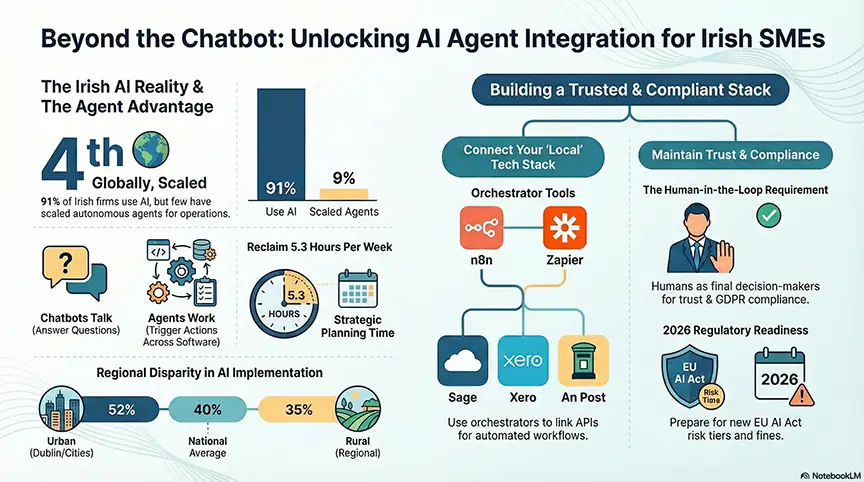
AI agent integration is becoming one of the most practical ways for SMEs in Ireland to save time without ripping out the systems they already rely on. For a business in Mayo, Dublin, Galway, or anywhere else in Ireland, the issue is rarely access to AI tools. The issue is getting them to work properly with your CRM, inbox, accounts package, booking system, or website. Ireland now ranks fourth globally for AI adoption. However, many organisations are still in the early stages of operational implementation, with skills, governance, and trust challenges slowing wider deployment
WHAT IS AI AGENT INTEGRATION?
AI agent integration is the process of connecting an AI agent to the tools, data, and workflows a business already uses so it can do more than answer questions. A proper integration with AI allows the system to pull information from one source, reason on it, and then take a safe next step such as drafting an email, updating a CRM record, flagging an issue, or preparing an invoice for approval.
How AI Agents Work in a Business System
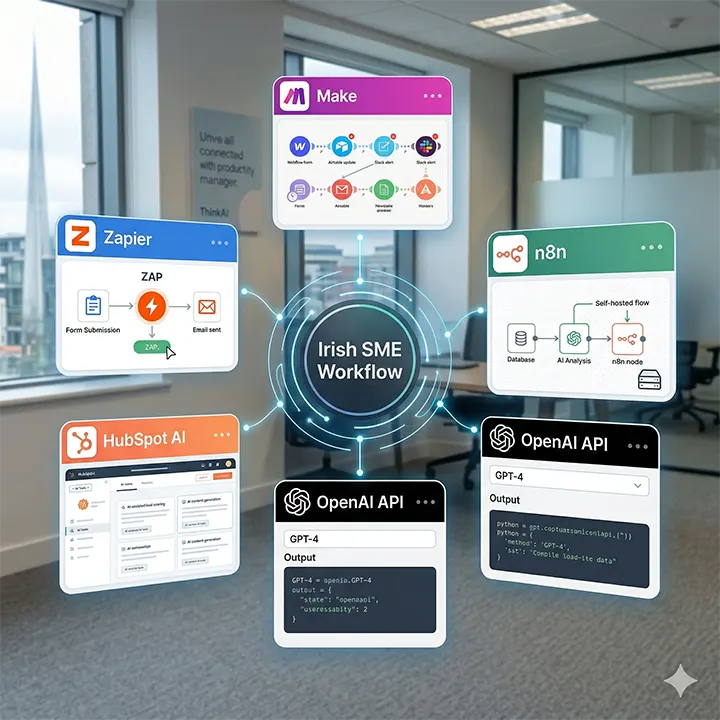
An AI agent usually sits on top of an automation layer such as Zapier, Make, or n8n. That layer connects the agent to software like HubSpot, Xero, Stripe, email, booking systems, or internal spreadsheets. In practice, that means a support request can be classified, enriched with customer data, and routed to the right team automatically instead of being handled manually.
The Difference Between Chatbots and Business AI Integration
A chatbot talks. Business AI integration works. A chatbot may answer a question on your website, but an integrated agent can check an order, create a ticket, update your CRM, or prepare a follow-up task for a staff member. That difference is what moves AI from novelty into operations.
TOP AI AGENT INTEGRATIONS FOR IRISH SMALL BUSINESSES
For most Irish SMEs, the most useful ai agent integrations are not exotic. They are the ones that connect existing tools properly and safely.
Zapier
Useful for fast, low-code connections across more than 8,000 app integrations, especially for sales, marketing, form routing, and notifications.
Make.com
Useful when you need more visual logic, multi-step workflows, and better control over larger process chains.
n8n
Strong for more advanced integration with ai, especially when a business needs custom logic, AI nodes, or self-hosting options for tighter control. n8n also publishes a self-hosted AI starter kit, which is relevant for businesses that want more control over infrastructure.
HubSpot AI
A strong option for SMEs that want customer, sales, and service workflows inside one AI-powered CRM environment.
OpenAI API
Best when the business needs tailored prompts, custom assistants, document handling, classification, or deeper workflow logic rather than off-the-shelf automation.
AI-DRIVEN BUSINESS SOLUTIONS: REAL AI INTEGRATION EXAMPLES
Retail in Ireland
A retailer in Mayo or Galway can integrate AI with point-of-sale, e-commerce, and stock systems so the business gets low-stock alerts, sales summaries, and draft reorder recommendations automatically. The attached research also highlights An Post Commerce API, which is especially relevant for Irish retail operations managing shipping and tracking.
Services Businesses
For consultants, clinics, and office-based firms in Dublin, AI integration examples often start with appointment booking, enquiry triage, CRM updates, and follow-up drafting. Instead of staff copying information between inboxes and calendars, the system handles the boring handoffs and leaves the final decision with a person.
Hospitality
In hospitality, AI can sit between the booking engine, property systems, and guest communications to answer common questions, surface upsell opportunities, and reduce time lost between disconnected systems. The research notes that Irish hotels lose substantial time each year switching between systems, which makes this one of the strongest sectors for early ROI.
HOW TO INTEGRATE AI INTO YOUR EXISTING BUSINESS TOOLS
1. Start with one workflow
Pick one repetitive process first, such as lead handling, customer support triage, invoice preparation, or appointment reminders.
2. Check your data
Before you integrate ai, make sure your customer records, product information, and system access are reasonably clean. Messy data produces messy outputs.
3. Choose the right platform
Zapier suits lighter workflows. Make suits more complex visual logic. n8n suits businesses that want deeper control, more customisation, or self-hosted options.
4. Add approval points
For anything customer-facing, financial, or sensitive, keep a human in the loop. That is not just good sense. In many cases it is the safer compliance position under GDPR and the wider AI regulatory environment.
5. Measure the result
Track time saved, errors reduced, and response speed improved. Irish businesses that adopt AI well tend to see productivity gains first, then stronger commercial benefits once workflows mature.
BENEFITS OF INTEGRATION WITH AI FOR SMES IN IRELAND
The main benefits of ai agent integration for Irish SMEs are practical:
- AI-generated descriptions, email flows, chatbot support.
- Faster customer response times
- Better use of existing systems
- Lower process friction across teams
- More consistent service delivery
- Safer scaling when approval gates are built in
For many SMEs, this is the most realistic path to business automation Ireland can actually use today. It does not require replacing everything. It requires connecting what is already there in a smarter way. Irish leaders using AI report measurable weekly productivity gains, but trust and governance remain the big dividing line between dabbling and real implementation.
WHY THINKAI IS MAYO'S TRUSTED AI PARTNER
ThinkAI is based in Mayo, so the advice is rooted in the reality of Irish SMEs rather than Silicon Valley hype. That matters. A business in the west of Ireland usually does not need a flashy demo. It needs a practical roadmap, sensible tooling, GDPR-aware delivery, and support that understands local trading conditions, staffing pressure, and the importance of keeping the human touch intact. The attached research also makes clear that Ireland has a real implementation gap between interest and operational rollout, especially outside major urban centres. That is where a local consultancy adds value.
Key Takeaways
- AI agent integration works best when it connects your existing tools, not when it replaces everything.
- Irish SMEs should start with one live workflow and one measurable business problem.
- Human approval points still matter for quality, trust, and compliance.
- Mayo, Galway, Dublin, and other Irish regions all face different adoption realities, but the practical use cases are already here.
- The best results usually come from focused integration, clean data, and a phased rollout.
Frequently Asked Questions (FAQ)
It means connecting AI to the systems your business already uses so it can help with real tasks, not just chat. That could include handling enquiries, updating records, or preparing actions for staff review.
ChatGPT on its own is a tool. An integrated AI agent is connected to your workflows, software, and data so it can support actual business operations.
Yes. Many SMEs in Ireland begin with one narrow workflow using tools like Zapier or Make before moving into more custom setups.
Common ai integration examples include lead routing, appointment reminders, stock alerts, invoice preparation, and customer support triage.
It can be, but only if the workflow is designed properly, permissions are controlled, and the business respects GDPR rules around purpose, access, and minimisation.
No. In most cases, the goal is to improve the value of your current systems by connecting them better.
Zapier, Make, n8n, HubSpot AI, and API-based tools are among the most common starting points for SMEs.
Yes. That is one of the more practical business use cases, especially for invoice drafting, payment events, and reconciliation workflows.
Yes. For Irish e-commerce businesses, An Post’s API can support shipping-related automation and tracking workflows.
A simple pilot can be scoped and launched fairly quickly. More complex integrations take longer because they need stronger data checks, approvals, and testing.
11. What sectors in Ireland benefit most from AI support for Irish businesses?
Retail, hospitality, professional services, healthcare administration, finance support, and e-commerce are all strong candidates.
No. The need is national. In fact, local support can matter even more for firms in Mayo, Galway, and other regional areas where internal AI capability may be thinner.
It often starts with contact forms, inbox triage, appointment handling, CRM updates, and proposal support.
Not in a sensible SME setup. The better model is AI handling repetitive work while people keep control of customer relationships and final decisions.
Irish businesses need to pay attention to risk level, documentation, and oversight. Ireland is also formalising its national enforcement structure in 2026.
There are digital and AI-related support routes through Enterprise Ireland, including Digital Discovery support for eligible businesses.
Usually, because the workflow is unclear, the data is poor, or the business tries to automate too much too soon. The attached research repeatedly points to the implementation gap and skills gap as major barriers.
No. What matters is whether the partner understands Irish regulation, local business realities, and your actual systems.
Pick one repetitive, measurable process and build a small pilot around it. That gives you a realistic view of ROI without turning the whole business upside down.
Yes, if it is tied to a real process, proper oversight, and sensible tooling. The strongest gains usually come from time savings, better consistency, and less manual admin.
Author Bio
Declan Foley is the founder of ThinkAI.ie and Creative Director at Designwest. He helps Irish businesses unlock growth through AI-powered strategy and digital innovation. Explore how ThinkAI can support your business at ThinkAI.ie.
Ready to explore what generative AI could do for your business? [Request a consultation] with ThinkAI today.
