

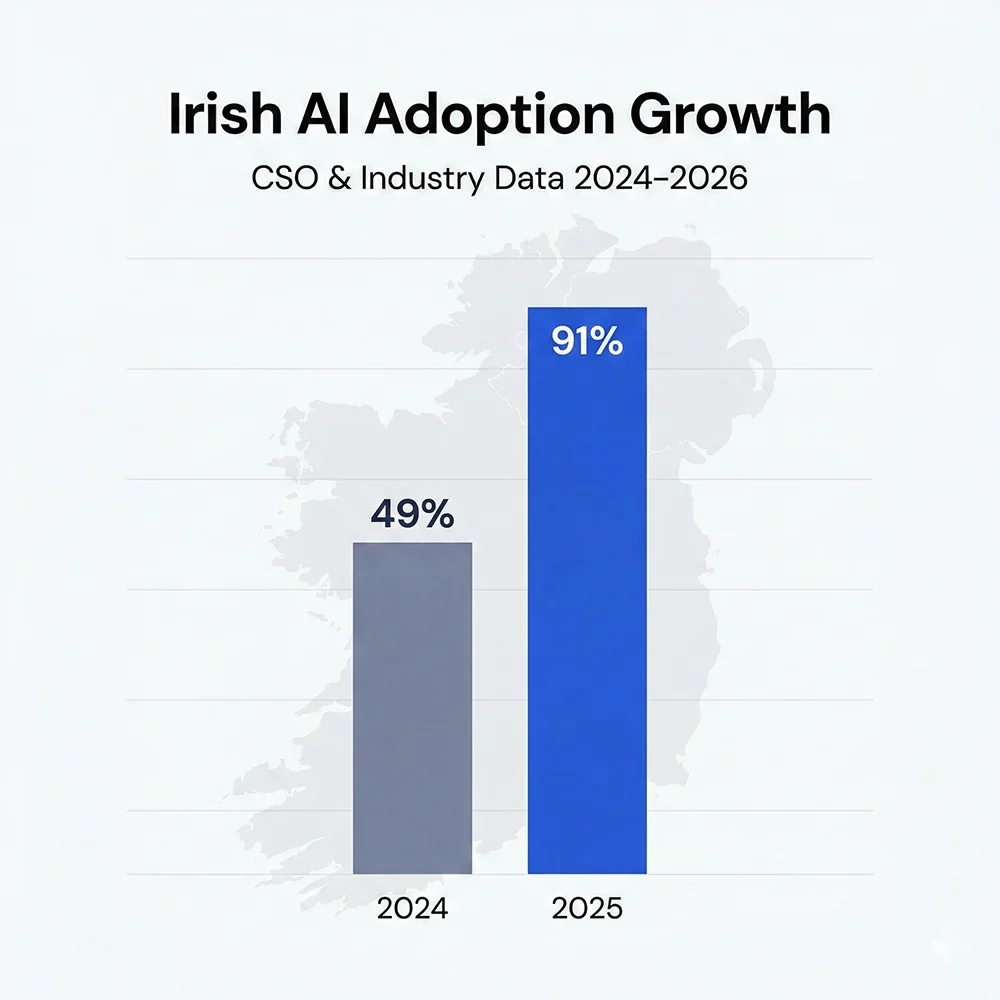
The digital landscape of the Republic of Ireland is navigating a period of unprecedented technological acceleration. By early 2026, Ireland emerged as a preeminent global leader in artificial intelligence (AI) adoption, currently ranking fourth worldwide behind only Singapore, the UAE, and Norway. For domestic businesses, this shift represents a critical inflection point where AI adoption has surged from 49% in 2024 to 91% by early 2025.
Implementing AI chatbots Ireland is no longer a luxury reserved for multinational corporations; it is an essential component for survival in a market where AI is projected to add at least €230 billion to the national economy by 2035. This guide provides Irish SME decision-makers—from Cork boutiques to Galway hotels—with a clear roadmap for launching chatbots that enhance growth while meeting stringent Irish regulations.
The AI Adoption Gap: Why Irish SMEs Must Act Now
While the headline figures suggest a universal embrace of technology, the underlying data reveals a “two-speed” economy. Large enterprises lead the charge with an adoption rate of 58%, whereas small enterprises—the backbone of the Irish retail and hospitality sectors—currently show an adoption rate of approximately 17%.
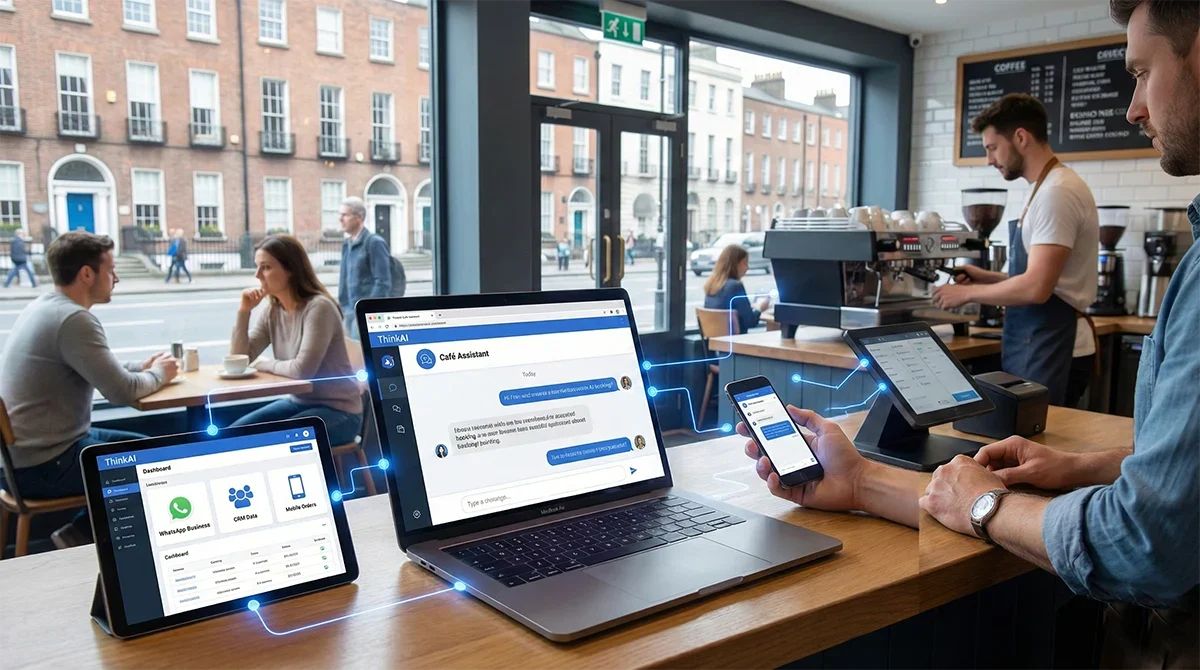
This disparity creates a competitive vacuum. An independent retailer in Limerick or a restaurant in Kinsale that cannot respond to customer inquiries at 2:00 AM—a task easily handled by a chatbot—risks losing market share to larger rivals offering 24/7 engagement.
7 Steps to Deploying AI Chatbots for Irish Businesses
Start by identifying repetitive tasks that consume staff time, such as answering shipping queries or processing restaurant bookings. Define measurable goals, such as “reducing customer service emails by 25%” or “increasing direct weekend bookings by 15%”. Involve your customer-facing team, as they know the questions asked 100 times a week.
Ireland offers one of the most generous support structures in the EU.
- Enterprise Ireland: The "Digital Discovery" grant covers 80% of project costs (up to €5,000) to hire an expert to assess AI ROI.
- Local Enterprise Offices (LEO): Small businesses with fewer than 10 employees can access the "Digital for Business" program for free assessments and expansion grants of up to €150,000.
- Skillnet Ireland: Offers subsidized training like the "Professional Academy Diploma in AI for Business" for as little as €500.
“Good AI needs good data”. Before deployment, ensure customer and product data is consolidated. If physical shop inventory does not match the online store, the chatbot will provide incorrect information, leading to dissatisfaction.
Choose a platform that aligns with your needs, such as Intercom (Irish-founded with massive local support) or Shopify Magic for retail. Conduct a Data Protection Impact Assessment (DPIA) to ensure GDPR compliance and that data is handled with encryption or pseudonymization.
The bot’s personality should reflect your brand’s existing standards.
- Tone: A Dublin financial bot should be professional, while a Galway boutique can be playful.
- Linguistic Nuances: For international guests, avoid local idioms like "Grand" or "I will yea" that may not translate well.
- Technical UI: Implement a 2-second "think time" and typing indicators to mimic human patterns.
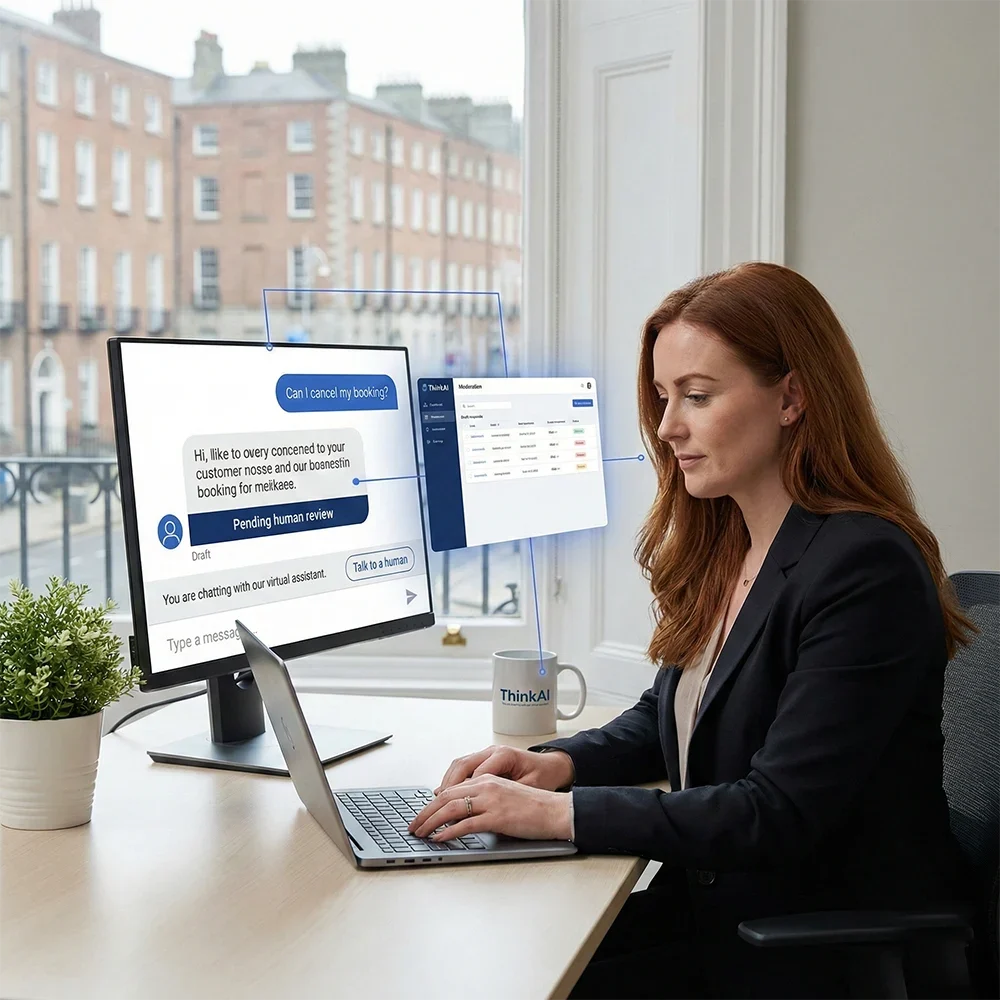
Assign a team member to monitor interactions in real-time during a pilot phase. This catches “hallucinations” (factually incorrect answers) before they impact customers. Always include a visible “Talk to a human” option to ensure users don’t feel trapped
Once live, review your KPIs. Use the conversational data to improve your website’s FAQ section and marketing strategies. As you move toward 2027, consider “Agentic AI“—systems capable of executing multi-step tasks like adjusting prices in real-time based on weather forecasts.
Navigating the Regulatory Landscape: EU AI Act & GDPR
Deployment is governed by stringent frameworks. The EU AI Act, taking full effect in August 2026, mandates transparency.
Essential Compliance Obligations
- Disclosure: Users must be informed they are interacting with AI.
- Human Contact: Under the Consumer Rights Directive, chatbots cannot be the sole point of contact; consumers must have the right to reach a human quickly via phone or email.
- Liability: Traders are held fully liable for information provided by chatbots, including misleading prices or incorrect descriptions.
- Prohibited Practices: AI cannot use subliminal techniques to distort behavior or exploit vulnerabilities.
| Category of Risk | Penalty for Non-Compliance | Regulatory Consequence |
|---|---|---|
| Prohibited AI Practices | Up to €35 million or 7% of global annual turnover | Immediate withdrawal from the EU market |
| >High-Risk Non-Compliance | Up to €15 million or 3% of global annual turnover | Mandatory corrective actions and regulatory supervision |
The AI Office of Ireland (Oifig Intleachta Shaorga na hÉireann) serves as the central coordinating authority, with the Data Protection Commission (DPC) overseeing AI and personal data protection.
AI Chatbot Applications in Key Irish Sectors
Retail: The Personalization Revolution
Irish retailers like Brown Thomas utilize AI for automated, personalized wishlist reminders. AI-powered demand forecasting can analyze seasonal trends and local events—like the Galway Races—to reduce stockouts by up to 40%.
Hospitality: Empowering the "Famous Irish Welcome"
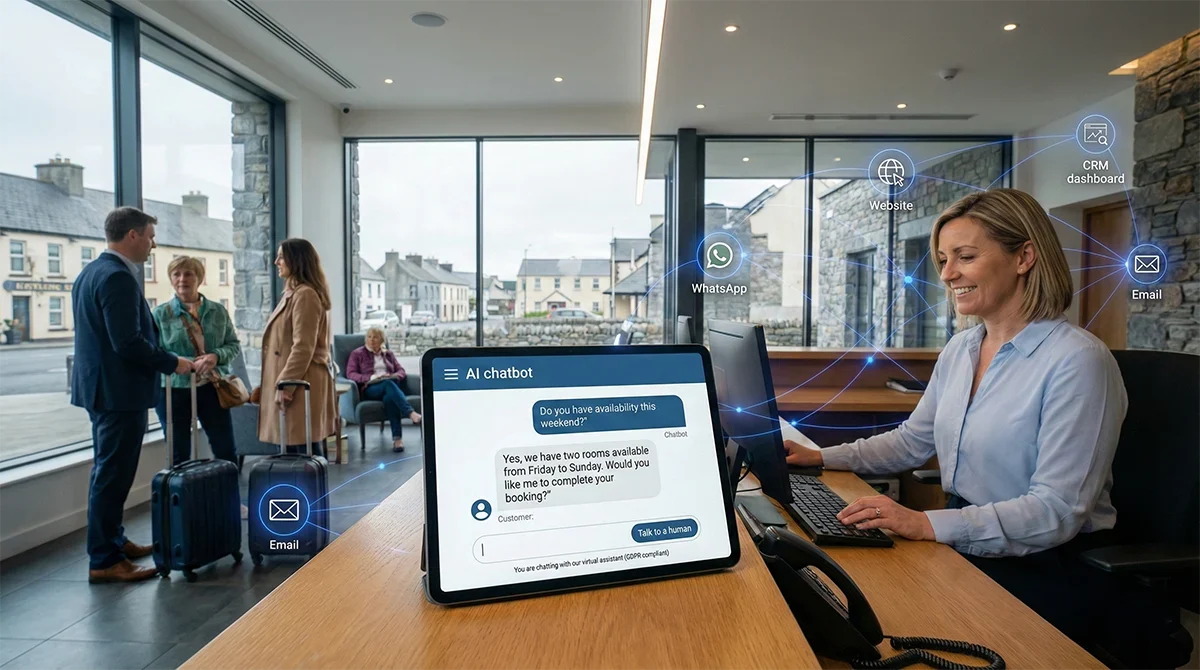
AI acts as a vital support system, allowing staff to focus on guest experience. Digital concierges handle reservations 24/7 in multiple languages, attracting tourists from the US, France, and Germany.
| Function | AI Chatbot Role | Tangible ROI Outcome |
|---|---|---|
| Reservation Handling | Guides users through the booking funnel and completes reservations seamlessly | >20% increase in direct bookings |
| Guest Services | Answers FAQs such as check-in times, breakfast details, and amenities | ~15 hours saved per week for front desk staff |
| Upselling | Promotes spa packages, dining offers, and late check-out options | Increased RevPAR and higher guest spend |
FAQ: Irish Business Chatbot Deployment
Not necessarily. Many platforms offerno-code visual builders. Technical support is usually only needed for complex integrations.
A simple FAQ bot can be ready in a few days to three weeks. Complex custom builds may take 1–3 months
Off-the-shelf services range from €50 to €300 monthly for SMEs. Custom builds often start around €10,000–€20,000.
Yes, by handling ~80% of routine questions and cutting customer service costs by up to 30%.
Yes. Enterprise Ireland and LEOs offer grants covering 50% to 80% of project costs.
Disclose the AI use, minimize data collection, and ensure data is stored securely, preferably on EU servers.
Yes, many AI platforms support Irish (Gaeilge), though you may need to manually curate responses for quality
Businesses are legally accountable for bot errors under the Product Liability Directive. Regular monitoring is essential.
No. Chatbots should augment staff by handling routine
tasks, allowing humans to focus on high-touch, complex interactions.
It’s when employees use unapproved public AI tools for company data, risking GDPR breaches.
Repurposing chatbot Q&As into structured website content (FAQ schema) helps search engines and AI assistants find your business.
Next-generation AI that doesn’t just chat but executes tasks
autonomously, like restocking umbrellas when rain is forecast.
51% of consumers prefer bots for immediate service needs, valuing 24-hour availability.
The gap where 58% of large Irish firms use AI compared to only 17% of small businesses.
Yes, by integrating with calendar systems or CRMs like HubSpot and Salesforce.
Track KPIs like Resolution Rate, Containment Rate, and the number of leads generated.
An Enterprise Ireland grant covering 80% of the cost to hire a digital expert for 3–7 days.
Yes, using Retrieval-Augmented Generation (RAG), bots can search your PDFs and docs for accurate answers.
A regulation (applying June 2025) requiring digital services to be accessible to people with disabilities.
Yes, it happens when businesses experiment with isolated tools without a cohesive strategy.
Use a “co-pilot” model where AI assists but humans make final decisions on sensitive matters like recruitment.
Visual cues like “…” that let users know the bot is processing, making the interaction feel more natural.
Yes, your policy must mention the chatbot and any third-party AI services utilized.
Yes, they can proactively offer spa packages or late check-outs, increasing revenue per guest.
The central coordinating authority for AI regulation established in 2026.
A government fund covering 50% to 80% of digital project costs for SMEs.
A 2-second pause prevents users from feeling overwhelmed by instant text.
Yes, platforms like Heyy allow multichannel unification across Instagram, WhatsApp, and web.
E-E-A-T: Why Trust This Guide?
This guide is produced by the ThinkAI Editorial Team, drawing on real-world insights from the Irish retail and hospitality sectors. Our recommendations are grounded in current CSO data and the 2026 legislative framework of the AI Office of Ireland. We advocate for a “human-in-the-loop” approach, ensuring that AI empowers the Irish workforce rather than replacing it.
If you’re ready to explore how AI can be safely and strategically deployed in your business, get in touch with ThinkAI to start your transformation today.