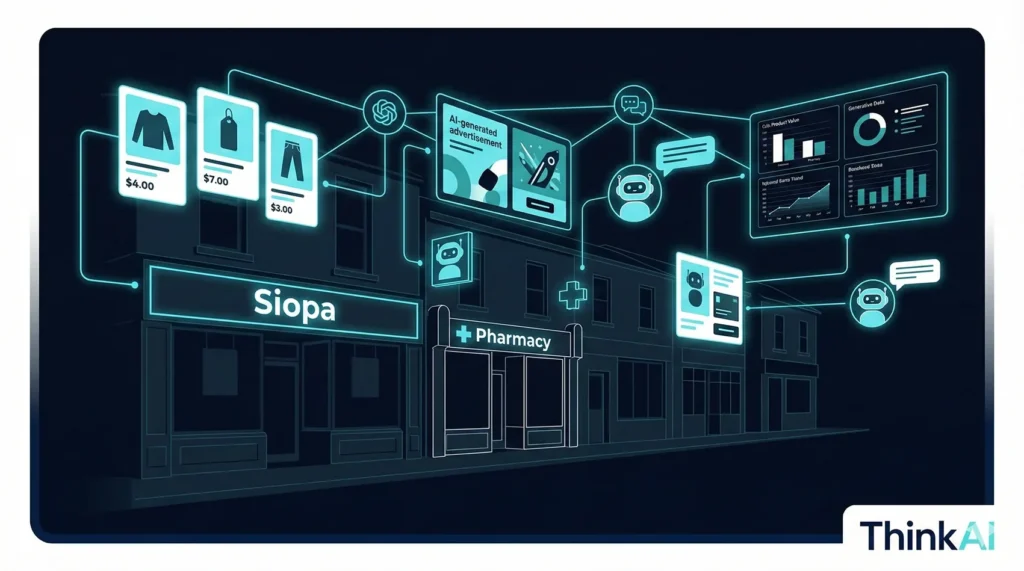


Generative AI in Ireland retail and AI-powered retail solutions have the potential to transform how local shops and online stores connect with customers. By analysing data and automating content, AI-Driven Retail Solutions can personalise marketing, streamline inventory, and enrich e‑commerce content – all while Irish businesses navigate GDPR and the new EU AI Act.According to one analysis, AI could eventually add €250 billion to the Irish economy by 2035. At the same time, Irish consumers remain cautious: a recent Accenture survey found 70% of shoppers know about generative AI but only 16% are excited about using it when shopping. In this climate, Irish retailers are exploring AI applications that boost sales and efficiency without breaking regulations or customer trust.
We’ll explore top use cases of generative AI in Irish retail, practical tips for getting started, and the legal and ethical safeguards you need. Throughout, we cite recent Irish and industry sources to ensure our advice is local and credible.
Why Irish Retailers are Embracing Generative AI
Irish retailers are increasingly adopting AI to stay competitive. Hyper-personalisation is a buzzword: by using customer data, AI can make each shopping experience unique. As Dell’s Neil Bowden notes, “Retailers in Ireland are embracing AI to personalise and streamline the customer journey” – for example, an AI “wine adviser” app that matches wines to meal preferences in real time. Industry surveys back this up. One analysis finds that 87% of adopters saw revenue gains and 94% reduced costs after piloting AI (even simple pilots like chatbots or dynamic pricing). Another report indicates 67% of retailers are testing generative AI and 49% have already deployed it in some form.
Despite this momentum, Ireland faces a skills gap. With 99.8% of Irish companies being SMEs, many lack in-house AI expertise. Dr Ashish Kumar Jha (Trinity College Dublin) warns that “SMEs – which make up 99.8% of enterprises in Ireland – risk falling behind due to barriers in expertise, investment and deployment”. In short, AI offers big gains but requires thoughtful adoption: cleaning data, piloting, and building skills.
- Revenue and efficiency boosts: Retailers report significant ROI from AI. For example, a Shopify study found that personalised marketing can cut acquisition costs by up to 50% and boost sales by 5–15%.
- Industry support: The Irish government is backing AI. Enterprise Ireland offers an AI Discovery” initiative to help businesses identify AI opportunities and plan projects. Skillnet networks (like Retail Ireland Skillnet) fund training programmes so your team can upskill on AI at subsidised rates.
Overall, Irish retailers see generative AI as a way to improve customer loyalty and efficiency. The trick is starting small: pick a clear use case, involve your team, and measure results before scaling.
Generative AI in Ireland Retail: Top Use Cases
Generative AI is versatile. Here are the top use cases for Irish retail, with examples and stats:
- Personalised Marketing & Recommendations: AI can craft tailored emails, ads and product suggestions. For instance, Shopify’s AI tools can generate unique product descriptions and email subject lines based on past purchase data. This makes customers feel understood – boosting click-through rates and loyalty. Personalised offers can reduce acquisition cost and increase average order value. Over time, the AI learns customer tastes and refines recommendations.
-
Content and Copywriting: Writing all your own product copy and social posts is time-consuming. Generative AI (like GPT-based chatbots or Shopify Magic) can draft blog posts, ads, or item descriptions in seconds. For example, you can feed it a product brief (“wireless headphones for gym use”) and it’ll spit out polished marketing copy and social media blurbs. Think of it as an assistant: you still proofread and tweak the output, but the AI saves hours of writing. The same generative AI design capabilities can also help retailers create visual concepts, promotional assets, and branded content more efficiently.
- Customer Service & Chatbots: AI chatbots (e.g. via Shopify Inbox or custom apps) greet website visitors, answer FAQs, and even recommend products on the fly. This means a shopper can ask questions 24/7 without a human replying instantly. In fact, a survey cited by Shopify found 96% of shoppers would like companies to use AI chatbots more, and 94% believe conversational AI will change customer support. In practice, AI chatbots can handle simple queries (size info, store hours) while alerting a human agent for complex issues. This frees up your staff to do higher-value tasks.
- Inventory & Operations: Generative AI isn’t just for marketing – it powers behind-the-scenes smarts too. AI demand-forecasting tools analyse POS data, weather forecasts, and even social media trends to predict which products will sell. The system can auto-reorder stock when levels run low, optimise pricing on slow-moving items, and alert you to supply chain issues. In short, you get the right goods in stock at the right time, reducing waste and lost sales. Many retailers use this to run dynamic pricing or improve in-store availability across branches.
- Media Generation: AI isn’t limited to text. Tools like Shopify Magic can edit product photos (removing backgrounds or adjusting lighting) with a click. Even create quick product videos: apps like Synthesia or Steve.ai will turn your product images and key points into a short video for social media. This helps an Irish retailer refresh visuals each season without a photographer. It’s like having an extra creative team member – albeit one that sometimes needs a guiding hand (always check outputs for accuracy).
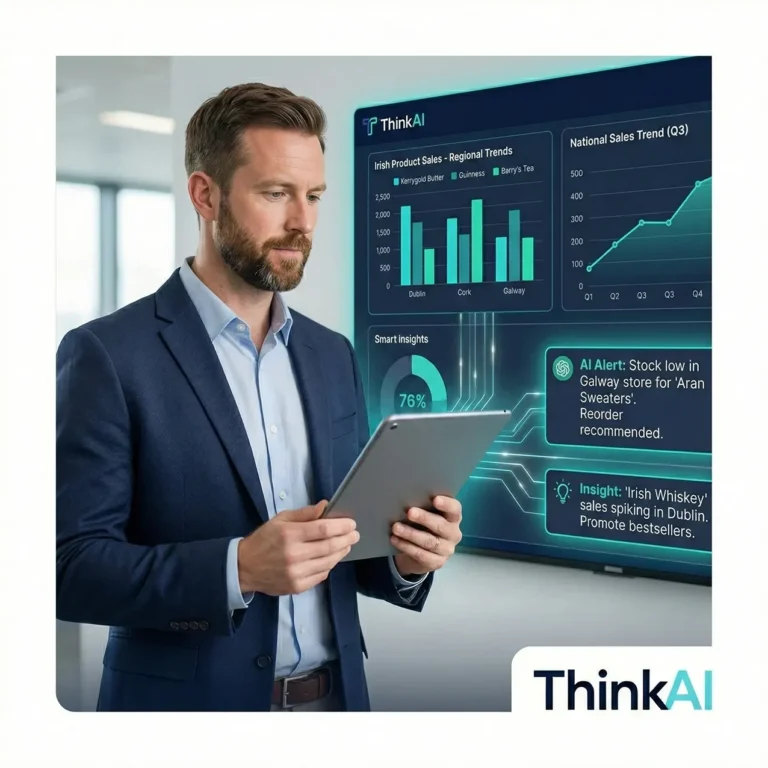
- Customer Segmentation and Analytics: Behind the scenes, generative AI can segment customers into intelligent groups (“VIP shoppers”, “bargain hunters”) by analyzing their behaviour. This allows for targeted campaigns or loyalty schemes. For example, Shopify Sidekick can let you query your own sales data in plain English (e.g. “show top 10 products for Dublin stores last quarter”), giving business insights at warp speed.
These use cases combine to create a smarter, more automated retail operation. As EY’s Irish report notes, generative AI and real-time data can deliver products and offers that match each customer’s preferences and behaviour, both online and in-store.
Personalising the Irish Shopping Experience
Personalisation is perhaps the most visible benefit of generative AI. By leveraging data from loyalty apps, online browsing and purchase history, AI can make each Irish shopper feel known:
- Online Recommendations: On your e-commerce site, AI can dynamically show “recommended for you” products. If a Dublin customer often buys organic food, AI might highlight new organic arrivals or recipe pairings. Over 60% of shoppers say they welcome budget-friendly AI suggestions in-store, and a similar share (around 62%) find online AI recommendations acceptable.
- In-Store Assistance: Even on the shop floor, apps and smart kiosks can use AI. Imagine an AI-based virtual assistant on a tablet in-store: by entering a few preferences, customers get styled outfit suggestions (similar to a personal shopping stylist). As Bronagh Riordan of EY Ireland explains, tools like mobile apps and loyalty data can “suggest products and deliver personalised services as the customer physically shops”. This omnichannel consistency ensures the same AI-driven experience whether shoppers are on Grafton Street or browsing at home.
- Fashion & Luxury Retail: Brown Thomas, Ireland’s premier department store, is an example. They’ve integrated Salesforce’s AI-powered Commerce Cloud and Marketing Cloud to personalise customer journeys across channels. From sending wishlist reminders to tailoring promotions, AI helps Brown Thomas expand efficiently while keeping the high-touch experience their shoppers expect.
In short, Irish retailers are using generative AI to make shopping less generic and more delightful. But it’s not magic – it still relies on high-quality data and human oversight. Poor data leads to poor personalisation, which even AI can’t fix. That’s why businesses focus first on getting data right and defining clear goals before letting the algorithms loose.
AI-Powered Content for E-commerce
E-commerce thrives on content: product descriptions, category pages, blog posts, social media and email marketing. AI can turbo-charge this content creation:
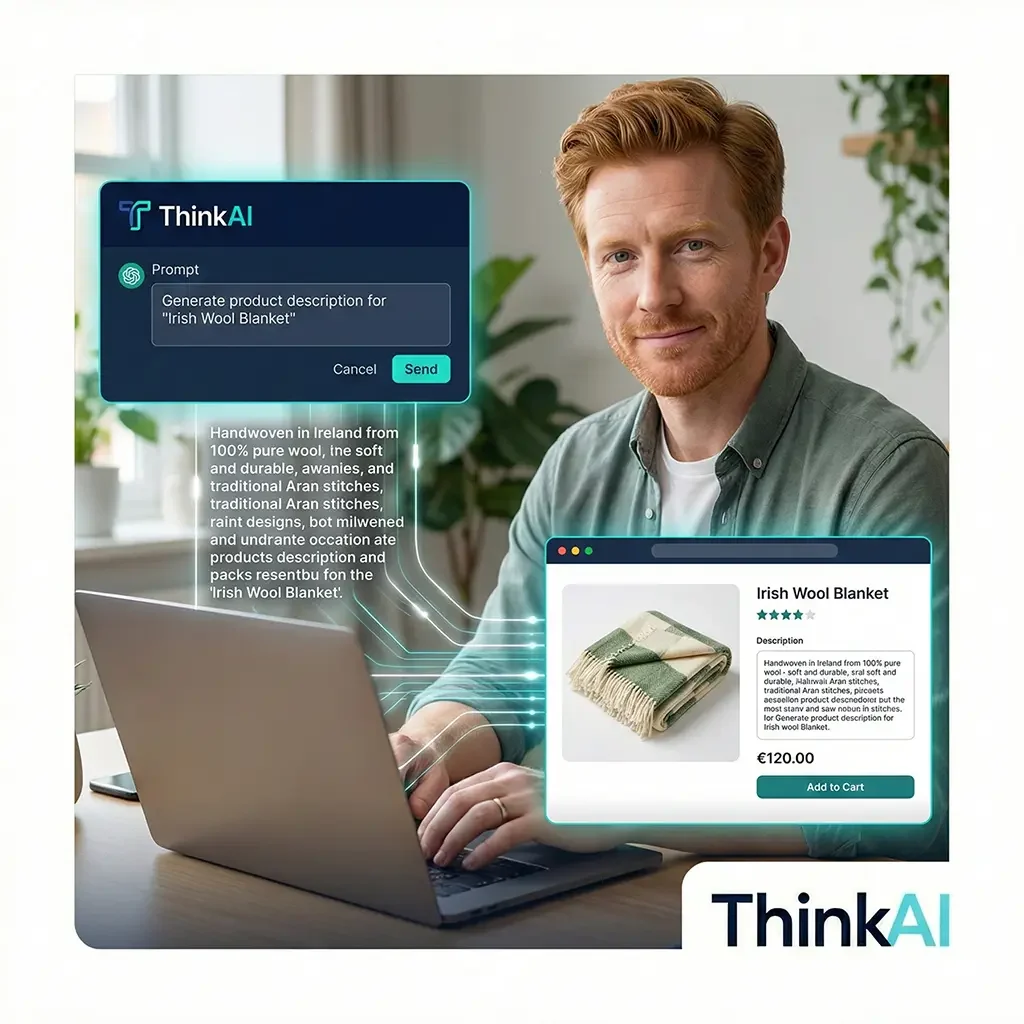
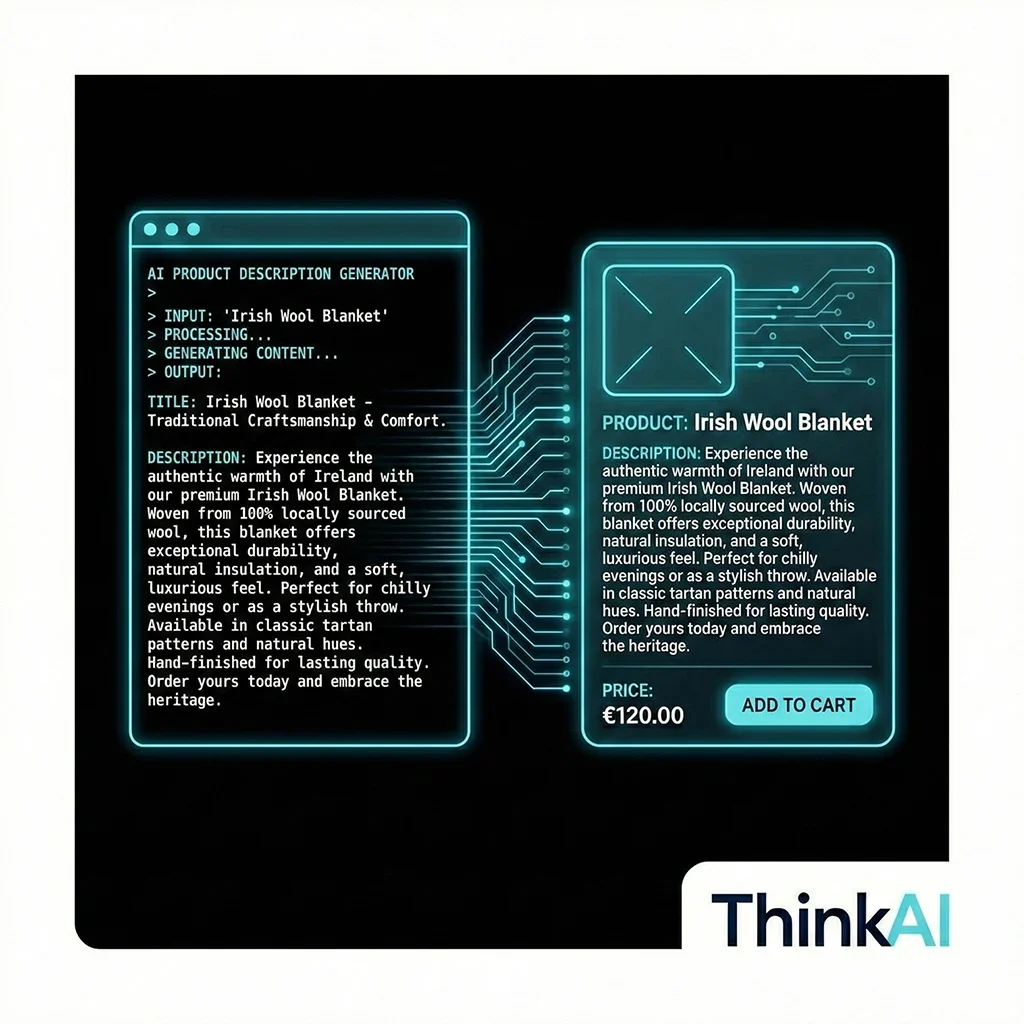
- Product Descriptions: Instead of writing hundreds of product descriptions by hand, an Irish retailer can use AI to draft them. For example, input key details about a handwoven Aran sweater, and the AI outputs a polished description highlighting its warmth and craftsmanship. This often requires just 10–20 seconds per product instead of many minutes. (Of course, always review for accuracy and tone!)
- Email and Social Copy: Generative AI can spin up dozens of email subject lines or social posts in your brand voice. If you’re promoting a mid-season sale, AI can suggest witty angles (“Wrap up your winter in these cosy knits!”) that you then tweak as needed.
- SEO Blog Posts: To drive traffic, think AI can outline or even draft blog articles. For instance, asking it to write “10 gift ideas for tech lovers” could yield a first draft that your team then localises. This can improve your SEO and keep content fresh without hiring extra writers.
Shopify’s tools demonstrate this: their Sidekick AI can recommend content ideas based on trending store data, such as writing a post about styling a popular jacket. Just remember: AI content is a starting point, not the final word. You’ll often combine AI output with human creativity (and an Irish dose of wit) to ensure it resonates locally.
Streamlining Inventory and Operations
Operational efficiency is another big win for Irish retailers leveraging AI retail innovation. By analysing patterns, AI-powered retail tools can automate mundane tasks:
- Demand Forecasting: AI models crunch past sales, seasonal trends, weather and even social chatter to predict how much stock you’ll need. One ERP-integrated AI might see that leather jackets spike before November, or that wool hat sales double when a cold snap is forecast. This helps avoid over-ordering or stock-outs.
- Automated Reordering: Connected to your stock data, AI can trigger replenishment orders when inventory falls below a threshold – for multiple stores – without manual checks.
- Dynamic Pricing: AI tools can recommend adjusting prices or running timed discounts. For example, if a product isn’t moving, AI might suggest a small sale or bundle. This is data-driven and much faster than manually analysing spreadsheets.
- Chatbots for Operations: Beyond customer chatbots, some retailers use internal “AI assistants” for staff. For example, an AI Slackbot that lets store managers query stock levels or order status by typing a question, saving time on routine inquiries.
- Fraud and Loss Prevention: In some contexts (especially for online payments), AI models can flag suspicious transactions, helping reduce fraud. In physical stores, AI cameras (if used) might detect unusual activity (though this treads carefully on privacy).
These operational uses of AI (from forecasting to chatbot automation) directly cut costs and shrink the time staff spend on routine tasks. In fact, one industry report notes ~90% of small firms are already using AI for tasks like reporting and automation. By freeing up staff from “repeatitive stock counts” or manual pricing, AI makes the whole business leaner – let’s say it prevents you from being “mad as a box of frogs” every time you reconcile inventory spreadsheets.
Staying Compliant: GDPR and the EU AI Act
Irish businesses must use generative AI responsibly and legally. Two key frameworks apply:
- GDPR (Data Protection Act 2018): Any AI that processes personal data (e.g. customer names, addresses, purchase history) must comply with GDPR. In practice, that means you need a lawful basis to use the data (often “consent” or “legitimate interest”), you collect only what’s needed, and you keep it secure. The Irish Data Protection Commission reminds businesses that when personal data is involved in AI use, GDPR rules “come into play” just as they would for any tech. For example, if you use a chatbot that personalises messages, you must ensure that any personal info used is handled lawfully and users know how their data is used. Keep records of processing activities (as required by GDPR) and be ready to answer subject access requests even if an AI model generated something about a customer.
- EU AI Act: This new law (due to take effect in stages from 2024–2027) introduces risk-based rules for AI systems. Since it’s EU-wide, it’s directly applicable in Ireland. Under the AI Act: prohibited AI practices must be eliminated; by Feb 2025, providers must label systems and push AI literacy; from Aug 2025, general-purpose AI (like big language models) has new transparency requirements; and from Aug 2026, strict rules apply to “high-risk” AI (e.g. biometric identification). For retailers using generative AI, the key is governance: document your AI’s data sources and development process, regularly test it for biases or errors, and ensure “human-in-the-loop” oversight. In short, you can’t just deploy AI and forget it – you must keep logs, do risk assessments, and be able to explain its outputs if asked by regulators.
- Ethics and bias: Independent of laws, Irish consumers expect fairness. We advise testing AI outputs for inappropriate content or bias. For instance, if your AI writing tool starts using slang that offends or gets Irish lingo wrong, catch it early. A good rule is: treat AI-generated content as drafts that a human reviews and edits. This avoids silly mistakes (the dreaded “computer says no” outcome) and ensures the final result is on-brand and respectful.
Action items (checklist):
- Ensure any personal data in your AI use has a GDPR-compliant basis (consent, contract, etc.) and that users know how it’s used.
- Keep records of AI data and decision logic. The AI Act requires documentation of data provenance and training processes.
- Run bias and accuracy tests on your AI outputs. If it’s giving wrong information, fix the data or model.
- Maintain human oversight: never let AI “set it and forget it.” A staff member should review AI suggestions before they reach the customer.
Following these steps is not just red tape – it builds trust. Irish law is strict (serious breaches can cost millions), but it also means a level playing field. If you get compliance right, customers and regulators alike will treat your AI as a reliable assistant, not a mystery “bot” churning out who-knows-what.
Getting Started with Generative AI (for Irish SMEs)
Ready to roll up your sleeves and try generative AI? Here’s a simple roadmap tailored to Irish retailers:
Pick a use case. Start with one clear goal – for example, a shopper chatbot, an automated email campaign, or a demand forecast for a key product. Don’t try to boil the ocean on day one. The Nucamp guide recommends one measurable pilot (chatbot or pricing model, say) and proving ROI locally.
Gather and clean data. Good AI needs good data. Before you fire up any AI, ensure your customer/product data is in one place and as error-free as possible. Garbage in = garbage out: missing or wrong data will make the AI give strange suggestions (and leave you scratching your head).
Choose the right tools. For many retailers, the fastest route is a unified commerce platform plus AI features. For example, Shopify’s POS with Shopify Magic or Sidekick can give you built-in AI for content and inventory. If you’re on a different system, look for integrations (like chatbots compatible with your website). Remember: think broadly. Even general-purpose AI (ChatGPT, Bard, etc.) can be used if plugged into your data securely.
Take advantage of supports. As an Irish business, use the grants and networks available. Enterprise Ireland’s AI Discovery programme can help cover consultancy days to plan your project. Skillnet or Ibec offers training courses on AI (often subsidised). Retail Ireland Skillnet, for example, has courses tailored to shop managers.
Implement “human-in-the-loop.” When you launch the pilot, assign someone (or a team) to monitor it closely. If it’s a chatbot, have staff review chats for errors; if it’s content, have editors proofread AI-generated copy. This ensures you catch any AI mistakes (or “hallucinations”) early and fix them.
Measure results and iterate. Define KPIs from the start: extra sales, time saved, customer feedback scores, whatever fits your use case. After a short period, compare before-and-after. Did email open rates rise? Are customers finding products faster? Did staff time on inventory drop? Use these insights to refine the AI or rollout more broadly.
The key is pragmatism: start small, learn, then scale. Many Irish SMEs find that, after a successful pilot, the same AI tools can be extended to other shops or campaigns. And if something isn’t working, stop or change it – there’s no harm in saying “that’s a bit of a faff and not worth it” and trying a different approach.
Irish Case Studies and Examples
Real-world examples show generative AI is not just theoretical:
- Brown Thomas (Dublin): This luxury department store uses Salesforce AI for personalized marketing and inventory visibility. Customers get consistent experiences whether shopping online or in-store. Thanks to AI-driven marketing cloud tools, their marketing emails (order updates, wish lists) are tailored to each customer’s journey.
- Enterprise-level (Bord Gáis Energy): Not retail, but worth noting: Bord Gáis uses Salesforce AI to improve customer service and campaign management. The lesson for retailers is clear: if big brands in Ireland trust AI, so can SMEs (with the right safeguards).
- Shopify in Ireland: Many Irish online retailers use Shopify, which has rolled out AI features like Sidekick and Magic. These let even small shops generate product copy or analyse sales data using everyday language. For example, an Irish apparel brand could use Sidekick to ask “What products sold best last Christmas?” and get instant insights, without writing any code.
- Accenture’s Irish survey: We’ve already noted the low excitement (16%). The positive news is that Irish shoppers do appreciate helpful AI if it saves them time or money. For instance, 63% of shoppers said they would welcome budget-friendly product suggestions in-store. This suggests starting with AI features that have clear customer benefits (discount recommendations, gift suggestions) can ease adoption.
- Tech Ireland Digital Skillnet AI Workshops: In late 2023 and 2024, Skillnet Ireland ran Generative AI masterclasses for business leaders, reflecting strong interest among Irish companies. These support networks mean you’re not alone: there’s a growing community and expertise on tap.
In summary, Irish case studies show generative AI being used in marketing, inventory, and service—across fashion, energy, and tech. The common thread is that these projects were business-driven, data-backed, and carefully managed. To explore how this can work for your business, feel free to get in touch or reach out today.
Frequently Asked Questions
Generative AI refers to algorithms (like large language models or image models) that can create content: text, images, recommendations, etc. For retail, it’s a toolbox, not a mystery. It can write product descriptions, answer customer queries, suggest inventory orders, and more. By using generative AI, you can automate routine tasks and personalize at scale – meaning you can serve customers faster and sell smarter. We care because it’s a competitive advantage: retailers using AI often see quicker marketing wins and cost savings.
Irish shoppers are aware but cautious. An Accenture survey found 70% know about generative AI, but only 16% were excited to use it in shopping. Many (36%) are “curious but concerned” about privacy and mistakes. That said, consumers do welcome AI features that save them hassle: e.g. 60% of Irish shoppers said they’d like AI to help suggest gifts within budget. The takeaway: highlight the benefits (time-savings, better deals) and be transparent. If your AI helps customers (for example, a chatbot that answers their questions quickly), they’re more open. Always give customers choice – like an opt-in to AI recommendations – to ease them in.
ROI varies by use case. Industry reports suggest high adoption ROI: for example, around 87% of retailers who piloted AI reported revenue increases, and 94% saw reduced costs in some operations. For a small shop, you might start with something that directly ties to revenue: say a chatbot that recovers abandoned carts or personalised emails that boost repeat sales. Track clear metrics (extra sales, fewer returns, staff hours saved). Even a 5–10% sales lift or a modest cost cut can pay back any tool subscription. The key is to start with one pilot, measure its impact, then expand if it pays off. Think of it like a revenue stream: if AI helps send out 20% more emails or recommend the right product to 10% more customers, that’s a return worth watching.
Costs range widely. Some AI tools are free or low-cost: for instance, you can use free tiers of ChatGPT, or AI features built into platforms like Shopify (included in your subscription). Other solutions (advanced AI services, enterprise software) charge monthly fees or per-use fees. A sensible approach is to try low-cost or trial options first. For example, generate some product copy with a free AI writer, or install a free chatbot plugin. If you need more, you could pay a few hundred euros/month for a premium AI service. Importantly, factor in not just subscription cost but also staff time to set it up. Often the bigger cost is ensuring data is ready and people know how to use the tool. Use government or network funds (like grants or training vouchers) to offset these costs where possible.
AI is surprisingly accessible now. Many AI tools come as pay-as-you-go cloud services (no huge upfront hardware investment). Free trials let you test ideas. For example, if you have an online store on Shopify, AI features like Sidekick and Magic are already built in. A small shop can start with a free chatbot or a Google Sheets AI plugin to analyse sales. The real investment is in time and learning. Smaller retailers should start with one problem to solve and use simple tools. Also, Enterprise Ireland and Skillnet can cover some project costs or training. So it’s within reach for an SME to implement AI pilots without massive budgets.
Start small and smart. Pick one clear use case (e.g. a Facebook ad written by AI, or a quick-sales chatbot), and treat it like a pilot project. Set a goal (more newsletter sign-ups? fewer unanswered customer questions?). Use existing tools or prototypes first. Always include a human review step: for instance, have a staff member proofread the AI’s work. Clean your data before feeding it in – poor input data causes mistakes (“garbage in, garbage out”). Document everything (which tool, what data, who monitors it) because the EU AI Act will require traceability. Also, train at least one person on the basics of AI (Enterprise Ireland and Skillnet offer such training). Finally, measure results and tweak the approach. This reduces risk and ensures the AI works for your store.
There’s a growing landscape of AI tools. Many retailers use large language models (like ChatGPT or Google’s Bard) for drafting text – they’re flexible and relatively easy to start with. E-commerce platforms often have their own AI: for instance, Shopify Magic/Sidekick is tailored to store data and marketing tasks. For email marketing, some tools like Klaviyo have AI-driven personalization. For images, tools like DALL·E or Canva’s AI can create or edit product visuals. The “best” tool depends on your need: if you want SEO copy, try a writing AI; if you need inventory forecasts, look at AI analytics apps. It’s usually best to use something made for retail (Shopify apps, for example) before jumping into general AI, because they integrate with your existing data.
Yes, you can use public AI chatbots for ideas and drafts, but be careful with confidential data. If you input real customer info into a public AI, check the privacy terms. It’s safer to use a private or on-premise solution for sensitive data. That said, you can generate marketing slogans or email templates with ChatGPT and then refine them in-house. Think of ChatGPT as an assistant on call – it can speed up brainstorming or rough drafts, but you should always human-check the results. Also, try to use it in a GDPR-compliant way (don’t upload entire customer lists into it).
AI hallucinations (factually incorrect or nonsense outputs) are a known quirk. Mitigate this by keeping a human in the loop. For example, if AI writes a product description, have someone verify the details against the actual product. Use guidelines in your prompts to avoid crazy results (e.g. “Write in clear Irish English and only list product features I’ve given you.”). You can also use smaller, domain-specific models which often hallucinate less. In practice, treat AI-generated content as a draft – it speeds things up, but final responsibility for accuracy lies with a person. This is part of responsible AI practice.
Not inherently – AI is just a tool. What matters is how you use personal data with it. The Irish Data Protection Commission notes that whenever personal data enters an AI system, GDPR rules still apply. That means you need a lawful basis (consent or legitimate interest) to use any customer data, and you must protect it. If you’re just using AI to generate generic content, GDPR isn’t a big issue. But if the AI system processes personal info (e.g. personalizes an email), you must do all the usual checks: keep minimal data, keep logs, inform customers. In short, follow GDPR as always. AI won’t magically “break” it – human misuse will.
The EU AI Act (coming into force in stages through 2026) won’t ban generative AI, but it does set rules for transparency and safety. For most retailers, generative AI is “general-purpose AI”, which from August 2025 must meet certain requirements (like providing user information and logging data sources). If you use AI for high-risk areas (like biometric ID or credit scoring), stricter rules apply (unlikely in retail). In practice, ensure you label AI use (e.g. say “AI-generated text”), have a risk management plan, and test for bias or errors. The penalties for non-compliance can be severe (millions in fines), so keep documentation and, if needed, consult an expert. ThinkAI can help here with compliance checklists.
It’s a common concern. Start with awareness: explain simple, practical benefits of AI to your team (e.g. “This chatbot will answer routine customer questions, freeing you up for higher-value tasks”). Upskill through short, hands-on workshops – Skillnet courses or even a “lunch-and-learn” on using an AI tool. Initially, let staff experiment with low-risk AI features (like a grammar-check plugin or an AI chat assistant) under supervision. Encourage feedback. Often, the biggest hurdle is fear of the unknown. Show that AI is meant to help, not replace them. With training, staff quickly adapt – plus it avoids the dreaded “computer says no” attitude by making them part of the loop. Remember: AI projects need a champion in the team – someone curious and tech-friendly to lead the rollout.
Yes, generative AI can write web content that helps SEO – like keyword-rich product pages or blog posts. The advantage is speed: you can prototype dozens of pages quickly. However, AI content can lack depth or originality if unchecked. Always refine AI-drafted content to ensure quality and uniqueness. For example, generate a draft with AI, then have a human add local flavour or verify facts. This hybrid approach saves time while avoiding “robotic” writing. As ThinkAI’s approach suggests, pairing AI with human oversight ensures copyright safety and authenticity. Many Irish SMEs use AI tools for first drafts and then tweak them into polished SEO pages.
AI is more about augmenting workers than replacing them, at least for now. In retail, AI handles routine tasks (like suggesting the next marketing email or compiling daily reports), which frees your team to focus on customer relationships and strategy. For example, instead of a staff member writing each product description from scratch, AI can generate drafts so the team can focus on photography or in-store experiences. That said, some roles may evolve: cashiers might shift to “customer guides” if self-checkout rises, or data analysts might add AI monitoring to their tasks. The savvy move is to reskill staff (training in AI basics) so they work with AI, not feel threatened by it. A pilot program or training (Funded by Skillnet, for instance) can reassure staff by showing them how the tech works.
You can see small wins very quickly (even days or weeks) if you choose a quick-turnaround pilot. For example, launching an AI chatbot on your website can immediately reduce the number of missed inquiries and free up staff time – measurable in a month. Generating marketing emails with AI might start improving open/click rates in the first campaign. Larger projects, like fully integrating AI inventory forecasting, take months to gather data and fine-tune. In general, expect fast results from front-office tools (chatbots, copywriting) and medium-term results from back-office projects (analytics, forecasting). Always define a short-term metric (an email campaign’s response rate, say) to track within 4–6 weeks and a medium-term metric (sales lift, labor hours saved) for 3–6 months.
You don’t need a PhD or full data science team, but basic AI literacy helps. Key skills include: understanding what data is needed (quality and scope), how to prompt or configure AI tools, and how to interpret AI outputs. Courses like Nucamp’s “AI Essentials for Work” (15 weeks) or Skillnet workshops cover these in practical ways. For in-house training, focus on “AI awareness” for all staff (what AI can do, privacy aspects) and hands-on training for the team directly using it (marketing staff on how to guide an AI writer, or inventory staff on reading AI forecasts). Often, bringing in an external consultant for a workshop (possibly funded by Enterprise Ireland) can jump-start this knowledge quickly.
Define clear KPIs before you start. These depend on your use case. Examples: For a marketing AI pilot, track email click-through or conversion rates. For a chatbot pilot, track number of inquiries resolved and decrease in average response time. For inventory AI, measure forecast accuracy or reduction in stockouts. Compare the results to your baseline (the numbers before AI). Even a 10–20% improvement or cost saving can justify the effort. Also get qualitative feedback: do customers notice the personalization? Do staff find their jobs easier? That feedback is part of your ROI. Document these metrics, because if you can show your management “X% more sales” or “Y hours saved”, it makes a strong case to expand the AI project.
Yes. If you serve multilingual customers, AI can translate and localise content quickly. For example, you could ask an AI to translate your product page from English to French and it will do it in seconds. It can also rewrite copy to fit cultural tone. Still, have a native speaker check the result before publishing. This feature lets Irish retailers sell abroad or serve linguistic communities (e.g. Irish, French, Spanish) without hiring multiple translators. It’s a massive time saver, but remember to review for marketing nuance.
A few things:
(1) Data privacy: Never feed identifiable customer data into an AI unless it’s encrypted and compliant, or you’ve ensured no data is stored long-term by the AI provider.
(2) Bias/inaccuracy: AI can reflect biases in its training data. For instance, if generative AI learned from content that under-represents certain groups, it might produce irrelevant suggestions for them. Be mindful of this and test outputs with diverse customer profiles.
(3) Over-reliance: Don’t blindly trust AI. Always have humans review key outputs.
(4) Technology churn: AI tools change fast. What’s cutting-edge today might be outdated in a year (think early chatbots vs GPT-4). Stay flexible.
(5) Cost creep: Watch usage-based AI tools; if an AI video generator starts running 100 videos a month, it could get pricey. Set budgets and alerts.
Use “copyright-safe” practices: rely on AI models trained on licensed or public data. If you use a service (like OpenAI’s GPT-4), check its terms – many forbid using outputs verbatim for sensitive IP. Always review and, if needed, edit AI-generated images (to avoid closely replicating existing designs). ThinkAI’s approach is to treat AI content as a draft: you polish it and ensure it’s original before publishing. Some retailers also keep track of which tool version was used, in case there’s a question later. In short, don’t publish AI output as-is without a human check – that’s both an editorial and legal safe practice.
Absolutely. AI can suggest keywords, outline blog posts, and even generate meta descriptions. For example, give it a brief on a product (“organic Irish wool blanket”) and it can spin out a landing-page copy with relevant keywords. This jumpstarts your SEO work. Just make sure the content still reads naturally. Using AI for SEO is like having a content intern: it can draft dozens of ideas quickly, but you still finalize them. When done right, AI helps keep fresh content flowing to improve your search rankings without extra manpower.
Yes. Many AI tools are designed for non-techies. For example, chatbots often integrate via a simple Shopify or WordPress plugin; you configure settings in a web form, not code. AI writing tools often have user-friendly interfaces (you type a prompt and click generate). The key is choosing user-friendly products or platforms. And remember, AI doesn’t have to be complicated. A single-click email generator can still give benefits. If IT is a struggle, start with AI features that fit your existing systems (like a built-in Shopify AI tool) rather than a custom build. Think of it as adding a smartphone app to your business – new, but often easier than it seems.
There are plenty of resources. ThinkAI is one consultancy in Ireland that specialises in guiding SMEs through AI strategy and implementation – from audits to training. Enterprise Ireland offers advisory grants and workshops, often connecting businesses with AI specialists. Skillnet training programmes cover AI for business (Retail Ireland Skillnet has retail-specific courses). Also look at events like the TechIreland AI Forum or local startup meetups; often AI experts speak or network there. Don’t be shy to reach out: many Irish tech providers (including ThinkAI) are eager to show you practical steps rather than just selling hype. Your first consultation could be free or grant‑funded.
A classic example: a shop owner uses AI to analyse customer purchase data and finds that “Bundle deals” (e.g. shampoo + conditioner) perform 25% better when promoted together. Acting on that, they adjust marketing to feature bundles prominently. The result: a measurable sales bump on those items in the next month. This kind of insight is hard to spot manually, but AI makes it obvious. Even simpler: using an AI chatbot that answers 30% of FAQ chats can save your team many hours and make customers happier by giving instant replies.
ThinkAI! Our team is based in Ireland and specialises in AI strategy, technical implementation and compliance (GDPR & AI Act). We work with SMEs to run pilots, train staff, and ensure “human in the loop” processes. If you have questions about any of the above – from choosing a tool to writing an AI policy – reach out to ThinkAI’s experts. We’re known for practical advice (and a bit of Irish humour) – so whether you need a friendly chat over a virtual cuppa or a full workshop, get in touch with ThinkAI. We can help turn this tech trend into a genuine advantage for your business.